
Defence Spending as the New Geopolitical Frontline and the Emergence of Fiscal War Scrapes in Contemporary Strategic Order

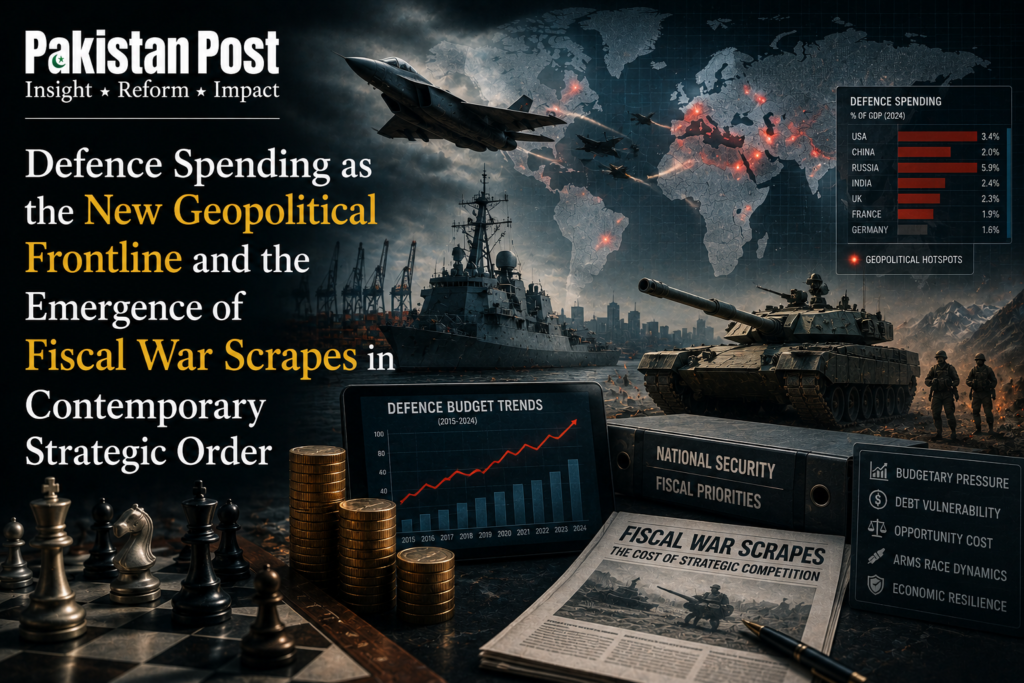
The structure of modern geopolitical competition is undergoing a profound transformation in which the visible boundaries of conflict are increasingly displaced by the invisible architecture of fiscal commitment. In earlier eras of international politics, the frontline of strategic competition was geographically identifiable, marked by territorial disputes, military deployments, and kinetic engagements that could be mapped onto physical space. In the contemporary environment, however, the frontline is increasingly fiscal, embedded within budgetary allocations, procurement schedules, debt instruments, long term liabilities, and industrial commitments that define the actual capacity of states to sustain power over time. This shift has given rise to what may be conceptualized as fiscal war scrapes, a domain in which defence spending becomes not merely an administrative function but a primary terrain of geopolitical competition.
The emergence of fiscal war scrapes reflects a deeper structural evolution in military power. Power is no longer solely expressed through the immediate application of force but through the long duration capacity to finance, maintain, and upgrade complex military systems. In this environment, the decisive variable is not only how much force a state can deploy at a given moment, but how sustainably it can underwrite the systems that generate that force. The temporal horizon of strategy has therefore expanded from episodic confrontation to continuous fiscal mobilization, in which defence budgets operate as living systems rather than static allocations.
This transformation is closely linked to the increasing technological complexity of military systems. Modern defence platforms are no longer discrete objects of procurement but integrated ecosystems requiring continuous maintenance, software updates, interoperability frameworks, and supply chain resilience. As a result, the cost of sustaining military capability extends far beyond initial acquisition and becomes distributed across decades of fiscal obligation. The implication is that defence spending must now be understood as an accumulation of long term commitments rather than a sequence of annual expenditures.
Within this context, the fiscal structure of states becomes a primary determinant of strategic posture. Countries with high debt servicing burdens, constrained fiscal space, or limited access to external financing face structural limitations in their ability to expand or even maintain advanced military capabilities. Conversely, states with diversified economic bases, strong industrial ecosystems, and access to global capital markets are better positioned to absorb the long-term costs associated with high end defence modernization. The result is an emerging stratification of strategic capacity based not only on current military assets but on underlying fiscal architecture.
The concept of fiscal war scrapes captures this layered interaction between defence spending and geopolitical positioning. It suggests that modern strategic competition is increasingly organized around the ability to sustain multiyear, multi-platform, and multi domain defence commitments that extend across political cycles. These commitments include not only procurement of advanced systems but also investments in research and development, supply chain localization, human capital training, and technological integration. Each of these components generates its own fiscal trajectory, contributing to a cumulative burden that shapes national strategic options.
One of the defining features of this system is the forward loading of defence costs. States increasingly commit to large scale procurement programs that extend years into the future, creating a pipeline of obligations that constrain future fiscal flexibility. These commitments are often made in response to perceived security threats or strategic competition, but once initiated they become embedded in institutional frameworks that are difficult to reverse. The result is a form of path dependent fiscal structure in which early decisions shape long term strategic capacity.
The implications of forward loaded defence spending extend beyond national budgets into the global defence industrial ecosystem. Major defence contractors, supplier networks, and technology providers operate within multi decade planning cycles that are closely aligned with sovereign procurement commitments. This creates a feedback loop in which state decisions drive industrial investment, and industrial capacity in turn shapes state options. The global defence economy thus becomes an integrated system in which fiscal decisions in one region reverberate across multiple jurisdictions.
In the South Asian context, this dynamic is particularly pronounced due to the combination of high strategic intensity and constrained fiscal environments. States in the region must balance competing demands of economic development, social welfare, infrastructure investment, and defence modernization. Within this constrained fiscal space, defence spending decisions acquire heightened strategic significance, as they directly influence the distribution of national resources across multiple sectors. The opportunity cost of defence spending becomes a central variable in assessing long term strategic sustainability.
At the same time, defence spending in such environments is not purely a cost centre but also a mechanism for technological advancement and industrial development. Investments in defence production can generate spillover effects in civilian sectors, contribute to technological diffusion, and support employment in high skill industries. However, these benefits are unevenly distributed and often depend on the degree of domestic industrial integration and the capacity of states to absorb and repurpose advanced technologies. Where such integration is limited, defence spending may function primarily as a fiscal burden rather than a developmental catalyst.
The strategic implications of fiscal war scrapes are further amplified by the increasing role of global financial markets in shaping defence capacity. Sovereign borrowing costs, credit ratings, and investor perceptions of stability all influence the ability of states to finance long term military commitments. In this context, defence spending is not isolated from macroeconomic conditions but deeply embedded within them. A deterioration in fiscal credibility can directly constrain military modernization, while strong economic performance can enable sustained defence investment even under strategic pressure.
This interdependence between fiscal stability and strategic capability introduces a new dimension to deterrence theory. Traditional deterrence frameworks focused primarily on military capability and signalling. In the contemporary environment, however, deterrence is also shaped by perceptions of fiscal sustainability. A state that is perceived to be overextended financially may face doubts regarding its ability to sustain prolonged strategic competition, even if its immediate military capabilities are strong. Conversely, a state with strong fiscal foundations may be perceived as more credible in sustaining long term strategic commitments.
The concept of fiscal endurance thus becomes central to modern strategic analysis. Endurance is not only about the ability to withstand military pressure but also about the capacity to maintain defence commitments without triggering economic instability. This introduces a dual burden on states, which must simultaneously manage external security challenges and internal fiscal constraints. The interaction between these two domains defines the operational environment of contemporary strategic planning.
The emergence of fiscal war scrapes also alters the temporal structure of conflict. Instead of discrete episodes of war and peace, states operate within continuous cycles of preparation, investment, and adjustment. defence budgets become instruments of ongoing strategic positioning rather than reactive tools deployed in response to immediate threats. This continuous state of fiscal mobilization blurs the distinction between wartime and peacetime economies, creating a hybrid condition in which strategic competition persists even in the absence of active hostilities.
In such an environment, the measurement of power becomes increasingly complex. Traditional indicators such as troop numbers, platform counts, or territorial control are insufficient to capture the underlying capacity of states to sustain long term competition. Instead, analysts must consider variables such as debt sustainability, procurement pipelines, industrial base depth, technological integration capacity, and exposure to external supply chain dependencies. These factors collectively determine the real strategic bandwidth available to states.
The political dimensions of fiscal war scrapes are equally significant. defence spending decisions are deeply embedded in domestic political economies, where competing interests shape budgetary priorities. Military institutions, political leadership, industrial lobbies, and public opinion all contribute to the formulation of defence budgets. These domestic dynamics interact with external pressures to produce complex bargaining environments in which strategic imperatives are continuously negotiated.
In many cases, defence spending becomes a mechanism through which states signal resolve, modernity, and strategic relevance. Large scale procurement announcements, modernization programs, and defence partnerships serve not only operational purposes but also symbolic functions, projecting an image of capability and intent to both domestic and international audiences. However, the gap between symbolic signalling and actual fiscal capacity can create vulnerabilities if not carefully managed.
The global dimension of fiscal war scrapes further complicates this picture. defence spending is increasingly embedded in transnational supply chains that link multiple states through production, financing, and technology transfer arrangements. This interdependence means that fiscal decisions in one country can have cascading effects across global defence networks. Disruptions in one part of the system can affect delivery schedules, cost structures, and capability timelines elsewhere, creating systemic interdependencies that were less pronounced in earlier eras of military production.
Within this interconnected system, the ability to manage fiscal complexity becomes a form of strategic competence. States that can effectively coordinate procurement, manage debt exposure, integrate industrial policy, and maintain economic stability are better positioned to navigate the demands of modern defence environments. Conversely, states that struggle with fiscal coordination may find their strategic ambitions constrained by structural limitations.
The South Asian experience illustrates these dynamics in a particularly concentrated form. High levels of strategic competition coexist with significant fiscal constraints, creating a situation in which defence spending decisions are both highly consequential and highly sensitive. In this environment, fiscal war scrapes are not abstract theoretical constructs but lived realities that shape policy choices, strategic planning, and international engagement.
Ultimately, the emergence of fiscal war scrapes signals a fundamental reconfiguration of the relationship between economics and security. Defence spending is no longer a secondary dimension of statecraft but a primary arena in which geopolitical competition is conducted. The ability to finance, sustain, and integrate military capabilities over time has become as important as the capabilities themselves. In this sense, the frontline of contemporary geopolitics is no longer located at the edges of territory but within the internal fiscal architectures of states.
This transformation does not render traditional military power obsolete, but it embeds it within a deeper and more complex structure of economic and financial relations. Understanding modern strategic competition therefore requires moving beyond surface indicators of military strength to examine the underlying fiscal systems that sustain them. It is within these systems that the true balance of power is increasingly determined, not in moments of confrontation alone but in the long duration processes of investment, commitment, and endurance that define the fiscal war scape of the twenty first century.
A Public Service Message