Pakistan Between Beijing, Bretton Woods, Washington, and the Gulf: Toward a Doctrine of Managed Interdependence

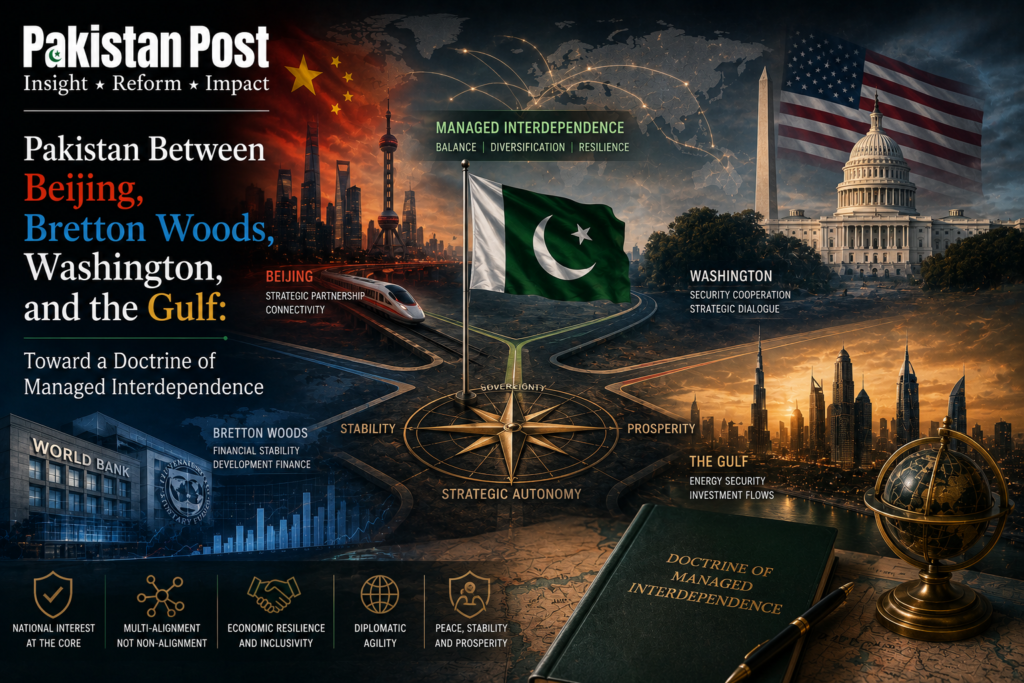
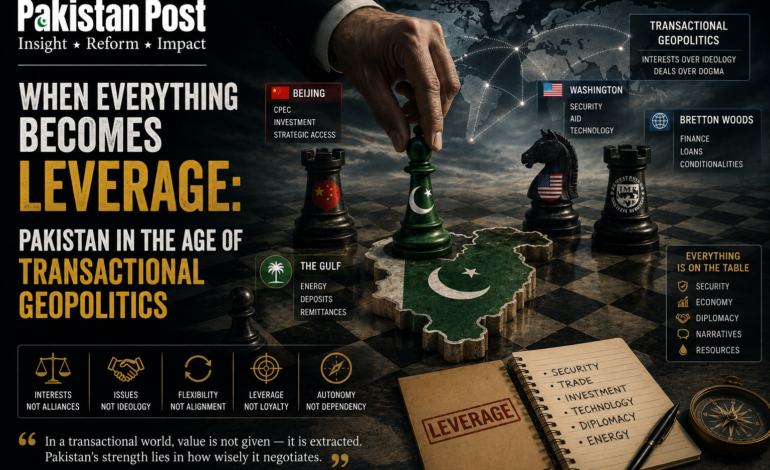
Pakistan is entering a foreign policy moment in which the old habit of treating external relationships as separate compartments is no longer sustainable. The country’s strategic landscape is now shaped by four simultaneous and deeply entangled vectors of dependence and leverage. China remains indispensable to Pakistan’s defence modernization, infrastructure ambition, and long term balancing strategy against India. The International Monetary Fund has become the arbiter of macroeconomic credibility, fiscal sequencing, and the outer limits of domestic economic discretion. The United States, despite the exhaustion of the post 9/11 security compact and the thinning of public rhetoric around partnership, still matters enormously in security signalling, financial sentiment, diplomatic crisis management, and access to wider Western markets and institutions. The Gulf, meanwhile, remains vital not only because of remittances and energy dependence, but because it is now tied to Pakistan’s political economy through investment promises, labour absorption, emergency financing, and the strategic consequences of regional upheaval stretching from Iran to the Red Sea. In such a setting, the question is no longer whether Pakistan should diversify its alignments. It already has. The real question is whether the state has developed a coherent doctrine for living inside overlapping dependencies without appearing opportunistic abroad, incoherent at home, and permanently reactive in moments of crisis.
This is where the language of multi alignment has become both attractive and evasive. Attractive, because it seems to offer a way out of the binary thinking that historically trapped Pakistan between alliance politics and strategic disappointment. Evasive, because the term can conceal the absence of a disciplined doctrine. Multi alignment can mean many things. At its most serious, it describes a statecraft model in which a country deliberately distributes risk, diversifies partnerships, prevents overexposure to any one patron, and preserves room for manoeuvre across competing power centres. At its weakest, however, it is merely a polite label for tactical improvisation under financial stress. Pakistan’s problem is that its current external posture contains elements of both. It is neither fully incoherent nor yet fully doctrinal. It reflects adaptation without complete integration, hedging without a settled grammar, and strategic instinct without institutional consolidation.
The first pillar of this emerging predicament is the China relationship, which remains the most structurally significant bilateral axis in Pakistan’s external orientation. China is not merely a friendly power or a traditional diplomatic partner. It is a defence supplier, a geopolitical counterweight, an investor in infrastructure, and a central node in Pakistan’s long term imagination of regional connectivity. CPEC was never just a bundle of roads and power plants. It represented an attempt to lock Pakistan into a larger Eurasian strategic geography in which geography could be converted into leverage and underdevelopment into corridor relevance. Even after the exuberance of the early CPEC years faded under the weight of debt anxieties, implementation lags, governance failures, and security attacks on Chinese nationals, the relationship itself did not diminish in strategic significance. Instead, it matured into something more demanding. Beijing’s expectations are now more transactional, more security conscious, and more performance oriented. It is no longer enough for Pakistan to invoke all weather friendship as a substitute for delivery. China now wants project protection, regulatory predictability, repayment discipline, and proof that Pakistan can convert symbolic partnership into usable economic outcomes.
That shift matters because it changes the nature of strategic dependence. Pakistan’s dependence on China is not only military or diplomatic. It is increasingly developmental and reputational. If Gwadar remains underperforming, if industrial cooperation remains thinner than promised, if energy sector inefficiencies continue to impair Chinese backed projects, and if attacks on Chinese personnel persist, then the problem is not simply a bilateral irritant. It is a stress test of the Pakistani state’s administrative credibility. The China relationship therefore places Pakistan under a form of pressure that is different from IMF pressure but no less consequential. The IMF demands fiscal reform and macro discipline. China increasingly demands state capacity. It wants evidence that Pakistan can secure assets, implement agreements, and produce returns on strategic investment. A country that needs Chinese capital but cannot guarantee execution risks converting strategic intimacy into strategic embarrassment.
The second pillar is the IMF, which now functions as far more than a lender of last resort. In Pakistan’s case the Fund has become a disciplining architecture that shapes the country’s economic language, its fiscal room for manoeuvre, and even its diplomatic signalling to other creditors. Every IMF review is interpreted not only as a judgment on macroeconomic performance but as a referendum on whether Pakistan is governable enough to be financed. The Fund does not just lend money. It certifies seriousness. It signals to bond markets, bilateral lenders, multilateral partners, and even domestic elites whether the state is capable of following through on painful decisions. In that sense, IMF dependence is not merely about balance of payments support. It is about the external validation of internal discipline.
This creates a peculiar tension in Pakistani foreign policy. The state seeks strategic autonomy, but its fiscal survival often requires externally supervised restraint. It wants to act like a sovereign regional player, but its budgetary choices, energy pricing, tax effort, and reform tempo are increasingly monitored through a program logic that leaves little room for romantic geopolitical posturing. The contradiction is not that Pakistan works with the IMF. Many states do. The contradiction is that Pakistan often continues to speak the language of exceptional strategic centrality while operating under the fiscal grammar of recurring emergency management. A doctrine that does not reconcile those two realities will always appear unstable. One cannot indefinitely claim strategic indispensability while repeatedly requiring rescue on terms that narrow domestic policy freedom.
Yet it would be simplistic to cast the IMF as merely a source of humiliation or foreign intrusion. The more serious issue is that IMF discipline has become a substitute for domestic political discipline because the Pakistani state has historically failed to build an internal coalition for reform. Tax broadening, energy rationalization, state owned enterprise restructuring, and expenditure discipline are not unpopular because the logic is mysterious. They are unpopular because they threaten entrenched distributions of privilege. The IMF enters where domestic politics refuses to govern itself. In that sense, Pakistan’s financial dependence on the Fund is also a mirror held up to its own elite bargain. The external program exists because the internal contract remains too weak to sustain adjustment without an outside enforcer. This is why foreign policy cannot treat the IMF as just an economic file. It is now central to the state’s external posture because it determines how much sovereignty the state can actually afford to exercise.
The third pillar is the United States, whose role in Pakistan’s strategic thinking has become subtler but not smaller. The era of publicly dramatized alliance is over. The Afghanistan war framework that once structured the relationship has largely dissolved. Counterterrorism no longer defines the partnership in the way it once did, and the emotional vocabulary of the relationship has thinned into something more restrained, more suspicious, but also more realistic. Yet to mistake reduced theatre for reduced importance would be a serious analytical error. Washington still matters in at least four ways. First, it remains central to the wider Western financial ecosystem in which IMF politics, sovereign credit sentiment, export access, and investor confidence are indirectly shaped. Second, it matters in security signalling because the United States remains the world’s most consequential military and diplomatic actor, and Pakistani crisis managers understand that escalation in South Asia cannot be fully insulated from Washington’s reading of events. Third, it matters in technology, education, diaspora capital, and private sector linkages that continue to shape Pakistan’s social and economic horizons. Fourth, it matters because no Pakistani foreign policy doctrine can be credible if it is built on the fantasy that antagonizing the United States carries no structural cost.
The challenge is that Pakistan’s relationship with Washington is haunted by mutual memory. For Pakistan, the memory is of abandonment, conditionality, drone era coercion, and the instrumentalization of partnership around American wars. For the United States, the memory is of mistrust, double games, and a Pakistan seen alternately as useful, frustrating, and difficult to classify. This mutual residue encourages a lazy policy pattern on both sides in which neither fully invests in rebuilding the relationship, yet neither can afford to ignore it. Pakistan therefore often engages Washington through a narrow set of tactical channels rather than through a broader strategic doctrine. It seeks de escalation support in moments of India related tension, values quiet backing in multilateral financial settings, and welcomes selective security engagement, but it has not fully articulated what a post Afghanistan, post dependency, post alliance relationship with the United States should look like.
That gap matters because without a doctrine Pakistan risk oscillating between two equally unhelpful instincts. One is the instinct of grievance, in which Washington is treated as a declining but still intrusive power whose role should be minimized rhetorically while quietly preserved functionally. The other is the instinct of episodic solicitation, in which every crisis revives the hope that strategic usefulness will again be monetized into diplomatic indulgence. Neither approach is adequate. Pakistan does not need a return to dependency. It needs a sober understanding that the United States remains one of several essential power centres whose relevance lies not in emotional alliance but in selective strategic utility. That requires maturity rather than nostalgia.
The fourth pillar is the Gulf, and here Pakistan’s foreign policy is confronting a structural vulnerability that is often underestimated because it is dispersed across labour markets, remittance flows, energy imports, and elite networks rather than concentrated in a single treaty relationship. The Gulf is not simply a source of temporary financial support or symbolic Islamic solidarity. It is embedded in Pakistan’s economic bloodstream. Millions of Pakistani workers in Saudi Arabia, the UAE, Qatar, and elsewhere sustain household consumption, foreign exchange inflows, and social stability through remittances. Pakistan’s energy security remains deeply tied to Gulf supply chains. Its ruling classes have historically viewed Gulf capitals as sites of political refuge, investment opportunity, and emergency liquidity. More recently, the Gulf has also emerged as a space where Pakistan seeks to reposition itself not merely as a manpower exporter but as a partner in logistics, mining, agriculture, ports, and digital investment.
But the Gulf relationship is entering a more dangerous era because the region itself is becoming more volatile, more strategic, and less forgiving of ambiguity. The old assumption that Pakistan could maintain fraternal ties across rival Gulf and Middle Eastern actors while avoiding hard choices is becoming increasingly difficult to sustain. Saudi Arabia, the UAE, Qatar, and Iran now sit within a wider regional environment shaped by normalization projects, proxy contests, shipping insecurity, energy route vulnerability, Israel related polarization, and intensifying great power competition. Pakistan’s exposure to Gulf upheaval is therefore not hypothetical. It is immediate. A major regional war can affect oil prices, remittance stability, shipping insurance, domestic inflation, diaspora safety, and sectarian temperature inside Pakistan itself. In other words, Gulf turbulence is no longer a distant theatre. It is a domestic macroeconomic and political variable.
This is why the phrase political exposure to Gulf upheaval is so important. Pakistan is not only dependent on Gulf economies. It is vulnerable to Gulf instability in ways that can reorder domestic priorities overnight. A spike in oil prices can disrupt the fiscal arithmetic of an IMF program. A confrontation involving Iran can place Pakistan under pressure from Gulf partners, Western powers, and domestic constituencies simultaneously. Escalation around the Strait of Hormuz can threaten import costs and current account assumptions. A regional crackdown on migrant labour could hit remittance flows at a time of external fragility. And because Pakistan’s own religious, sectarian, and ideological landscape has long been porous to Middle Eastern influence, any major Gulf rupture risks travelling inward through media narratives, clerical alignments, political messaging, and security anxieties. The Gulf is therefore not an optional add on to Pakistan’s foreign policy. It is one of the principal theatres in which domestic resilience and external diplomacy now intersect.
If these four vectors are viewed together, the inadequacy of Pakistan’s current foreign policy vocabulary becomes clear. China, the IMF, the United States, and the Gulf are not separate files to be handled by different desks with minimal strategic integration. They are interlocking theatres of dependence, leverage, expectation, and risk. China offers long horizon strategic depth but expects delivery and security. The IMF offers financing credibility but constrains policy discretion and exposes domestic governance weakness. The United States offers diplomatic weight, market and technology pathways, and crisis management relevance, but demands a relationship not built on old scripts. The Gulf offers remittances, energy, and investment possibilities, but increasingly imports regional instability into Pakistan’s own strategic equation. The country’s problem is not that it has too many relationships. Its problem is that it still often manages them through fragmented bureaucratic logic, elite improvisation, and short term balancing rather than through a clearly articulated doctrine of national prioritization.
So what would a serious doctrine look like? It would begin by abandoning the illusion that foreign policy can be insulated from political economy. Pakistan does not need a doctrine of alignment. It needs a doctrine of managed interdependence. Such a doctrine would accept that in a middle power with chronic external financing needs, adversarial regional geography, and underperforming domestic institutions, absolute autonomy is not a realistic objective. The goal should instead be to maximize bargaining room, minimize asymmetric vulnerability, and convert dependence into structured interdependence wherever possible. Managed interdependence would rest on a simple proposition: Pakistan should engage every major external partner through a clearly defined hierarchy of interests, explicit red lines, and institutionally coordinated delivery mechanisms, rather than through rhetorical overpromising and ad hoc crisis management.
The first principle of such a doctrine would be functional differentiation without strategic contradiction. Pakistan must decide what each relationship is for and then protect those functions from being undermined by theatrical signalling elsewhere. China should be treated as Pakistan’s primary long horizon strategic and infrastructural partner, but not as a substitute for domestic reform or as a limitless insurer against economic irresponsibility. The IMF should be engaged as a stabilizing instrument and credibility anchor, but with the explicit aim of reducing repeat dependence through internal reform rather than treating every program as a bridge to the next program. The United States should be approached as a critical power in finance, technology, diplomacy, and crisis signalling, without the expectation of a return to patron client intimacy. The Gulf should be treated not just as a source of remittances and emergency funds but as a central theatre for economic diversification, labour protection, energy transition planning, and geopolitical risk management. Functional differentiation matters because it prevents Pakistan from loading every bilateral relationship with unrealistic expectations.
The second principle would be macroeconomic realism as the foundation of strategic autonomy. No foreign policy doctrine can be credible if the state’s external behaviour is repeatedly constrained by insolvency risk. Pakistan’s strategic discourse has too often romanticized geopolitical location while neglecting the fiscal and productive foundations of national power. A country that cannot reliably raise revenue, manage energy pricing, broaden exports, and discipline elite rent extraction will eventually discover that its diplomacy is being written by its balance sheet. Managed interdependence therefore requires a redefinition of sovereignty itself. Sovereignty is not merely the ability to say no to external pressure. It is the capacity to finance your choices, absorb shocks, and negotiate from a position other than desperation. That means tax reform is foreign policy. Energy reform is foreign policy. Export upgrading is foreign policy. Debt management is foreign policy. A doctrine worthy of the name would say this openly.
The third principle would be reputational consistency. Pakistan has often suffered from the perception that it says different things to different capitals and treats ambiguity as a diplomatic asset even when that ambiguity corrodes trust. Some flexibility is inevitable in a crowded geopolitical environment, but flexibility is not the same as opacity. A more coherent doctrine would define a limited number of stable public commitments that travel across all major relationships. These might include non participation in bloc politics, support for territorial sovereignty and negotiated conflict resolution, opposition to regional escalation, commitment to connectivity based on mutual economic gain, and insistence that economic stabilization is inseparable from social protection. Such commitments would not solve every contradiction, but they would give Pakistan a visible strategic grammar that outlives individual crises and personalities.
The fourth principle would be institutional integration inside the Pakistani state. At present, Pakistan’s external engagements are too often handled through parallel silos. Economic ministries negotiate one set of realities, security institutions manage another, diplomats improvise around both, and political leadership alternates between grand narrative and emergency firefighting. That model is no longer viable. If trade routes, remittances, sanctions risk, military signalling, digital regulation, and energy exposure are all part of the same strategic ecosystem, then the state needs an integrated national security and economic coordination mechanism with real authority, not merely ceremonial consultation. Foreign policy doctrine cannot survive if it is not backed by an institutional architecture capable of producing cross sector decisions. Managed interdependence requires a state that can connect a Gulf war scenario to fuel pricing, an IMF review to defence spending, a Chinese investment concern to provincial security governance, and a Washington conversation to export strategy. In the absence of that integration, doctrine collapses into slogans.
The fifth principle would be selective de risking rather than impossible decoupling. Pakistan cannot and should not attempt to free itself from every dependency at once. That is neither feasible nor necessary. But it can identify the points where dependence becomes dangerous because it is too concentrated, too opaque, or too politically manipulable. Energy imports are one such vulnerability. Export concentration is another. The remittance dependence on a relatively narrow Gulf labour geography is a third. Security exposure around Chinese projects is a fourth. The answer is not disengagement. It is de risking through diversification, domestic capacity building, and contingency planning. A doctrine of managed interdependence would therefore ask, relationship by relationship, where Pakistan’s exposure is excessive and how that exposure can be reduced without strategic self sabotage.
The sixth principle would be narrative discipline. Foreign policy in Pakistan has often oscillated between triumphalist symbolism and fatalistic victimhood. Neither is useful. The state does not need to perform ideological certainty for domestic audiences if doing so narrows its diplomatic room abroad. Nor does it need to constantly dramatize its centrality to global powers when much of the world sees it through the more prosaic lenses of creditworthiness, security risk, and market potential. A more mature doctrine would speak in the language of interests, resilience, and reciprocal gain rather than civilizational melodrama or perpetual grievance. This matters not because rhetoric alone changes outcomes, but because rhetoric that outruns capability creates expectations the state cannot meet. Strategic credibility begins with proportion.
There is also a deeper conceptual shift required. Pakistan has historically understood foreign policy through the lens of threat management and alliance utility. Both remain important, especially given India and Afghanistan related security concerns. But the twenty first century has made that framework insufficient. The real contest now is over state capability under conditions of interdependence. Which countries can manage debt without surrendering agency, attract capital without sacrificing policy space, maintain security without militarizing all diplomacy, and navigate rival power centres without becoming a client of all and a trusted partner of none? Pakistan’s future doctrine must answer that question. It must move from the geopolitics of survival to the statecraft of calibrated leverage.
That does not mean Pakistan can suddenly escape the hard facts of its position. It will continue to need China. It will continue to need the IMF for some time. It will continue to need a functional relationship with Washington. It will continue to depend on the Gulf. The objective is not to deny those dependencies but to order them. A state with Pakistan’s constraints cannot afford a foreign policy of vanity. It needs a foreign policy of sequence. First, stabilize the macroeconomic base sufficiently to reduce the frequency of emergency bargaining. Second, restore credibility with major partners by delivering on commitments rather than multiplying announcements. Third, convert geopolitical relationships into productive economic outcomes rather than symbolic alignment trophies. Fourth, build domestic institutions capable of anticipating the spillover effects of regional shocks. Fifth, define a small set of enduring national positions that make Pakistan legible across rival capitals.
The test of whether Pakistan is truly entering an era of multi alignment will not be whether it can maintain cordial ties with several powers at once. Many states do that. The test will be whether it can do so while reducing the gap between strategic aspiration and institutional capability. If multi alignment simply means borrowing from one actor, importing oil from another, buying weapons from a third, and seeking diplomatic rescue from a fourth, then it is not a doctrine. It is a survival pattern. But if it evolves into a disciplined system of managed interdependence grounded in macroeconomic realism, institutional integration, reputational consistency, and functional clarity, then it could become the first genuinely post ideological foreign policy doctrine Pakistan has developed in decades.
That is the choice before the Pakistani state. It can continue to treat foreign policy as the art of tactical navigation through recurring constraint, relying on the ingenuity of individual officeholders and the elasticity of public narratives. Or it can recognize that the world it inhabits now punishes incoherence more quickly than before. In an era when war in the Gulf can shake an IMF program, when Chinese patience depends on Pakistani state capacity, when American relevance persists without alliance romance, and when fiscal weakness can erode diplomatic agency, Pakistan does not need more slogans about balance. It needs a doctrine equal to complexity. Not non alignment in the old sense, not bloc politics in the old sense, and not improvisation dressed up as strategy, but a colder and more modern doctrine: managed interdependence in the service of national resilience. Only such a doctrine can hold together Beijing, Bretton Woods, Washington, and the Gulf without allowing Pakistan itself to come apart in the process.
A Public Service Message