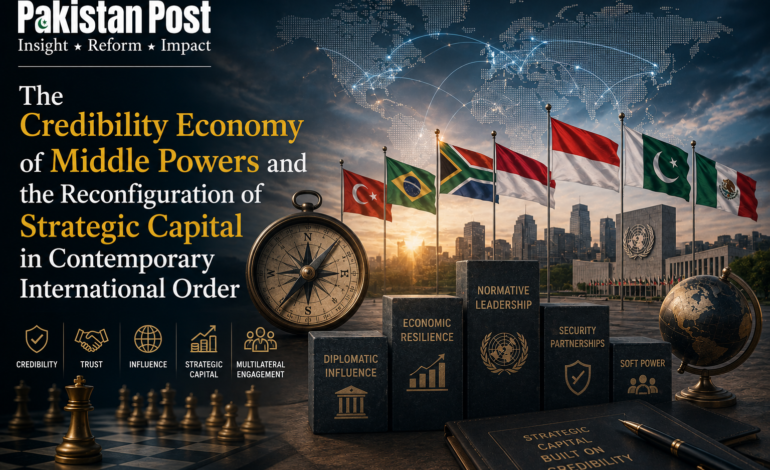
The Credibility Economy of Middle Powers and the Reconfiguration of Strategic Capital in Contemporary International Order


The contemporary international system is increasingly structured around a form of stratified influence in which power is no longer exercised solely through material capabilities such as military strength or economic scale, but through the more fluid and contingent resource of credibility. Within this emerging configuration, middle powers occupy a particularly instructive position. They are neither structurally dominant nor strategically marginal; rather, they operate within a volatile intermediary space where perception, performance, and narrative coherence determine their ability to convert limited material assets into disproportionate diplomatic influence. The result is the emergence of what may be described as a credibility economy, in which strategic value is accumulated, stored, and expended through reputational capital rather than purely kinetic or economic means.
This transformation reflects a broader shift in the architecture of international relations. Traditional realist frameworks assumed that power derived primarily from measurable capabilities, including population size, industrial capacity, military expenditure, and territorial control. While these variables remain relevant, they no longer operate in isolation. Instead, they are mediated through interpretive systems that evaluate how effectively states can project coherence, resilience, and reliability in moments of crisis. In such a system, credibility becomes a form of currency that can amplify or diminish the effectiveness of underlying material power.
For middle powers, this dynamic is particularly consequential. Unlike major powers, which can rely on structural dominance to absorb reputational fluctuations, or small states, which often depend on legal protections and external guarantees, middle powers must continuously demonstrate strategic reliability to sustain their position within the international hierarchy. This requires not only effective policy execution but also consistent narrative management, institutional discipline, and the ability to signal predictability to external observers. Credibility, in this sense, is not an abstract attribute but a continuously produced outcome of state behavior under conditions of observation.
The credibility economy is fundamentally relational. It does not exist within a single state but emerges from the interaction between multiple observing systems, including foreign governments, multilateral institutions, financial markets, media ecosystems, and strategic think tanks. Each of these actors contributes to the construction of reputational assessments that influence how states are perceived in terms of reliability, escalation control, governance stability, and policy consistency. These perceptions, once formed, circulate through diplomatic channels and institutional decision-making processes, shaping access to investment, security cooperation, and diplomatic inclusion.
In this environment, the ability of a middle power to participate in high level diplomatic tables is increasingly contingent on its perceived capacity to manage complexity under pressure. This includes not only military or security crises but also economic volatility, political transitions, and informational contestation. The capacity to maintain institutional continuity during periods of stress becomes a key indicator of credibility. States that demonstrate such capacity are more likely to be included in crisis management discussions, regional coordination frameworks, and multilateral negotiation platforms.
The South Asian strategic environment provides a particularly revealing context in which to observe these dynamics. States operating in this region must navigate overlapping pressures of security competition, economic constraint, and narrative contestation, often simultaneously. In such a context, the ability to project coherence during moments of heightened tension becomes a critical determinant of diplomatic positioning. The perception that a state can manage escalation responsibly, avoid uncontrolled spillover, and maintain command over its internal narrative significantly enhances its credibility profile in international discourse.
Importantly, credibility in this sense is not synonymous with military dominance. Rather, it is associated with the disciplined management of risk and the ability to signal restraint without signalling weakness. This distinction is crucial, as the international system increasingly rewards states that can calibrate their strategic posture in ways that avoid unnecessary escalation while maintaining deterrence credibility. Excessive aggression may erode trust, while excessive passivity may undermine deterrence. The credibility economy thus rewards calibrated ambiguity, institutional discipline, and strategic predictability.
One of the defining features of this system is the conversion of episodic performance into long term reputational capital. Short term actions, such as crisis response, diplomatic signalling, or military engagement, are not evaluated in isolation but are incorporated into broader narratives about state behavior over time. This cumulative process means that credibility is path dependent. Past actions shape future expectations, and deviations from established patterns are often interpreted as signals of structural change rather than isolated incidents.
In this context, middle powers face a unique challenge. They must continuously manage the relationship between action and interpretation, ensuring that their behavior is neither misread as instability nor underestimated as passivity. This requires a high degree of institutional coordination across military, diplomatic, and informational domains. States that can synchronize these domains effectively are better positioned to maintain credibility across multiple audiences simultaneously.
The role of crisis behavior in shaping credibility is particularly significant. Moments of crisis serve as high intensity evaluative events in which state behavior is closely scrutinized by external observers. The speed, coherence, and consistency of response during such moments often carry disproportionate weight in subsequent reputational assessments. A well-managed crisis response can significantly enhance a state’s credibility, while a poorly managed one can have long lasting negative effects. This asymmetry reflects the fact that credibility is often more sensitive to failure than to success.
The credibility economy is also deeply influenced by informational asymmetry. External observers rarely have complete access to internal decision-making processes, and therefore rely on observable signals to infer state intentions and capabilities. These signals include official statements, military movements, diplomatic engagements, economic indicators, and media narratives. The interpretation of these signals is often mediated by pre-existing assumptions, regional biases, and strategic expectations, which further complicates the process of reputational evaluation.
In recent years, the proliferation of open-source intelligence and real time data analysis has intensified this dynamic. The increased availability of information has not necessarily reduced uncertainty; rather, it has multiplied the number of interpretive frameworks through which events are understood. As a result, credibility is no longer constructed through information scarcity but through interpretive authority. States and institutions compete to define how available information should be understood, rather than controlling access to information itself.
This shift has significant implications for middle powers, which often lack the global narrative infrastructure of major powers but possess sufficient strategic relevance to attract sustained analytical attention. For these states, credibility depends not only on behavior but also on the ability to shape interpretive frameworks that contextualize that behavior in favorable terms. This requires engagement with international media, think tanks, academic institutions, and diplomatic networks in a coordinated manner.
The economic dimension of credibility is equally important. Financial markets, credit rating agencies, and international investment institutions incorporate perceptions of political stability and policy predictability into their assessments of sovereign risk. As a result, credibility has direct implications for economic performance, influencing capital inflows, borrowing costs, and long-term investment trajectories. In this sense, the credibility economy is not merely a diplomatic construct but a material force that shapes economic outcomes.
The relationship between military capability and credibility is particularly complex. While military strength can enhance credibility by signalling deterrence capacity, it can also undermine it if perceived as destabilizing or disproportionate. Conversely, restraint in military behavior can enhance credibility if interpreted as evidence of strategic maturity, but it can also weaken perceived deterrence if interpreted as vulnerability. The credibility economy thus operates through a delicate balance between demonstration and restraint.
Middle powers must therefore navigate a strategic environment in which every action carries interpretive consequences that extend beyond its immediate functional purpose. Military exercises, procurement decisions, diplomatic alignments, and crisis responses are all subject to continuous external evaluation. The cumulative effect of these evaluations shapes the state’s position within the credibility hierarchy, influencing its access to strategic partnerships and diplomatic platforms.
The emergence of credibility as a central currency of international relations also reflects broader changes in the structure of global governance. As formal hierarchies become more diffuse and multilateral institutions more complex, influence is increasingly distributed through informal networks of trust, reliability, and perceived competence. These networks are not codified in treaties or agreements but are continuously reproduced through interaction and observation.
In such a system, the ability of middle powers to sustain credibility becomes a form of strategic capital accumulation. This capital can be drawn upon during negotiations, crises, or diplomatic engagements to enhance influence beyond what material capabilities alone would suggest. However, this capital is also fragile. It can be eroded by inconsistency, miscalculation, or perceived instability, and once diminished, it is difficult to fully restore.
The South Asian case again provides a useful lens through which to understand these dynamics. States in this region operate under continuous external observation due to their strategic significance, nuclear capabilities, and historical patterns of conflict. As a result, their actions are subject to intense scrutiny, and their credibility profiles are continuously updated by external observers. This creates both opportunities and constraints, as credible performance can significantly enhance diplomatic leverage, while perceived instability can rapidly constrain strategic options.
Ultimately, the credibility economy represents a structural transformation in the logic of international politics. It does not replace traditional power variables but overlays them with a dense layer of interpretive evaluation that mediates their effects. For middle powers, this transformation is both enabling and constraining. It allows them to achieve influence disproportionate to their material capabilities, but it also imposes continuous demands for coherence, discipline, and strategic consistency.
In this evolving environment, credibility is not a static attribute but a dynamic process of continuous production and evaluation. It is shaped by action, interpretation, and repetition, and it operates across multiple temporal scales simultaneously. Understanding this economy is essential for grasping how contemporary international order is structured, how influence is distributed, and how middle powers navigate an increasingly complex strategic landscape.
A Public Service Message