
Classrooms Behind Screens, Futures Left in the Dark

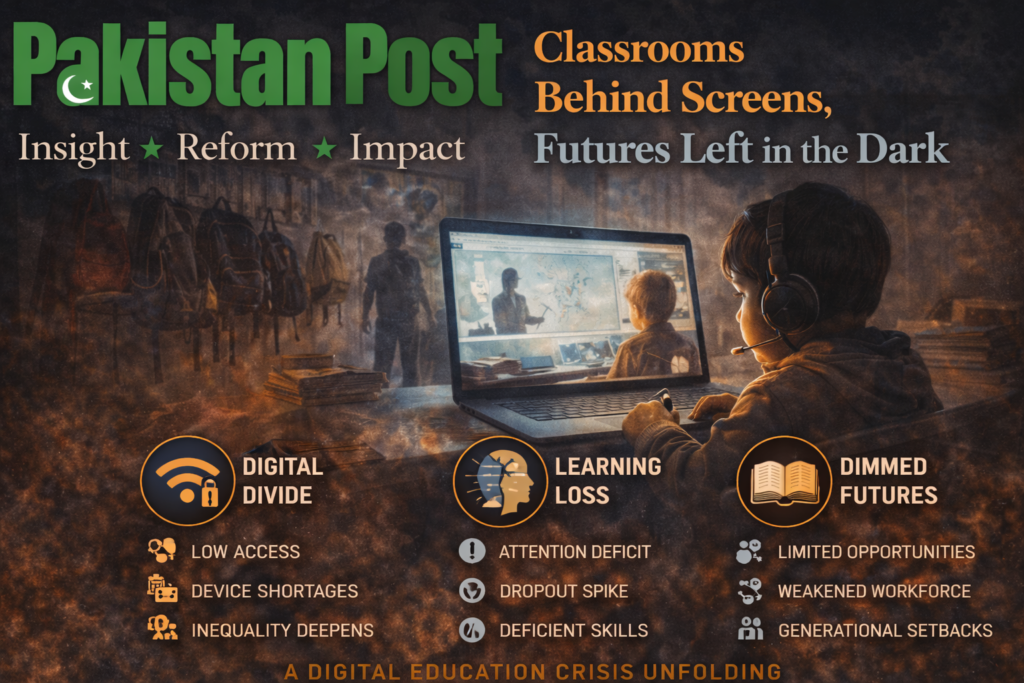
There is a dangerous disconnect between policy imagination and lived reality that defines the current trajectory of online education. It is being presented as a modern solution, a technological leap, and an equalizer of opportunity, yet for a vast segment of the population it has become another layer of exclusion. The narrative of digital progress assumes access, stability, and affordability, but these assumptions collapse the moment one steps into the homes of those who struggle to secure even basic necessities. When families are choosing between food and survival, the expectation that they will sustain internet connectivity, devices, and uninterrupted electricity is not only unrealistic, it is profoundly unjust.
Online education, in its current form, is not merely a shift in medium. It is a shift in burden. The cost of infrastructure that institutions once carried within physical campuses has been transferred silently to households. Electricity, internet bandwidth, devices, and even learning environments are now expected to be managed by families regardless of their economic capacity. This transfer has created a deeply unequal system where access to education is no longer determined by admission or merit but by the ability to pay for connectivity and stability.
For those who can afford high speed internet, backup power solutions, and personal devices, the system functions with relative efficiency. Classes are attended, materials are accessed, and assessments are completed. For those who cannot, education becomes fragmented, inconsistent, and often inaccessible. A student in a low income household may share a single device among multiple siblings, rely on unstable mobile data, and face frequent power outages. Each disruption is not a minor inconvenience but a direct interruption of learning. Over time, these interruptions accumulate into gaps that are difficult to bridge.
The inequality is not subtle. It is structural. It divides students into two distinct categories. One group progresses with continuity and support, while the other struggles to remain connected, both literally and academically. This division is not based on intellectual ability or effort. It is based on economic capacity. In such a system, the promise of education as a pathway to social mobility is fundamentally compromised.
The issue is further aggravated by the mismanagement of digital platforms. Educational portals, which are meant to facilitate learning, often suffer from technical instability, poor design, and lack of scalability. Students report difficulties in accessing lectures, submitting assignments, and participating in assessments. System crashes during examinations, delayed uploads, and inconsistent notifications create an environment of uncertainty. Instead of supporting learning, these platforms become barriers that students must navigate alongside their academic responsibilities.
This mismanagement reflects a deeper problem in planning and execution. The transition to online education was treated as a logistical adjustment rather than a systemic transformation. Institutions adopted platforms without adequate testing, training, or support structures. Faculty members, many of whom were not previously trained in digital pedagogy, were expected to adapt immediately. Students were assumed to have the necessary resources and skills. The result is a system that operates under constant strain, where both teachers and learners are forced to compensate for institutional shortcomings.
Electricity instability adds another layer of disruption. Frequent power outages, especially in areas with prolonged load shedding, make consistent participation in online classes nearly impossible. A student may log into a lecture only to be disconnected midway. Recorded lectures, often presented as a solution, require internet access for download or streaming, which brings the problem back to connectivity and cost. The absence of reliable electricity transforms education into a matter of chance rather than continuity.
The economic dimension cannot be overstated. Internet packages, particularly those capable of supporting video streaming and interactive sessions, are not affordable for many households. Data consumption increases significantly with online classes, placing additional financial pressure on families already operating under tight budgets. When combined with rising fuel prices, which affect overall household expenditure, the cost of maintaining digital access becomes even more burdensome. Transportation costs, food prices, and utility bills all compete for limited resources, and education, despite its importance, is often forced into compromise.
Fuel pricing policies indirectly intensify this crisis. Increased fuel costs raise the price of electricity generation, transportation, and essential goods. Families feel the impact across multiple dimensions, leaving even less capacity to invest in educational resources. For institutions, operational costs rise as well, but instead of absorbing these costs, they are often passed on to students in the form of fees or indirect expenses. The cumulative effect is a system where financial pressure at every level translates into reduced access for those at the bottom.
The psychological impact on students is significant. Learning under conditions of uncertainty, instability, and financial stress affects concentration, motivation, and performance. Students who repeatedly miss classes due to connectivity or power issues begin to disengage. The sense of falling behind, despite effort, creates frustration and anxiety. Over time, this can lead to withdrawal from the education system altogether. The loss is not only individual but societal, as potential talent is sidelined by structural barriers.
Teachers are not immune to these challenges. Many struggle with the same issues of connectivity and electricity. Delivering lectures in such conditions requires additional effort and adaptability. The absence of physical interaction also affects teaching effectiveness. Engagement becomes harder to maintain, and feedback mechanisms weaken. The quality of education suffers as a result, even for those who remain connected.
Assessment integrity is another area of concern. Online examinations, conducted through unstable platforms, raise questions about fairness and reliability. Technical disruptions during exams can disadvantage students, while the lack of controlled environments opens possibilities for academic dishonesty. Institutions attempt to address these issues through various measures, but without robust infrastructure, these efforts remain limited.
The cumulative effect of these challenges is a system that amplifies existing inequalities. Instead of leveling the field, online education has widened the gap between those with resources and those without. It has exposed the fragility of planning and the consequences of implementing solutions without addressing underlying conditions.
Addressing this crisis requires a fundamental rethinking of approach. The first step is acknowledging that access to digital education is not uniform and cannot be assumed. Policies must be grounded in the realities of economic disparity and infrastructural limitations. Without this acknowledgment, any intervention will remain partial and ineffective.
Subsidized internet access for students from low income households is essential. This can be achieved through partnerships with service providers, targeted vouchers, or direct support mechanisms. Access must be reliable and sufficient to support educational activities, not limited or symbolic.
Device accessibility must also be addressed. Programs that provide affordable or loan based devices can significantly reduce barriers. These initiatives should be designed with transparency and accountability to ensure that they reach the intended beneficiaries.
Electricity reliability requires coordinated effort at the policy level. While large scale energy reforms take time, interim solutions such as community based learning centers with backup power can provide stable environments for students. These centers can serve as shared spaces where connectivity and electricity are ensured, reducing the burden on individual households.
Digital platforms used by institutions must undergo rigorous evaluation and improvement. Scalability, user interface, and technical support are critical components that cannot be overlooked. Continuous monitoring and feedback mechanisms should be established to identify and resolve issues promptly.
Faculty training in digital pedagogy is equally important. Effective online teaching requires different strategies than traditional classroom instruction. Providing teachers with the tools and skills to adapt can enhance the quality of learning and engagement.
Assessment methods must be restructured to account for the realities of online education. Flexible evaluation models that reduce reliance on high stakes, time bound examinations can mitigate the impact of technical disruptions. Continuous assessment, project based evaluation, and open resource approaches can provide more equitable alternatives.
Financial policies must consider the cumulative burden on students. Fee structures should reflect the reduced physical infrastructure usage and the additional costs borne by students. Transparent communication regarding fees and support options can help build trust.
Monitoring and accountability mechanisms must be strengthened. Implementation should be tracked, and outcomes should be evaluated regularly. Institutions that fail to meet standards must be required to take corrective action. Without accountability, even well designed policies will fail.
Public awareness and engagement can play a supportive role. Highlighting challenges and sharing best practices can create momentum for change. Collaboration between government, institutions, and communities is essential to develop sustainable solutions.
The goal is not to reject online education but to make it equitable and functional. Technology has the potential to expand access, but only when supported by inclusive policies and robust infrastructure. Without these, it becomes a tool that reinforces existing divides.
The current trajectory reflects a system where ambition outpaces preparation and where solutions are implemented without addressing prerequisites. This approach must change. Education cannot be treated as an abstract objective detached from economic and social realities. It must be designed with those realities at the center.
There is an urgent need to restore balance. Access must be universal, quality must be consistent, and support must be targeted. Only then can online education fulfill its promise rather than deepen exclusion.
The measure of any education system lies in its ability to reach those who are most vulnerable. At present, that measure reveals a gap that cannot be ignored. Bridging this gap requires decisive action, sustained commitment, and a willingness to confront uncomfortable truths. Without this, the screens that were meant to open doors will continue to act as barriers, leaving countless futures in the dark.
A Publish Service Message