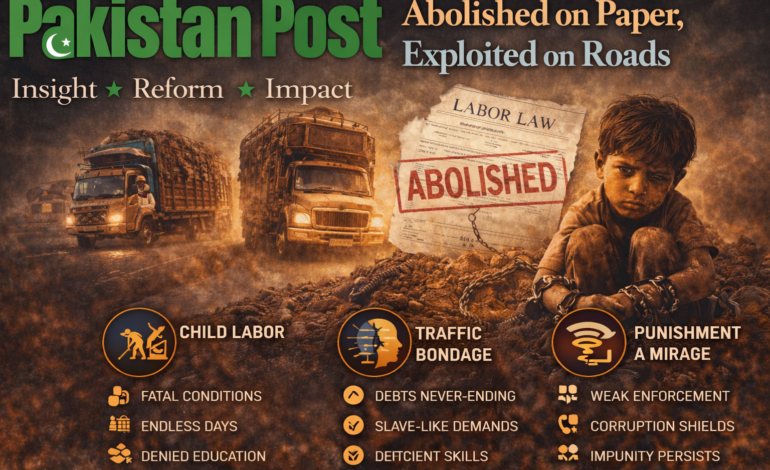
Abolished on Paper, Exploited on Roads


There is a dangerous illusion shaping the current economic narrative, one that exists comfortably in policy documents but collapses the moment it encounters lived reality. Relief is announced, fares are declared reduced or abolished, petroleum pricing is adjusted with official justification, and yet the ordinary citizen continues to pay more, suffer more, and receive less. This widening gap between state decisions and street level implementation has become one of the most defining failures of governance, and its burden falls disproportionately on those who can least afford it.
The question is no longer whether policies are being made. The question is whether they are being enforced, monitored, or even taken seriously beyond the announcement stage. When transport fares are officially reduced or abolished in response to petroleum price adjustments, the expectation is immediate and visible relief. Instead, what emerges is a parallel reality where transport operators continue to charge old rates or even higher ones, unchecked and unchallenged. The state withdraws after notification, and enforcement disappears into silence.
For the working class, this is not a theoretical inconvenience. It is a daily extraction of income. A laborer, a domestic worker, a student, or a low-income employee does not engage with policy through official notifications. They experience it through the fare they pay every morning and every evening. When that fare does not decrease despite official claims, it signals something more severe than inefficiency. It signals a breakdown of authority.
The petroleum policy lies at the center of this contradiction. Fuel price adjustments are often presented as calibrated decisions based on international market fluctuations, currency valuation, and fiscal constraints. These justifications may hold technical validity, but their social consequences are rarely addressed with equal seriousness. Every increase in petrol prices triggers a chain reaction across the economy. Transport costs rise, goods become more expensive, and basic survival becomes harder for those already on the margins.
What intensifies the crisis is the asymmetry in response. When fuel prices increase, transport fares rise immediately, often beyond proportional limits. There is no delay, no hesitation, no negotiation. The impact is swift and visible. However, when fuel prices decrease or when relief measures are announced, the reverse does not occur. Fares do not fall with the same speed, nor with the same consistency. This selective transmission of policy impact reveals a system where upward pressure is automatic but downward relief is optional.
This asymmetry is not accidental. It thrives in an environment where regulatory enforcement is weak, fragmented, or absent. Transport authorities issue notifications, but monitoring mechanisms remain either ineffective or non-existent. Field inspections are rare, penalties are inconsistent, and compliance is largely voluntary. In such a setting, policy loses its binding force and becomes advisory at best.
The result is a form of informal taxation imposed on the poor, not by law but by neglect. Every extra rupee paid in transport fare is a deduction from already strained household budgets. It affects food consumption, education expenses, healthcare access, and overall quality of life. For families operating on narrow financial margins, even minor increases accumulate into significant hardship over time.
The broader economic impact cannot be ignored. When transport costs remain artificially high despite policy relief, inflationary pressures persist. Goods transported across cities and regions carry inflated costs, which are passed on to consumers. Markets do not correct themselves because the underlying distortion remains unaddressed. This creates a cycle where policy intentions fail to translate into economic outcomes.
There is also a psychological dimension to this failure. Repeated experiences of announced relief that never materializes erode public trust. Citizens begin to disengage from official communication, viewing it as disconnected from reality. This erosion of trust is not limited to economic policy. It extends to governance as a whole. When people no longer believe that decisions will be implemented, the credibility of institutions weakens.
The transport sector itself operates within a complex structure, but complexity cannot be an excuse for inaction. Operators often cite rising maintenance costs, informal payments, and operational uncertainties as reasons for not adjusting fares downward. While some of these concerns may have merit, they do not justify complete non-compliance with official directives. A regulated sector cannot function on selective adherence.
The absence of accountability is the core issue. Without clear consequences for non-compliance, there is little incentive to follow policy. Penalties, where they exist, are either too minor to act as deterrents or too inconsistently applied to create fear of enforcement. This creates a rational environment for continued violation. Operators calculate that the cost of ignoring policy is lower than the cost of compliance.
Administrative fragmentation further complicates the situation. Responsibility for transport regulation is often divided among multiple agencies, each with limited jurisdiction and overlapping mandates. Coordination is weak, data sharing is minimal, and enforcement becomes diluted. In such a fragmented system, accountability becomes diffused, making it difficult to assign responsibility or demand results.
Technology offers potential solutions, yet its adoption remains limited. Digital fare monitoring systems, complaint platforms, and real time enforcement tools could significantly enhance transparency and compliance. However, without political will and administrative commitment, such tools remain underutilized or symbolic.
The issue also reflects deeper structural inequalities. Those who are most affected by fare manipulation have the least capacity to resist it. They cannot negotiate, they cannot opt out, and they often lack access to formal complaint mechanisms. Their vulnerability becomes a resource that the system quietly exploits.
Petroleum policy, in this context, must be evaluated not only in terms of fiscal balance but also in terms of distributive impact. Pricing decisions should be accompanied by clear implementation frameworks that ensure benefits reach the intended population. Without such frameworks, policy becomes disconnected from purpose.
There is a need to reestablish the link between decision and outcome. This requires a shift from announcement driven governance to enforcement driven governance. Every policy decision must be followed by a structured implementation plan, including timelines, monitoring mechanisms, and accountability measures. Without this, even well-intentioned policies will fail.
Field level enforcement must be strengthened through dedicated units with clear mandates. Regular inspections, surprise checks, and public reporting can create pressure for compliance. Penalties must be meaningful and consistently applied. Repeat violations should trigger escalating consequences, including suspension of operating permits where necessary.
Public engagement is equally important. Citizens must have accessible channels to report violations, and these reports must lead to visible action. Transparency in enforcement outcomes can reinforce trust and encourage participation. When people see that complaints lead to results, they are more likely to engage with the system.
Data driven governance can play a transformative role. Collecting and analyzing data on fares, routes, and compliance levels can help identify patterns and target interventions. This requires investment in systems and capacity, but the returns in terms of efficiency and credibility are substantial.
At a deeper level, there must be recognition that economic policy is not neutral. It shapes lives in immediate and tangible ways. When policies fail to protect the most vulnerable, they exacerbate inequality and social tension. Ensuring that relief measures reach the poor is not an act of charity but a responsibility of governance.
The current situation reflects a misalignment between intent and execution. Policies are crafted with one narrative, but implemented with another, or not implemented at all. This disconnect is where exploitation takes root. Closing this gap is essential for restoring both economic balance and institutional credibility.
The roads tell a different story than official statements. They reveal a system where authority is announced but not exercised, where relief is promised but not delivered, and where the cost of failure is borne by those with the least capacity to absorb it. Until enforcement becomes as immediate and uncompromising as the policies themselves, the cycle will continue.
The silence of enforcement is not neutral. It is an active space where injustice operates unchecked. Breaking that silence requires more than policy. It requires will, structure, and an unambiguous commitment to ensuring that decisions made at the top are felt where they matter most.
A Public Service Message