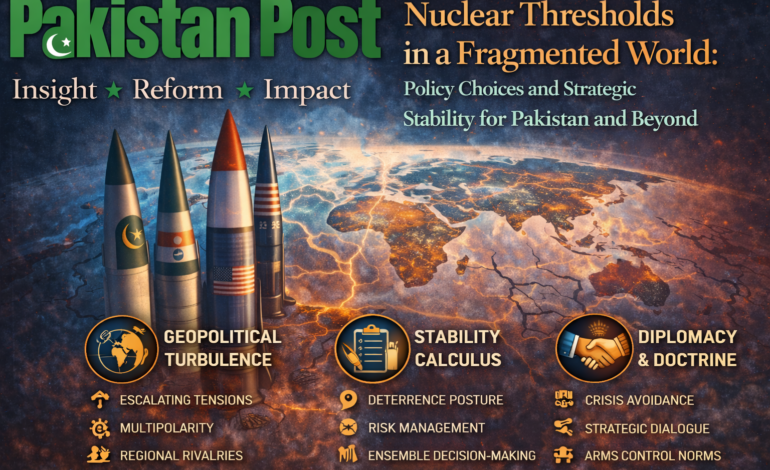
Nuclear Thresholds in a Fragmented World: Policy Choices and Strategic Stability for Pakistan and Beyond

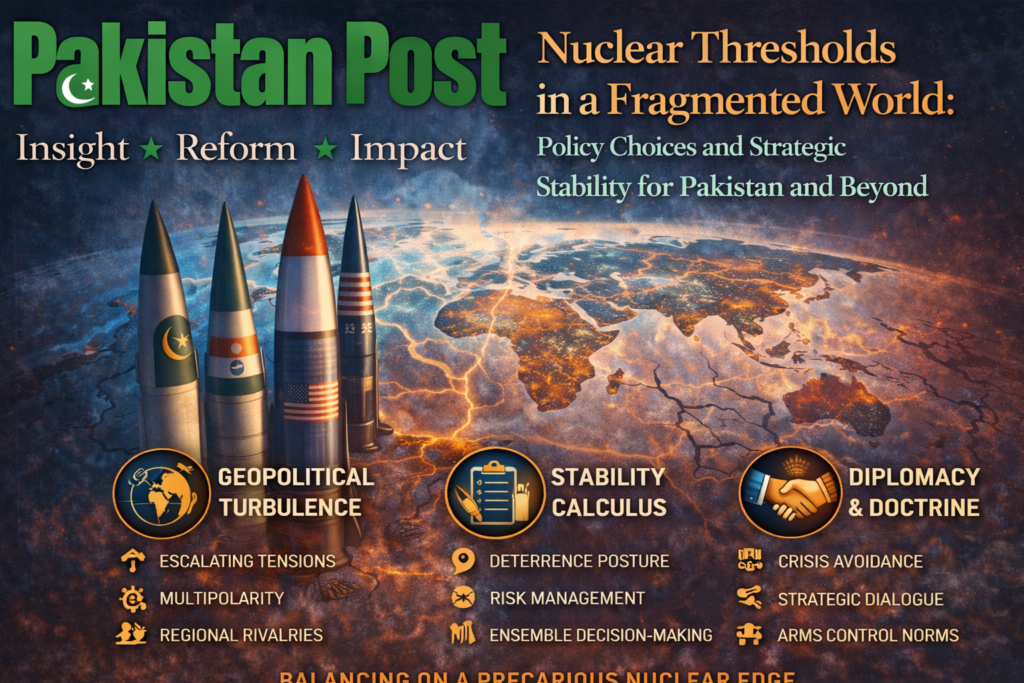
The nuclear question has returned to the center of global strategic though not as a distant abstraction but as an immediate and structuring force shaping policy choices, economic alignments, and the psychological climate of nations. For policymakers and analysts observing the current geopolitical moment, the convergence of technological acceleration, fragmented multilateralism, and renewed great power competition has created a condition in which nuclear risk is no longer confined to deterrence theory textbooks but embedded within everyday decision making across diplomatic, economic, and security domains. The urgency of this moment demands not only technical assessments of arsenals and doctrines but a deeper philosophical and structural reflection on how nuclear logic is reorganizing global order.
The contemporary nuclear landscape differs significantly from the bipolar clarity of the Cold War. The doctrine of mutually assured destruction once operated within a relatively stable framework where two superpowers calibrated their actions within known thresholds. Today that structure has dissolved into a multipolar environment where multiple nuclear capable states operate under distinct strategic cultures, threat perceptions, and political pressures. This diffusion of nuclear capability has increased the complexity of deterrence calculations and reduced the predictability that once underpinned strategic stability. For policymakers in countries such as Pakistan, this complexity is not theoretical but immediate, given the region’s embedded tensions and the presence of multiple nuclear actors with overlapping and sometimes conflicting doctrines.
The transformation of warfare through emerging technologies further complicates nuclear stability. Cyber capabilities, artificial intelligence, and autonomous systems are increasingly integrated into command and control infrastructures. While these technologies promise efficiency and speed, they also introduce vulnerabilities that could lead to miscalculation or unintended escalation. A cyber intrusion into early warning systems, whether intentional or accidental, could generate false signals that compress decision making timelines and increase the probability of catastrophic error. Analysts must therefore expand the definition of nuclear risk to include not only physical weapons but the digital ecosystems that govern their deployment.
Economic interdependence, once considered a stabilizing force in international relations, is now entangled with strategic competition in ways that can both mitigate and exacerbate nuclear tensions. On one hand, global trade networks create incentives for restraint, as large scale conflict would disrupt economic flows and impose severe costs on all actors involved. On the other hand, economic tools such as sanctions, trade restrictions, and resource control are increasingly weaponized, creating pressures that can spill over into military domains. The interplay between economic coercion and security competition creates a feedback loop in which economic disputes can escalate into strategic confrontations with nuclear implications.
The role of narrative and perception in nuclear politics has also become more pronounced. In an era of information saturation and rapid media cycles, the framing of events can shape public opinion and political decision making in real time. Leaders operate not only within strategic calculations but also within the pressures of domestic audiences and global scrutiny. The fear of appearing weak or indecisive can drive escalatory rhetoric and actions, even when underlying interests might favor restraint. For analysts, understanding the symbolic dimension of nuclear politics is as important as assessing material capabilities.
Pakistan’s position within this evolving landscape requires a nuanced and multidimensional policy approach. As a nuclear state situated in a region marked by historical tensions and ongoing disputes, Pakistan must balance deterrence credibility with strategic restraint. The doctrine of credible minimum deterrence has served as a guiding principle, emphasizing the sufficiency of capability rather than parity. However, the changing regional and global dynamics necessitate a continuous reassessment of what constitutes credibility and sufficiency. This reassessment must consider not only the capabilities of adversaries but also the broader strategic environment, including technological developments and alliance structures.
Diplomacy remains a critical instrument in managing nuclear risk, yet its effectiveness is challenged by the erosion of multilateral institutions and norms. Arms control agreements that once provided frameworks for transparency and limitation are weakening or collapsing. The absence of robust and inclusive mechanisms for dialogue increases the likelihood of misunderstanding and miscalculation. For policymakers, there is a need to reinvigorate diplomatic engagement at both bilateral and multilateral levels, focusing on confidence building measures, crisis communication channels, and the development of new norms that reflect contemporary realities.
The ethical dimension of nuclear policy cannot be ignored. The destructive potential of nuclear weapons raises fundamental questions about the legitimacy of their use and the moral responsibility of states that possess them. While deterrence theory argues that the existence of nuclear weapons prevents their use by creating mutual fear, this logic is contingent on rational behavior and stable conditions. The possibility of irrational actors, accidental launches, or unforeseen interactions between complex systems challenges the assumption that nuclear deterrence is inherently stable. Policymakers must therefore engage with ethical considerations not as abstract ideals but as integral components of strategic decision making.
Climate change introduces an additional layer of complexity to the nuclear equation. Environmental stressors such as resource scarcity, extreme weather events, and population displacement can exacerbate existing tensions and create new conflict scenarios. In regions already marked by political instability, these pressures can increase the risk of confrontation between nuclear armed states. Furthermore, the potential environmental consequences of a nuclear exchange, including nuclear winter and long term ecological damage, underscore the interconnectedness of security and sustainability. Analysts must integrate environmental considerations into their assessments of nuclear risk and policy options.
The intersection of domestic politics and nuclear strategy is another critical area of analysis. Political leadership, institutional structures, and governance quality influence how nuclear policies are formulated and implemented. In contexts where decision making is centralized and transparency is limited, the risks associated with miscalculation and escalation may be higher. Conversely, robust institutions and clear lines of authority can enhance stability by ensuring that decisions are informed, deliberate, and subject to checks and balances. For Pakistan, strengthening institutional capacity and promoting strategic culture that values restraint and responsibility are essential components of nuclear policy.
Technological asymmetry between states also plays a significant role in shaping nuclear dynamics. States with advanced surveillance, missile defense, and precision strike capabilities may perceive advantages that alter their strategic calculations. These perceptions can undermine deterrence by creating incentives for preemptive action or by reducing confidence in second strike capabilities. Addressing these asymmetries requires both technological adaptation and diplomatic engagement to prevent destabilizing arms races. Policymakers must carefully evaluate investments in defense technologies to ensure that they enhance security without provoking counterproductive responses.
Public engagement and education are often overlooked aspects of nuclear policy. The general population’s understanding of nuclear risks and policies can influence democratic accountability and the legitimacy of strategic decisions. Informed public discourse can support responsible policymaking by creating awareness of the stakes involved and by encouraging transparency and debate. For media institutions such as Pakistan Post, there is a responsibility to facilitate this discourse by providing accurate, nuanced, and accessible analysis of nuclear issues.
The role of regional organizations and alliances in shaping nuclear policy is another area that warrants attention. While global institutions face challenges, regional frameworks can provide platforms for dialogue and cooperation tailored to specific contexts. In South Asia, the development of mechanisms for crisis management and conflict resolution could contribute to reducing nuclear risks. These mechanisms do not require comprehensive agreements but can begin with incremental steps such as communication protocols, joint exercises, and mutual notifications of military activities.
The concept of strategic stability must be redefined in light of contemporary realities. Stability can no longer be understood solely in terms of the absence of war between major powers. It must encompass resilience against disruptions, adaptability to technological change, and the capacity to manage crises effectively. This broader conception of stability requires integrated approaches that combine military preparedness, diplomatic engagement, economic resilience, and societal cohesion. Policymakers must adopt holistic frameworks that recognize the interconnectedness of these dimensions.
The potential for non state actors to influence nuclear dynamics adds another layer of risk. While the acquisition of nuclear weapons by such actors remains a low probability scenario, the possibility of sabotage, cyber attacks, or the exploitation of vulnerabilities in nuclear infrastructure cannot be dismissed. Ensuring the security of nuclear materials and facilities is therefore a critical priority. This includes not only physical protection but also cybersecurity measures and personnel reliability programs. International cooperation in this area is essential, as vulnerabilities in one state can have global consequences.
The psychological dimension of nuclear deterrence is often underestimated. Deterrence relies on the perception of credible threat, which in turn depends on the beliefs and expectations of adversaries. Misperceptions, cognitive biases, and cultural differences can distort these perceptions and lead to unintended escalation. Analysts must incorporate insights from psychology and behavioral science into their assessments to better understand how decision makers perceive risks and respond to signals. This interdisciplinary approach can enhance the effectiveness of deterrence strategies by aligning them more closely with human behavior.
In considering policy options, it is important to recognize that there are no perfect solutions to the challenges posed by nuclear weapons. Every strategy involves trade offs and uncertainties. The goal of policy should therefore be to manage risks rather than to eliminate them entirely. This requires a pragmatic approach that balances competing priorities and adapts to changing conditions. Continuous evaluation and adjustment of policies are essential to ensure that they remain relevant and effective.
The role of leadership in navigating nuclear challenges cannot be overstated. Leaders must possess not only technical understanding but also the judgment and restraint required to make decisions under conditions of uncertainty and pressure. The cultivation of such leadership involves education, training, and the development of institutional cultures that prioritize responsibility and accountability. For countries like Pakistan, investing in human capital and leadership development is as important as investing in technological capabilities.
The future of nuclear policy will be shaped by the choices made today. Decisions regarding arms control, technological development, diplomatic engagement, and institutional reform will have long term implications for global security. Policymakers and analysts must therefore adopt a forward looking perspective that anticipates emerging trends and prepares for potential scenarios. Scenario planning and strategic foresight can provide valuable tools for navigating uncertainty and for identifying opportunities to reduce risks.
Ultimately, the nuclear question is not only a matter of strategy but a test of collective human judgment. The existence of nuclear weapons reflects both technological achievement and existential vulnerability. Managing this paradox requires a commitment to rationality, cooperation, and ethical responsibility. While the challenges are formidable, they are not insurmountable. Through informed analysis, thoughtful policymaking, and sustained engagement, it is possible to navigate the complexities of the nuclear age and to reduce the risks that it poses.
The imperative is clear for the Pakistan’s policy and impact.The nuclear discourse must move beyond alarmism and complacency to embrace a nuanced understanding of the forces at play. Policymakers must integrate insights from multiple disciplines and perspectives, while analysts must provide rigorous and independent assessments that inform decision making. The stakes could not be higher, as the consequences of failure extend beyond national boundaries to the very future of human civilization.
A Public Service Message