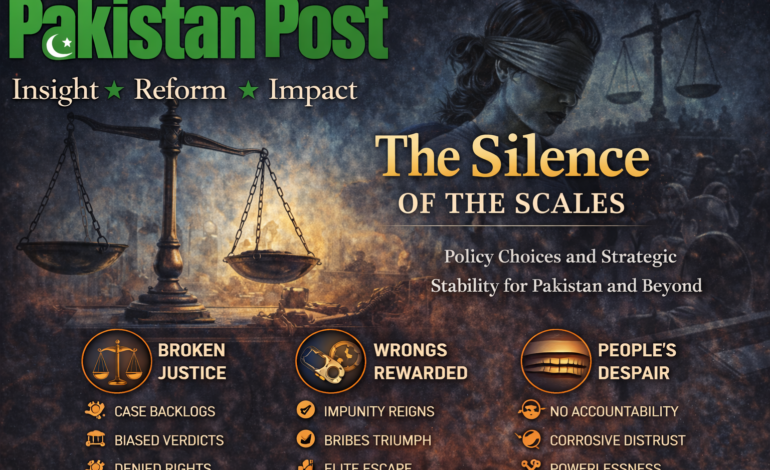
The Silence of the Scales


By:
Ghulam Sajjad Gopang
Senior Lawyer of Supreme Court
On 30 March 2026, a decision delivered by the Court in Dadu, Sindh, marked a deeply consequential moment in the administration of justice in Pakistan. The acquittal of individuals holding elected public office, including members of the national and provincial legislatures from Larkana, in a case concerning the killing of three members of a single family, has triggered widespread concern about the functioning of investigative and adjudicatory processes where influence intersects with law.
The case itself carried all the elements that ordinarily compel rigorous judicial scrutiny. The first information report was lodged without delay. The incident occurred in daylight. The victims, belonging to one family, were subjected to lethal violence in a manner that left little ambiguity regarding the severity and intent of the act. Medical examination reports were consistent with the allegations, detailing the nature and number of injuries in a way that aligned with the prosecution’s narrative. Under standard evidentiary expectations, such alignment between ocular account, medical findings, and prompt reporting often forms the backbone of a prosecutable case.
Yet the outcome diverged sharply from these expectations. The central reasoning attributed to the acquittal was the failure of two eyewitnesses, described as individuals of modest socioeconomic standing, to support the prosecution during trial proceedings. Their withdrawal from earlier statements or reluctance to testify introduced a gap that proved decisive. In legal doctrine, the credibility and consistency of witnesses remain critical, but the structural conditions under which such witnesses operate cannot be divorced from their evidentiary role. When individuals lacking social protection are required to testify against persons embedded within entrenched power hierarchies, the question arises whether silence reflects unreliability or coercive pressure.
This tension is not novel within Pakistan’s criminal justice system. However, its recurrence in high visibility cases underscores systemic fragility. The law does provide mechanisms to address investigative lapses and evidentiary manipulation. A recent Landmark judgment of the Supreme Court, dated 31 January 2026, in the Case of Muhammad Bux versus the State, SET PRINCIPLES and approved for Reporting reiterated that deficiencies in investigation do not automatically entitle an accused to acquittal. The Court further emphasized account ability of investigating officers under statutory provisions where evidence is mishandled or suppressed. In that case, despite acknowledged defects, the conviction and sentence were sustained, reinforcing the principle that justice must not be defeated by procedural inadequacies alone.
The contrast between that judicial stance and the present outcome has amplified public disquiet. It raises critical questions about consistency in legal reasoning and the thresholds applied in different forums. While each case must be adjudicated on its own facts, the perception of uneven application of principles erodes confidence in institutional reliability. For a justice system, perception is not a peripheral concern. It is central to legitimacy.
The complainant in this case, a woman who has pursued legal recourse over an extended period following the killing of her father, grandfather, and uncle in Mehar, Sindh, has become emblematic of persistence in the face of structural resistance. Her actions over the years have drawn attention not merely because of their symbolic nature but because they reflect the lived experience of navigating a system where access to justice is often mediated by power. Her continued resolve to challenge the acquittal through appellate mechanisms indicates both faith in higher judicial forums and recognition that the initial outcome is not necessarily final within the legal hierarchy.
The broader implications of the acquittal extend beyond the immediate parties. There exists a documented pattern in which perceived failures of justice have precipitated acts of retaliation within court premises and other controlled environments. Incidents in Lahore, Rawalpindi, and Karachi over recent years illustrate a disturbing trajectory where individuals, disillusioned by legal outcomes, resort to direct violence against accused persons. Such occurrences are not merely breaches of security; they are manifestations of eroded trust. When formal mechanisms are seen as ineffective or compromised, informal and unlawful responses gain traction.
This dynamic presents a profound governance challenge. The rule of law depends not only on the existence of legal frameworks but on their credible enforcement. When citizens begin to question whether outcomes are determined by evidence or by influence, the deterrent effect of law diminishes. The consequences are cumulative. Each controversial acquittal, each instance of perceived impunity, contributes incrementally to a climate where compliance with law is no longer viewed as rational.
The structural roots of this challenge are complex. Feudal power configurations in certain regions continue to shape social relations, economic dependencies, and political alignments. Individuals occupying positions of local dominance often possess the capacity to influence both formal and informal processes. This influence can manifest in subtle forms, including social pressure on witnesses, or in more direct interventions. The criminal justice system, ideally insulated from such dynamics, frequently operates within the same social context, making complete insulation difficult.
Investigative quality is another critical variable. Effective prosecution relies on meticulous evidence collection, preservation, and presentation. Where investigations are compromised, whether through negligence or external interference, the burden on courts increases. Judges are constrained to decide on the basis of the record before them. If that record is incomplete or unreliable, the space for conviction narrows. However, this reality does not absolve the system as a whole. It instead highlights the need for integrated accountability across all stages of the process.
Witness protection remains one of the most significant gaps. Without credible mechanisms to ensure safety and anonymity where necessary, individuals called upon to testify in serious cases face tangible risks. Economic vulnerability compounds this risk, as witnesses may lack the resources to withstand prolonged pressure. The absence of structured support systems effectively transforms witness testimony into an act of personal courage rather than a civic duty supported by the state.
Judicial capacity and case management also merit attention. Delays in proceedings can weaken cases over time, as memories fade, evidence deteriorates, and external influences accumulate. While the case in question reportedly did not suffer from delay at the initial reporting stage, the overall duration of legal proceedings can still impact outcomes. Efficient adjudication is therefore not merely a matter of administrative convenience but a substantive component of justice.
The appellate process now assumes critical importance. Higher courts have the authority to reexamine evidence, assess legal reasoning, and correct errors where identified. The potential engagement of experienced legal counsel with a substantial record in criminal litigation indicates an intention to pursue the matter with rigor. The appellate forum will be tasked with balancing respect for trial court findings with its own duty to ensure that justice is neither compromised nor perceived to be compromised.
At a systemic level, the situation calls for targeted reforms grounded in empirical assessment rather than rhetorical commitment. Strengthening investigative independence is essential. This includes insulating investigating officers from external pressures, enhancing forensic capabilities, and establishing clear consequences for misconduct. The legal provisions that penalize evidence tampering must be enforced consistently to create deterrence within investigative agencies themselves.
Witness protection frameworks require immediate operationalization. Legislative provisions must be translated into practical mechanisms, including secure relocation, financial assistance, and confidentiality protocols. International models offer guidance, but adaptation to local conditions is necessary to ensure effectiveness. Without such measures, reliance on eyewitness testimony in cases involving powerful accused persons will remain inherently unstable.
Judicial training and resource allocation should also be prioritized. Judges dealing with complex criminal cases must have access to continuous professional development, particularly in areas such as evaluation of hostile witnesses, use of circumstantial evidence, and application of precedent. Adequate staffing and technological support can further enhance efficiency and reduce backlog.
Transparency is another critical factor. Public access to reasoned judgments enables scrutiny and fosters understanding of judicial decisions. Where outcomes are controversial, detailed articulation of reasoning can mitigate speculation and reinforce the principle that decisions are grounded in law rather than external considerations. This does not eliminate disagreement, but it anchors debate in substantive analysis.
The role of legal professionals extends beyond courtroom advocacy. Bar associations and senior practitioners have a responsibility to uphold ethical standards and to resist participation in practices that undermine justice. Professional accountability mechanisms must be strengthened to address misconduct within the legal community itself.
Media institutions carry a parallel responsibility. Accurate and restrained reporting is essential to inform public discourse without inflaming tensions. Sensationalism may attract attention but does little to advance understanding. Analytical reporting that situates individual cases within broader systemic patterns can contribute to more informed engagement by both the public and decision makers.
Educational initiatives can play a longer term role in reshaping expectations and norms. Integrating legal literacy into curricula and community programs can enhance public understanding of rights and procedures. An informed citizenry is better equipped to demand accountability and to participate constructively in legal processes.
The intersection of law and power is not unique to any single jurisdiction, but its manifestations vary. In contexts where historical structures of influence remain deeply embedded, reform requires sustained effort across multiple fronts. Incremental improvements, while valuable, must be aligned within a coherent strategy that addresses root causes rather than symptoms alone.
Restoring confidence requires visible and verifiable change. This includes not only corrective action in specific cases but also demonstrable commitment to reform at the structural level. Accountability must be consistent, irrespective of the status of individuals involved. Equality before law is not an aspirational ideal but a constitutional mandate.
The persistence of the complainant in seeking appellate review underscores a fundamental truth. Despite setbacks, there remains an expectation that justice can be realized through lawful means. Preserving that expectation is essential. If it erodes, the consequences will be far more difficult to contain than any single case outcome.
After Winning 1300 Murder Cases in 30 years of Professional Advocacy I have come to the conclusion that as a POSITIVE & CONSTRUCTIVE CRITICISM I can suggest that The ACQUITTAL JUDGEMENT and events of OPEN AIRIAL FIRINGS by accused persons as Celebrations of their Victory on 30 March 2026 should therefore be viewed not as an isolated anomaly but as a diagnostic moment. They reveal stress points within the entire Judicial system including Lawyers, Prosecution, Police and Judiciary that, if unaddressed, will continue to produce similar outcomes in future as well. The cost of inaction is not limited to individual cases. It extends to the credibility of institutions and the stability of social order in PUBLIC AT LARGE & entire Society.
In the final analysis, the integrity of the justice system is measured not by its performance in routine matters but by its response to cases that test its resilience to Satisfaction of Tax payer Nation. When confronted with allegations involving powerful actors, the system must demonstrate that its commitment to law is unwavering. Only then can the scales of justice regain their balance, and only then can silence be replaced by trust.
A Public Service Message