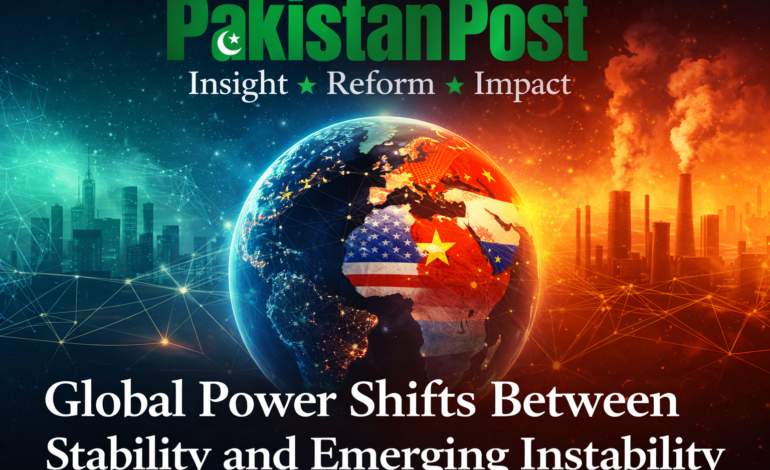
Global Power Shifts Between Stability and Emerging Instability


In the contemporary global order, events rarely arrive as isolated shocks. They appear instead as overlapping disturbances in an increasingly interconnected system where economics, politics, culture, and information flows are tightly interwoven. Wars, financial volatility, technological disruption, and political polarization are often treated as separate crises, yet they may be better understood as expressions of a deeper transformation in how global power is organized and exercised. The central question is whether these developments represent fragmentation and decline or whether they reflect a form of managed adaptation in which instability itself becomes part of systemic continuity.
At the heart of this inquiry is a tension between two interpretations of power. The first sees international politics as driven by deliberate strategy, where dominant actors consciously shape outcomes to preserve their position. The second views the system as fundamentally decentralized, where outcomes emerge from the interaction of institutions, incentives, and constraints without central coordination. The reality likely lies somewhere between these poles. Power today is neither fully orchestrated nor entirely accidental. It operates through distributed networks in which states, corporations, financial markets, media platforms, and technological systems interact in ways that generate patterned but not fully designed outcomes.
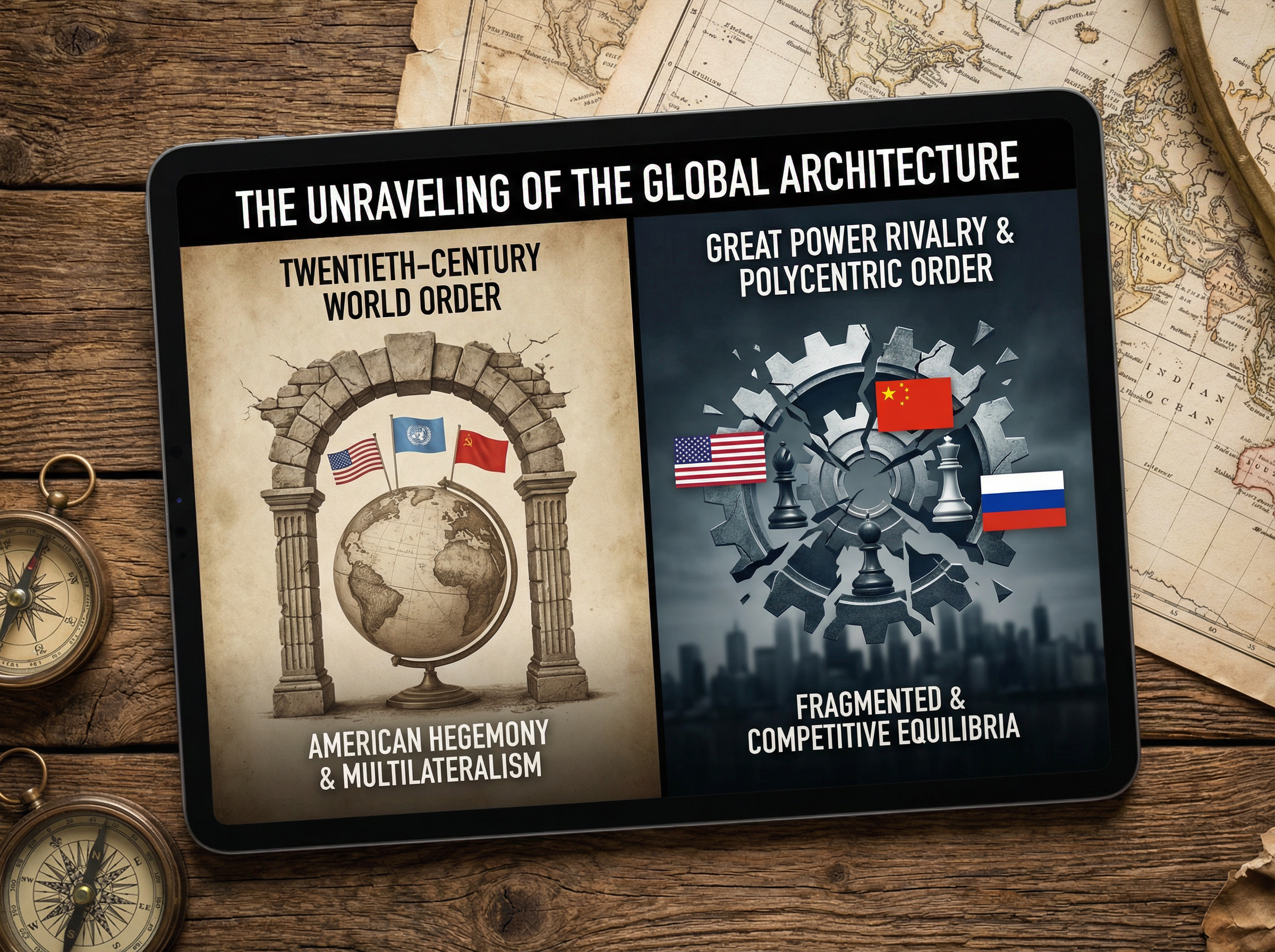
This perspective becomes clearer when considering the transition from a unipolar to a more fragmented global structure. The post Cold War era was characterized by the dominance of the United States and its allies, underpinned by financial globalization, security alliances, and institutional influence. That moment of relative coherence is now giving way to a more complex configuration involving multiple centers of power, particularly the rise of China, the resurgence of Russia, and the increasing assertiveness of regional actors. Yet this is not a simple replacement of one hierarchy with another. It is a transition toward a more fluid and contested system in which influence is distributed unevenly across different domains.
One of the conceptual tools often used to interpret such transitions is the Thucydides Trap, which suggests that conflict becomes more likely when an emerging power challenges an established hegemon. While historically informed, this framework risks oversimplifying the present by implying structural inevitability. In reality, the contemporary system is shaped not only by shifts in material power but also by nuclear deterrence, economic interdependence, and institutional constraints that make direct great power war less likely even in conditions of heightened tension. What emerges instead is a pattern of managed rivalry, where competition is intense but often indirect, dispersed across economic sanctions, technological decoupling, proxy conflicts, and narrative contestation.
Within this environment, instability does not necessarily function as system breakdown. It can also operate as a form of systemic adaptation. Economic pressures, political fragmentation, and cultural polarization are frequently interpreted as signs of weakness. Yet they may also serve to reorganize priorities, redirect resources, and recalibrate governance structures. Fiscal strain can justify industrial policy shifts. Security threats can legitimize defense expansion. Cultural anxiety can reshape political coalitions. These dynamics do not require a single coordinating actor; they emerge from the alignment of incentives across institutions responding to perceived uncertainty.
This is where the idea of managed instability becomes analytically useful, not as a conspiracy thesis but as a way of describing how complex systems absorb shocks. Instability in this sense is not the opposite of order but one of its operational conditions. Systems that are large, interconnected, and adaptive often evolve through cycles of disruption and adjustment. What appears as crisis may simultaneously function as a mechanism of reconfiguration. However, recognizing this does not imply that outcomes are controlled or predictable. It simply suggests that breakdown and continuity can coexist.
Economic structure plays a central role in this process. Advanced economies face long term pressures including stagnant productivity growth, inequality, inflationary cycles, and fiscal constraints. At the same time, strategic sectors such as defense, energy security, semiconductors, and artificial intelligence have become central to national policy. The expansion of these sectors reflects both external competition and internal economic logic. In periods of uncertainty, states tend to prioritize resilience over efficiency, redundancy over optimization, and security over openness. This shift does not necessarily indicate preparation for conflict, but it does indicate a reorientation of economic priorities toward strategic competition.
Historically, periods of economic stress have often coincided with geopolitical tension, but the relationship is not mechanical. It is mediated by institutions and political choices. The expansion of defense spending, for example, can be interpreted in multiple ways. It may reflect genuine security concerns, domestic industrial policy, or a combination of both. Similarly, trade fragmentation may result from strategic decoupling or from the cumulative effects of regulatory divergence and technological competition. The difficulty lies in distinguishing intent from structure, as similar outcomes can emerge from different causal pathways.
The contemporary landscape is further complicated by the proliferation of proxy conflicts. From Eastern Europe to the Middle East and the Indo Pacific, competition between major powers increasingly unfolds through regional actors and indirect engagement. These conflicts serve as instruments of influence projection while reducing the risks associated with direct confrontation. They also function as laboratories for military innovation and alliance testing. Yet they are not fully controllable. Once initiated, proxy dynamics develop their own internal logics, shaped by local conditions and shifting incentives.
Alongside material competition, informational and cultural systems play an increasingly important role in shaping geopolitical behavior. Digital platforms, algorithmic recommendation systems, and fragmented media ecosystems influence how events are perceived and interpreted. Information does not flow neutrally; it is filtered through structures that reward engagement, emotional intensity, and identity alignment. This creates an environment in which narratives can become self reinforcing. Perceptions of threat can intensify political polarization, which in turn reinforces the salience of those same threats.
However, this should not be reduced to a simplistic model of top down manipulation. It is more accurately understood as a system of distributed amplification. States attempt to communicate strategic messages, media organizations respond to incentives for attention, and audiences engage with content that reflects their concerns and identities. The outcome is a form of narrative convergence that emerges without requiring centralized coordination. In this sense, ideological alignment is often an emergent property of systemic interaction rather than the result of explicit design.
The role of historical memory is central in structuring these narratives. Interpretations of World War I and World War II continue to shape contemporary geopolitical discourse. These events function not only as historical reference points but as moral frameworks through which present conflicts are interpreted. Concepts such as appeasement, resistance, aggression, and deterrence carry normative weight that influences policy debates. Yet historical analogies are inherently selective. They illuminate certain dimensions of current events while obscuring others, particularly the structural differences between past and present international systems.
At the same time, cultural dynamics within societies contribute to the broader geopolitical environment. The resurgence of identity politics, debates over national cohesion, and renewed interest in traditional values can be interpreted in multiple ways. They may reflect genuine social change driven by demographic and cultural shifts, or they may function as responses to perceived instability. In either case, cultural polarization has political consequences. It shapes electoral outcomes, influences policy priorities, and contributes to the emotional tone in which geopolitical issues are debated. Whether or not these trends are deliberately instrumentalized, they can still produce effects that align populations toward more adversarial worldviews.
The concept of weimarisation is sometimes invoked to describe these patterns, drawing an analogy with the social and economic instability of the Weimar Republic. While the analogy captures certain features such as polarization, economic stress, and institutional strain, it risks overstating similarity and underestimating structural differences. Contemporary societies operate within a far more interconnected global economy and under conditions of nuclear deterrence and institutional density that significantly alter the consequences of instability. The value of the analogy lies not in prediction but in sensitivity to the relationship between economic stress and political radicalization.
A more precise analytical approach is to view the system as one characterized by bounded rationality and emergent behavior. Actors pursue objectives based on incomplete information, constrained by institutional structures and shaped by evolving perceptions of risk. Outcomes arise not from unified intent but from the interaction of multiple decision centers operating under shared pressures. This does not eliminate the possibility of strategic behavior, but it situates it within a broader context of systemic complexity.
Within this framework, the distinction between crisis and continuity becomes increasingly difficult to maintain. Economic shocks may accelerate structural reforms. Political crises may consolidate institutional authority. Cultural conflict may reinforce political identities. What appears as breakdown may simultaneously function as adaptation. Conversely, what appears as stability may conceal accumulated tensions that later manifest in sudden disruption. The system does not move along a linear trajectory but through nonlinear adjustments shaped by feedback loops and threshold effects.
This duality has important implications for how global order is understood. If instability can be absorbed into systemic continuity, then the presence of crisis does not automatically imply impending collapse. At the same time, the capacity of systems to absorb shocks is not infinite. Resilience can coexist with fragility. The same mechanisms that enable adaptation can also generate new vulnerabilities. Complexity does not eliminate risk; it redistributes it.
Ultimately, the contemporary international environment is best understood as existing between design and drift. There are elements of intentional strategy, particularly in areas of security, technology, and economic policy. Yet there are also powerful structural forces that operate independently of intent. The interaction between these dimensions produces a world that is partially guided and partially emergent, partially coherent and partially fragmented.
To interpret this world requires abandoning the expectation of singular explanations. Neither purely conspiratorial nor purely accidental accounts are sufficient. Instead, what is needed is an analytical framework that can accommodate complexity without collapsing it into simplicity. The global order is not being rebuilt according to a single blueprint, nor is it simply unraveling. It is being continuously renegotiated through the interaction of power, perception, and constraint.
In this sense, the most important feature of the present moment is not certainty but ambiguity. Systems that appear to be in crisis may simultaneously be evolving. Structures that appear stable may be undergoing quiet transformation. Power that appears centralized may be distributed. And instability that appears destructive may also be functional. The task of analysis is not to resolve these contradictions prematurely but to remain attentive to them, recognizing that in complex systems contradiction is not an anomaly but a defining condition of how change actually occurs.
A Public Service Message