

ALGORITHMIC POLITICS: HOW SOCIAL MEDIA IS RECONFIGURING POLITICAL IDENTITY IN PAKISTAN

Pakistan’s political identity formation is increasingly being shaped not in party offices, parliamentary debates, or traditional broadcast studios, but within algorithmically governed digital environments where visibility is engineered, attention is monetized, and political meaning is continuously reassembled through user interaction. The shift is

PAKISTAN’S MEDIA ECOSYSTEM AND DECLINING TRUST: FROM LEGACY JOURNALISM TO ADVOCACY AND ANALYSIS

Pakistan’s media landscape is undergoing a structural transformation that is neither linear nor stable, but increasingly fragmented, contested, and shaped by forces that extend far beyond the newsroom. What was once a relatively centralized ecosystem dominated by print newspapers and state-regulated broadcast channels

Information Warfare, AI Generated Content, and Digital Sovereignty in South Asia

The architecture of conflict in South Asia is undergoing a quiet but profound transformation. Traditional domains of military deterrence and diplomatic signaling are now increasingly intersecting with a parallel battlefield defined by information flows, algorithmic amplification, and artificial intelligence generated content. In this

Fintech Expansion, Mobile Banking, and the Political Economy of Financial Inclusion in Pakistan

The rapid expansion of fintech ecosystems in Pakistan has emerged as one of the most visible yet uneven transformations in the country’s contemporary political economy. Mobile wallets, branchless banking networks, digital payment platforms, and instant transfer systems have redefined the mechanics of money

Digital Governance, E-ID Systems, and the Emerging Architecture of the Data State
The expansion of digital governance in Pakistan is no longer a policy experiment at the margins of the state apparatus. It has become a central organizing principle of administrative authority, fiscal management, and citizen identification. The rise of biometric identity systems, integrated databases,
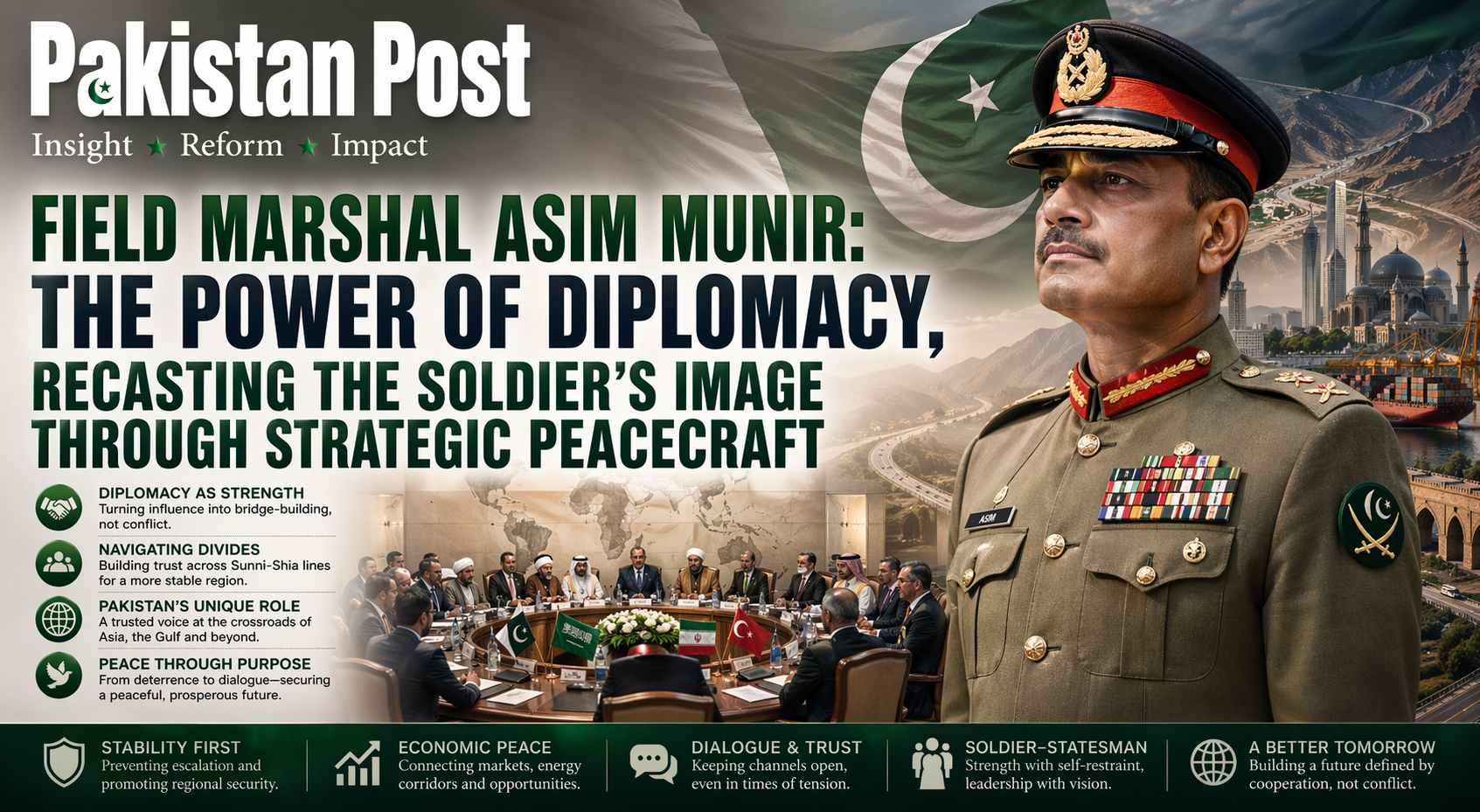
Field Marshal Asim Munir: The Power of Diplomacy, Recasting the Soldier’s Image Through Strategic Peacecraft
Power, in the classical imagination of states, was measured in divisions, missiles, and the capacity to impose cost upon an adversary. In the twenty first century, however, power has become a more intricate currency. It now includes the ability to reassure markets, calm

Digital Governance, E-ID Systems, and the Emerging Architecture of the Data State
The expansion of digital governance in Pakistan is no longer a policy experiment at the margins of the state apparatus. It has become a central organizing principle of administrative authority, fiscal management, and citizen identification. The rise of biometric identity systems, integrated databases,

Artificial Intelligence and Structural Transformation in Pakistan’s Economy
Artificial intelligence is no longer a distant technological frontier but a consolidating force reshaping global economic hierarchies, productivity regimes, and labour markets. It is also becoming a site of strategic competition, where a small cluster of technology superpowers and platform corporations increasingly define

When 80 Percent Becomes a Ceiling Instead of a Door: The Quiet Crisis of Merit in Pakistan’s Education System
Merit is often presented as the purest expression of fairness in education, a simple promise that effort and ability will determine opportunity. In Pakistan, this promise is increasingly reduced to a numerical ritual, 80 percent, 70 percent, sometimes slightly more, sometimes slightly less

Educational Misalignment and the Structural Human Capital Gap in Pakistan’s Economic Transition

Pakistan’s education system stands at the centre of a widening structural contradiction: a rapidly changing global economy demanding advanced digital, analytical, and technical skills, and an institutional framework of learning that remains largely anchored in outdated curricula, fragmented governance, and uneven quality standards.