Field Marshal Asim Munir: The Power of Diplomacy, Recasting the Soldier’s Image Through Strategic Peacecraft

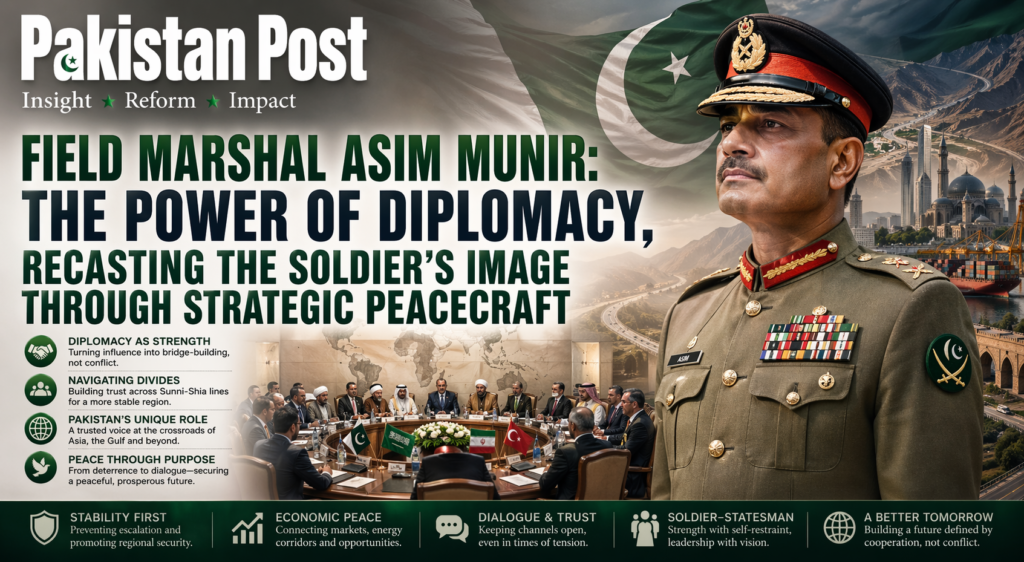
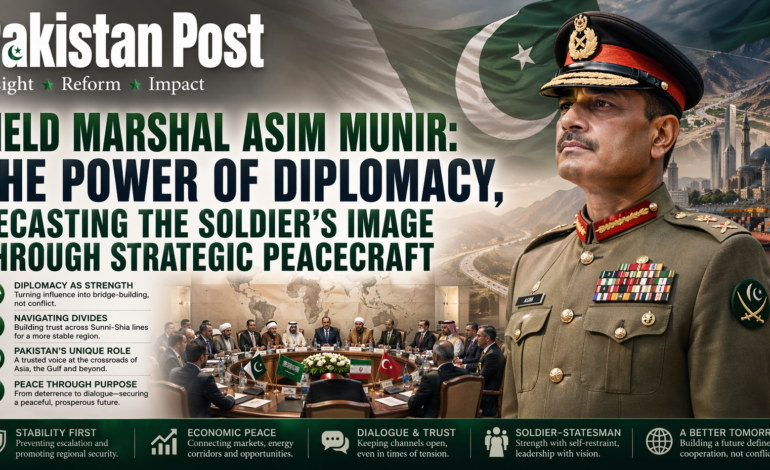
Power, in the classical imagination of states, was measured in divisions, missiles, and the capacity to impose cost upon an adversary. In the twenty first century, however, power has become a more intricate currency. It now includes the ability to reassure markets, calm allies, prevent escalation, and create pathways for dialogue where others see only deadlock. Nations that understand this transition are adjusting their strategic grammar. They still retain armies, but they increasingly seek influence through mediation, connectivity, and disciplined restraint. In that changing environment, Pakistan has an opportunity to project a more mature and stabilising role, and much of that possibility is tied to the evolving public image of its military leadership, particularly Field Marshal Asim Munir, whose tenure has coincided with a period of regional volatility demanding both vigilance and diplomacy.
For decades, Pakistan’s military image abroad was shaped largely by the vocabulary of security: borders, counterterrorism, deterrence, and crisis management. Those themes were real and often unavoidable, given the country’s geography and strategic pressures. Yet geography that creates insecurity can also create relevance. Pakistan sits at the junction of South Asia, Central Asia, the Gulf, China, and the wider Muslim world. It is proximate to maritime routes, energy corridors, and ideological fault lines that have shaped regional politics for generations. Such a location imposes burdens, but it also grants leverage. A country placed at crossroads can either become a battlefield of competing interests or a bridge among them. The distinction depends less on maps than on leadership.
Recent years have demonstrated how quickly the Middle East and adjacent regions can move from uneasy calm to dangerous confrontation. Rivalries between Iran and Arab Gulf states, tensions involving Western powers, disruptions in maritime trade, and domestic fragilities across several states have all reinforced a single lesson: wars are easier to start than to contain. Every missile launch, every proxy clash, and every rhetorical escalation carries economic aftershocks that travel well beyond the immediate theatre. Oil prices react, shipping costs rise, currencies wobble, investors retreat, and public anxieties spread. In such an environment, the countries capable of speaking to multiple camps without being entirely captured by any one of them become valuable.
Pakistan occupies that rare category. It has longstanding ties with Saudi Arabia and other Gulf partners through labour, defence cooperation, and finance. It also shares a border with Iran, maintains diplomatic channels with Tehran, and has enduring reasons to preserve stability on its western flank. It has strategic relations with China, practical engagement with the United States, and relevance to broader Muslim political discourse. Few states can converse, with varying degrees of trust, across so many axes at once. This does not make mediation easy, but it does make it plausible.
The importance of image in this context should not be underestimated. States deal not only with capabilities but with perceptions. If a military institution is seen solely through the prism of coercion, its diplomatic utility narrows. If it is also viewed as disciplined, rational, and supportive of de-escalation, its usefulness expands. The emergence of a softer image of the soldier does not imply softness in the sense of weakness. Rather, it suggests confidence sufficient to prefer measured influence over theatrical aggression. It is the distinction between appearing dangerous and being dependable.
Field Marshal Asim Munir’s public positioning has increasingly intersected with this broader need. In moments of regional tension, messaging associated with Pakistan’s leadership has often emphasised stability, sovereignty, and avoidance of wider conflict. For an external audience, such signals matter. Investors listen. Foreign ministries listen. Diaspora communities listen. Adversaries listen too. Calm language, when backed by credible capability, can be more powerful than flamboyant threats. It indicates control.
The deeper strategic challenge lies in navigating the long shadow of Sunni and Shia division, a fault line frequently described in religious terms but often driven by geopolitical competition. Sectarian narratives are regularly instrumentalised by states and non-state actors seeking influence. Historical memory, doctrinal identity, and political grievance are woven together into conflicts whose real engines may be security fears, regional rivalry, or domestic legitimacy struggles. Any actor seeking to reduce these tensions must recognise that sermons alone cannot solve what strategy has inflamed.
Pakistan’s own social composition and historical experience give it particular insight into this complexity. It is a Sunni majority country with a substantial Shia population and long traditions of coexistence, however imperfect. It has felt the destructive effects of sectarian violence internally and therefore understands the domestic cost of imported rivalries. It also knows that polarisation abroad can echo at home. This creates both incentive and credibility for advocating restraint.
Successful navigation of the Sunni Shia divide requires several principles. First, a mediator must show visible respect for both traditions while avoiding symbolic gestures that imply capture by one camp. Second, discussions should be framed around state interests such as security, trade, and border stability rather than theological victory. Third, quiet diplomacy should be preferred to performative mediation; many breakthroughs fail when exposed too early to public grandstanding. Fourth, economic interdependence should be placed at the centre of any durable settlement, because shared profit can sometimes achieve what shared rhetoric cannot. Fifth, communication should emphasise unity without denying difference, realism without cynicism.
Pakistan can operationalise these principles in practical ways. It can maintain active backchannel communication with Gulf capitals and Tehran simultaneously. It can offer itself as neutral ground for technical talks on border security, trade facilitation, pilgrimage management, maritime safety, and humanitarian coordination. It can encourage religious scholars to lower temperatures rather than inflame them. It can use military-to-military contact to reduce miscalculation where political dialogue is stalled. It can also remind partners that instability in one arena rarely remains local.
The role of military leadership in such efforts is often misunderstood by outside observers. In many states, especially those facing persistent security pressures, armed forces possess institutional memory, intelligence networks, and crisis communication channels that civilian ministries alone may not command. This can make them useful instruments of stabilisation when aligned with national policy. The key question is not whether soldiers engage diplomatically, but whether they do so in service of peace, legality, and elected state interests. When they do, the result can be effective statecraft.
That is where the modern concept of the soldier-statesman emerges. History remembers commanders who won battles, but it often reveres those who prevented them. The most sophisticated security doctrine today recognises that deterrence and diplomacy are not opposites. They are partners. Strength without dialogue invites isolation. Dialogue without strength invites dismissal. A credible state seeks both.
For Pakistan, cultivating this synthesis carries domestic as well as external benefits. Internationally, it can reposition the country from a crisis-prone theatre to a crisis-managing actor. That shift has implications for investment, tourism, educational exchange, and diplomatic capital. Domestically, it can help redirect public imagination away from perpetual siege psychology toward constructive relevance. Citizens gain confidence when their country is seen as useful to peace rather than merely vulnerable to conflict.
The economic dimension is especially important. Markets reward predictability. If Pakistan can consistently project itself as a stabilising intermediary in a turbulent neighbourhood, it enhances the case for logistics hubs, energy transit, manufacturing partnerships, and technology cooperation. Investors prefer gateways over battlegrounds. A state that can connect Central Asian resources, Gulf capital, Chinese infrastructure, and South Asian demand occupies a commercially attractive position. But such a role depends upon trust, and trust depends upon steady conduct.
Communication strategy therefore matters. In a digital age, a single speech, photograph, or phrase can shape narratives across continents within hours. Leadership messaging should avoid triumphalism and ideological excess. It should emphasise sovereignty, regional peace, economic cooperation, and humanitarian concern. It should speak in the language of maturity. This is not cosmetic branding. It is strategic signalling.
A modern chief executive of state confidence, whether civilian or military, must understand multiple audiences simultaneously. Citizens want reassurance. Allies want reliability. Rivals want predictability. Markets want stability. Media want clarity. Diplomacy now unfolds not only in embassies but across screens. Managing that environment requires discipline. Loose rhetoric may satisfy a domestic crowd for one evening but damage strategic objectives for years.
Pakistan could deepen this softer image through institutional rather than personality-based initiatives. It could establish a permanent centre for regional dialogue bringing together retired diplomats, security experts, economists, and scholars from rival states. It could host annual conferences on intra-Muslim harmony focused on practical cooperation rather than ceremonial declarations. It could expand humanitarian diplomacy during regional disasters, demonstrating solidarity beyond blocs. It could sponsor youth and academic exchanges among countries trapped in inherited suspicion. It could also support maritime security discussions protecting trade routes vital to all sides.
Another area of opportunity lies in energy diplomacy. Many regional tensions persist alongside mutual economic needs. Gas pipelines, electricity trade, food security arrangements, and transport corridors can create constituencies for moderation. Pakistan can advocate frameworks in which competition remains political but commerce remains open. Such compartmentalisation is often the first step toward broader détente.
None of this suggests that diplomacy guarantees success. Rivalries in the region are deep, memories are long, and external powers often complicate local balances. Mediators can be mistrusted, crises can erupt suddenly, and domestic politics in every country can punish compromise. Yet the absence of mediation guarantees something worse: unmanaged escalation. In that sense, even partial success matters.
Critics may argue that states should first solve internal problems before aspiring to regional influence. There is merit in prioritising governance, economic reform, and social cohesion. Yet external stabilisation and internal progress are not separate compartments. Reduced regional tension lowers security costs, improves investor sentiment, and widens policy space for domestic reform. Foreign calm can create internal opportunity.
The symbolic transformation of the soldier’s image is therefore tied to practical outcomes. If uniforms are associated only with confrontation, societies remain trapped in old scripts. If they are also associated with rescue operations, anti-terror professionalism, disaster relief, and regional de-escalation, the meaning of authority broadens. The institution becomes not merely a shield but a platform for order.
For Field Marshal Asim Munir, the strategic opportunity lies less in spectacle than in consistency. Grand announcements fade quickly. Quiet successes endure. If Pakistan can help lower sectarian temperatures, preserve communication between rivals, and encourage economic logic over ideological reflex, the country’s leadership will earn recognition that no publicity campaign can manufacture. Reputation in diplomacy is accumulated through repeated usefulness.
There is also a wider lesson for the Muslim world. For too long, many societies have imported conflicts faster than they export solutions. Sectarian rhetoric has consumed energy that could have built universities, industries, and scientific capacity. States that begin to mediate rather than magnify these divides can help redirect history. Pakistan, given its scale and connections, is capable of contributing to that change if it chooses prudence over posturing.
In the final analysis, the century ahead is unlikely to belong exclusively to those with the largest arsenals. It will belong to those able to combine deterrence with dialogue, faith with pluralism, geography with connectivity, and strength with self-restraint. Pakistan’s location gives it relevance. Its choices will determine whether that relevance is feared, ignored, or respected.
The rise of a softer image of the soldier, if grounded in real policy rather than slogan, can become part of that national recalibration. It means presenting discipline without menace, readiness without recklessness, patriotism without chauvinism, and influence without domination. It means understanding that sometimes the most consequential victory is the war that never occurs.
If Pakistan’s leadership can continue to navigate the gates between Sunni and Shia powers, maintain channels among competing capitals, and place peace at the centre of strategic policy, it may discover that diplomacy yields dividends no battlefield can provide. In an anxious region, the state that helps others step back from the edge often steps forward in stature itself.
A Public Service Message