Information Warfare, AI Generated Content, and Digital Sovereignty in South Asia

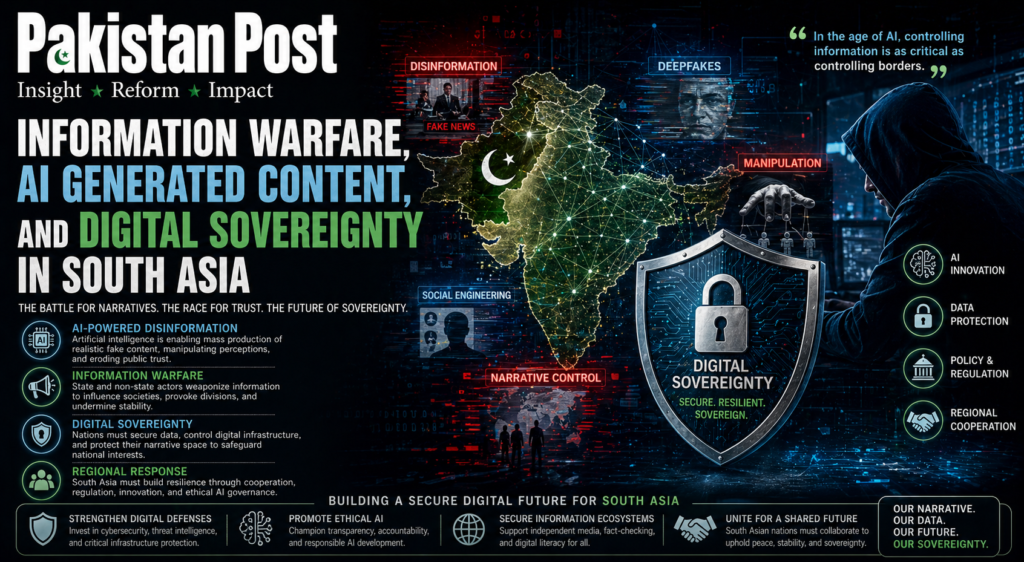
The architecture of conflict in South Asia is undergoing a quiet but profound transformation. Traditional domains of military deterrence and diplomatic signaling are now increasingly intersecting with a parallel battlefield defined by information flows, algorithmic amplification, and artificial intelligence generated content. In this emerging environment, power is not only exercised through territorial control or kinetic capability but also through narrative dominance, data manipulation, and the strategic shaping of perception. Information warfare has evolved from a supplementary instrument of statecraft into a central domain of geopolitical competition.
The rise of artificial intelligence has accelerated this transformation by lowering the cost, increasing the scale, and enhancing the sophistication of content generation. Deepfakes, synthetic audio, automated text production, and algorithmically optimized social media campaigns have created an ecosystem where distinguishing between authentic and manufactured information is increasingly difficult for both institutions and citizens. In such an environment, truth becomes contestable not through evidence alone but through volume, velocity, and virality.
South Asia, with its high population density, intense geopolitical rivalries, and deeply polarized media ecosystems, represents one of the most vulnerable regions to this new information order. Pakistan’s strategic environment is particularly exposed due to its long standing geopolitical tensions, active information competition in regional narratives, and rapidly expanding digital media consumption. The shift from traditional media gatekeeping to decentralized digital platforms has weakened institutional filters, allowing both organic and orchestrated misinformation to circulate with unprecedented speed.
At the core of this transformation is the increasing role of platform mediated communication. Social media ecosystems now function as de facto public spheres, where political discourse, diplomatic signaling, and public sentiment are continuously shaped by algorithmic recommendation systems. These systems are optimized for engagement rather than accuracy, which creates structural incentives for sensationalism, polarization, and emotionally charged content. In conflict prone environments, such incentives can amplify instability by rewarding narratives that escalate rather than deescalate tensions.
Artificial intelligence further intensifies these dynamics by enabling scalable content production. What previously required coordinated human networks can now be achieved through automated systems capable of generating thousands of posts, images, or videos within minutes. This reduces the cost of influence operations and increases the difficulty of attribution. The boundary between state sponsored information campaigns, politically motivated actors, and independent digital influencers becomes increasingly blurred.
Pakistan’s institutional preparedness for this new information environment remains uneven. While cybersecurity capacity has improved in certain sectors, particularly within banking and critical infrastructure, broader information integrity frameworks remain underdeveloped. Coordination between media regulatory bodies, cybersecurity agencies, and strategic communication institutions is still fragmented. This limits the state’s ability to respond coherently to large scale disinformation campaigns or AI generated narrative manipulation.
The implications of this shift extend beyond national security into the domain of electoral stability and democratic legitimacy. Elections are increasingly influenced not only by traditional campaigning but by digital narrative ecosystems that operate continuously and often invisibly. AI generated content can be deployed to amplify polarization, distort public perception of candidates, or fabricate events that shape voter sentiment. The speed of dissemination often outpaces the capacity of verification, creating informational asymmetry between those who produce content and those who attempt to verify it.
Civil military discourse in Pakistan is also affected by this evolving information environment. Historically sensitive narratives are now continuously negotiated in digital spaces where misinformation and strategic framing can rapidly escalate into broader public debates. The lack of coordinated digital communication strategies across institutions creates vulnerabilities that can be exploited by both domestic and external actors seeking to influence public perception.
Regionally, India Pakistan information dynamics remain a central axis of digital contestation. Both states operate within highly reactive media ecosystems where narrative escalation can occur rapidly through social media amplification. In such contexts, AI generated content introduces a new layer of complexity by enabling plausible but synthetic narratives that can be used to influence public sentiment or diplomatic signaling without direct attribution. This increases the risk of misinterpretation, escalation, and strategic miscalculation.
Globally, these developments are part of a broader shift toward what analysts describe as cognitive warfare, where the objective is not only to influence behavior but to shape perception itself. In this framework, data flows, algorithmic systems, and information architectures become strategic assets comparable to traditional military capabilities. States that lack control over their digital information ecosystems risk becoming dependent on external platforms for narrative infrastructure, which raises questions of sovereignty in the digital domain.
The concept of digital sovereignty is therefore becoming increasingly central to contemporary statecraft. Digital sovereignty does not imply isolation from global information networks but rather the capacity to regulate, secure, and influence domestic information ecosystems in alignment with national priorities. It encompasses control over data infrastructure, regulatory authority over platform operations, and the ability to protect information integrity against external manipulation.
Pakistan’s digital sovereignty remains constrained by structural dependencies on global technology platforms, external cloud infrastructure, and transnational social media ecosystems. While these platforms provide connectivity and communication capabilities, they also mediate information flows in ways that are not fully governed by domestic regulatory frameworks. This creates a partial sovereignty condition where the state exercises jurisdiction over content within its territory but has limited control over the infrastructure that shapes its dissemination.
The emergence of AI generated content further complicates regulatory responses. Traditional media regulation frameworks are not designed to address synthetic media at scale. Deepfake detection, algorithmic transparency, and content provenance verification require technical capacities that are still developing within regulatory institutions. Without these capabilities, regulatory responses risk becoming reactive rather than preventive.
One of the most significant risks in this environment is the erosion of epistemic trust. When citizens are unable to reliably distinguish between authentic and synthetic information, trust in media institutions, political processes, and even state communication channels begins to degrade. This creates conditions of informational uncertainty where competing narratives coexist without authoritative resolution. In such environments, public discourse becomes increasingly fragmented and polarized.
The economic dimension of information warfare is also significant. Disinformation campaigns can influence investor confidence, disrupt market stability, and affect currency perception in emerging economies. In Pakistan’s case, where economic stability is closely linked to external financial flows and investor sentiment, information volatility can have macroeconomic consequences beyond the digital sphere.
Addressing these challenges requires a multi layered policy response that integrates technological capacity building, institutional coordination, and regulatory modernization. First, Pakistan must invest in national level capabilities for AI driven content detection and verification. This includes developing indigenous tools for deepfake identification, metadata tracing, and automated misinformation analysis.
Second, institutional coordination must be strengthened across cybersecurity agencies, media regulators, and strategic communication bodies. Fragmentation of responsibility reduces response speed and weakens overall effectiveness. A unified national framework for information integrity would allow for more coherent policy implementation and crisis response.
Third, platform accountability mechanisms must be enhanced. Social media companies operating in Pakistan should be required to comply with transparency standards regarding algorithmic amplification, content moderation practices, and data access for regulatory audit purposes. Without such transparency, regulatory oversight remains incomplete.
Fourth, digital literacy must be treated as a core component of national resilience. Citizens must be equipped to critically evaluate digital content, recognize synthetic media, and understand the dynamics of algorithmic amplification. This requires integration of media literacy into educational curricula as well as public awareness campaigns.
Fifth, regional dialogue mechanisms on information security should be explored. Given the transnational nature of digital platforms, unilateral responses are insufficient. Cooperative frameworks on misinformation mitigation, crisis communication, and cyber stability could reduce the risk of escalation in South Asia’s already fragile security environment.
Finally, Pakistan must approach digital sovereignty not as a defensive concept but as a strategic objective. This involves building domestic capacity in data infrastructure, strengthening regulatory autonomy, and ensuring that national information ecosystems are not fully dependent on external platform governance structures.
The trajectory of information warfare suggests that future conflicts will be increasingly shaped by perception management as much as by traditional military capabilities. In this environment, states that fail to secure their informational ecosystems risk strategic vulnerability even in the absence of kinetic confrontation.
For Pakistan, the challenge is not only to defend against disinformation but to construct a resilient information architecture capable of sustaining democratic legitimacy, economic stability, and regional strategic balance. Artificial intelligence has not created this challenge, but it has significantly intensified it. The response must therefore be equally sophisticated, integrating technology, governance, and strategic communication into a coherent national framework for digital resilience and sovereignty.
A Public Service Message