Fintech Expansion, Mobile Banking, and the Political Economy of Financial Inclusion in Pakistan

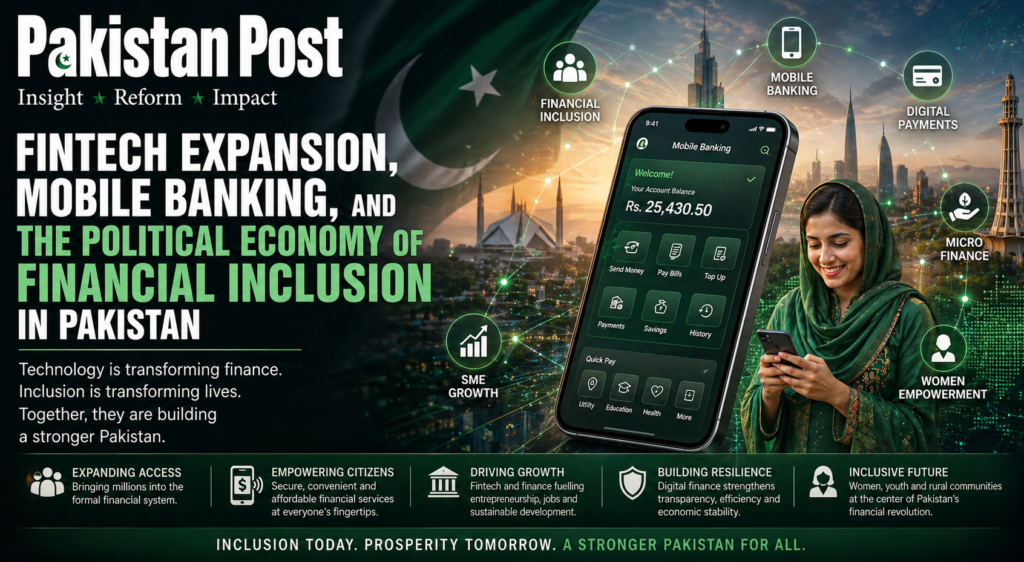
The rapid expansion of fintech ecosystems in Pakistan has emerged as one of the most visible yet uneven transformations in the country’s contemporary political economy. Mobile wallets, branchless banking networks, digital payment platforms, and instant transfer systems have redefined the mechanics of money circulation, particularly in a context where traditional banking penetration has historically remained limited. This shift is not merely technological. It represents a deeper restructuring of financial inclusion, state oversight, and market participation in an economy long characterized by informality, cash dependence, and segmented access to formal credit systems.
At the centre of this transformation lies a paradox. On one hand, digital finance is expanding access to financial services for populations previously excluded from formal banking structures. On the other hand, the architecture of this inclusion is increasingly mediated by private platforms, algorithmic credit systems, and data-driven risk profiling that may reproduce new forms of exclusion even as they eliminate older ones. The question, therefore, is not whether fintech is expanding in Pakistan, but how its expansion is redistributing economic opportunity, financial power, and informational control.
Pakistan’s fintech landscape has grown rapidly over the past decade, driven by mobile penetration, regulatory liberalization, and state-backed digitization initiatives. The emergence of mobile money platforms, digital wallets, and agent banking networks has significantly reduced transaction costs for millions of users. Services such as instant peer-to-peer transfers, utility bill payments, and digital merchant payments have become increasingly embedded in everyday economic activity. This shift has been particularly pronounced in urban and semi-urban areas, where digital infrastructure and literacy levels are relatively higher.
A key institutional actor in this transformation is the State Bank of Pakistan. Through regulatory frameworks supporting branchless banking, digital onboarding, and electronic money institutions, the central bank has actively facilitated the expansion of digital financial services. State Bank of Pakistan has pursued a policy balance between innovation and financial stability, attempting to encourage fintech growth while maintaining oversight over systemic risk, anti-money laundering compliance, and consumer protection.
However, regulatory expansion has not fully resolved the structural asymmetries embedded in the fintech ecosystem. The growth of digital finance in Pakistan is heavily concentrated in a small number of dominant platforms and banking partners, creating a quasi-oligopolistic structure in certain segments of the market. This concentration raises concerns about competition, pricing power, and data ownership. As financial transactions increasingly shift to digital platforms, the control over transactional data becomes a form of economic power, enabling firms to develop proprietary credit scoring systems and behavioral analytics that are not fully transparent to regulators or users.
The promise of financial inclusion is often framed in terms of access. Yet access alone does not capture the complexity of inclusion in digital financial systems. Inclusion in fintech ecosystems is conditional, data dependent, and algorithmically mediated. Individuals are not only users of financial services but also data producers whose transactional histories determine their eligibility for credit, insurance, and other financial products. This shift from collateral based lending to data driven lending has expanded credit availability for some segments while simultaneously excluding those without sufficient digital footprints.
In Pakistan’s informal economy, where a significant portion of employment is unregistered and cash based, this creates a structural challenge. Informal workers may transact heavily in economic terms but remain invisible to digital credit scoring systems. As a result, financial inclusion risks becoming a function of digital visibility rather than economic activity. Those who are already integrated into formal or semi formal systems gain disproportionate access to fintech services, while those outside these systems remain excluded despite being economically active.
The rise of mobile wallets and branchless banking networks has also altered the geography of financial access. Rural areas, long underserved by traditional bank branches, have benefited from agent based banking models that reduce the need for physical infrastructure. These systems rely on local intermediaries who facilitate deposits, withdrawals, and transfers. While this model has improved reach, it also introduces dependency on agent liquidity, network connectivity, and operational reliability. In areas with weak infrastructure, service interruptions can reinforce distrust in digital systems and slow adoption rates.
Another critical dimension of fintech expansion is the increasing role of digital credit. Short term, instant loan products offered through mobile applications have become a significant entry point for first time borrowers. These products are often marketed as frictionless financial solutions, requiring minimal documentation and offering rapid disbursement. However, the pricing structures of such loans, combined with opaque credit scoring algorithms, raise concerns about predatory lending practices and over indebtedness among low income users.
In global fintech literature, this phenomenon is often associated with platform based financialization, where financial services are embedded into digital ecosystems controlled by technology firms rather than traditional banks. In Pakistan, this trend is still in its early stages but is already visible in the integration of payment systems into e commerce platforms, ride hailing services, and utility payment applications. The result is an ecosystem in which financial transactions are increasingly intermediated by non banking platforms, blurring the boundaries between commerce, data extraction, and credit provision.
The geopolitical dimension of fintech is also becoming more pronounced. Cross border payment systems, remittance flows, and digital currency experiments are increasingly shaped by global financial infrastructure competition. Pakistan, as a remittance dependent economy, is particularly sensitive to shifts in international payment systems. The digitization of remittances has reduced transfer costs and improved speed, but it has also increased reliance on global payment intermediaries and correspondent banking networks that are subject to external regulatory and geopolitical pressures.
At the macroeconomic level, fintech expansion has implications for monetary policy transmission, tax compliance, and financial stability. Digital payments increase transaction traceability, which can expand the tax base and improve fiscal capacity. However, rapid credit expansion through fintech channels can also introduce systemic risks if not adequately regulated. The challenge for policymakers is to balance innovation with macroprudential oversight in a financial ecosystem that is evolving faster than traditional regulatory frameworks.
Within this context, the role of the central bank becomes increasingly complex. State Bank of Pakistan must simultaneously encourage financial innovation, regulate emerging digital credit markets, ensure consumer protection, and maintain monetary stability. This multi layered mandate requires new regulatory tools, including real time data monitoring, fintech sandbox environments, and enhanced coordination with telecommunications regulators and cybersecurity institutions.
Despite these challenges, the potential gains from fintech expansion remain significant. Digital financial systems can reduce transaction costs, improve savings mobilization, and enhance economic participation among previously excluded populations. They can also improve efficiency in government transfer programs, reduce leakage in subsidy systems, and strengthen fiscal transparency. However, these gains are contingent on institutional design rather than technological diffusion alone.
One of the most pressing risks is the emergence of digital inequality. This form of inequality is not defined solely by income but by differential access to data infrastructure, digital literacy, and algorithmic visibility. Individuals who are integrated into digital ecosystems benefit from lower transaction costs and greater access to credit, while those outside these ecosystems face increasing marginalization. This creates a dual financial system, one formal and algorithmically mediated, the other informal and cash based, with limited interaction between the two.
Another concern is data governance. Fintech systems generate vast amounts of behavioral and financial data, yet the ownership, storage, and monetization of this data remain concentrated in a small number of institutions. Without robust data protection frameworks, users have limited control over how their financial data is used for credit scoring, marketing, or third party analytics. This raises questions about informational asymmetry and digital rights in financial systems.
Policy responses must therefore move beyond expansionist narratives of financial inclusion toward a more nuanced framework of inclusive financial governance. First, regulatory frameworks should establish clear rules for data ownership, usage rights, and consent mechanisms in fintech ecosystems. Users should have the right to access, correct, and port their financial data across platforms.
Second, digital credit markets require stronger oversight. This includes transparency requirements for algorithmic credit scoring, disclosure of effective interest rates, and limits on predatory lending practices. Regulatory sandboxes should be expanded to test new products under controlled conditions before large scale deployment.
Third, interoperability across payment platforms should be strengthened to prevent market fragmentation and reduce monopolistic tendencies. A unified digital payment architecture would allow users to transfer funds across platforms without friction, enhancing competition and reducing switching costs.
Fourth, financial literacy programs must be integrated into national education and community outreach initiatives. Digital financial inclusion is sustainable only when users understand the risks, obligations, and mechanisms of digital credit and payment systems.
Fifth, rural fintech infrastructure requires targeted investment. This includes improving network connectivity, strengthening agent liquidity systems, and developing offline capable financial tools for areas with intermittent digital access. Without such interventions, geographic inequality in financial access will persist.
Finally, institutional coordination between monetary authorities, telecommunications regulators, and cybersecurity agencies must be deepened. Fintech is not solely a financial sector phenomenon but a cross sectoral infrastructure that spans data, communication, and commerce systems.
The future of fintech in Pakistan will be shaped less by technological availability and more by institutional choices. If left entirely to market dynamics, digital finance may reproduce existing inequalities under a new technological guise. If guided through coherent regulation, inclusive infrastructure investment, and strong data governance, it has the potential to significantly broaden economic participation.
The central challenge is to ensure that financial inclusion does not become merely digital inclusion. True inclusion requires not only access to platforms but equitable participation in the value created by financial data, credit systems, and digital markets. In this sense, fintech is not simply a tool for modernization. It is a site of political economy where questions of power, access, and governance are being actively redefined.
A Public Service Message