
PAKISTAN’S MEDIA ECOSYSTEM AND DECLINING TRUST: FROM LEGACY JOURNALISM TO ADVOCACY AND ANALYSIS

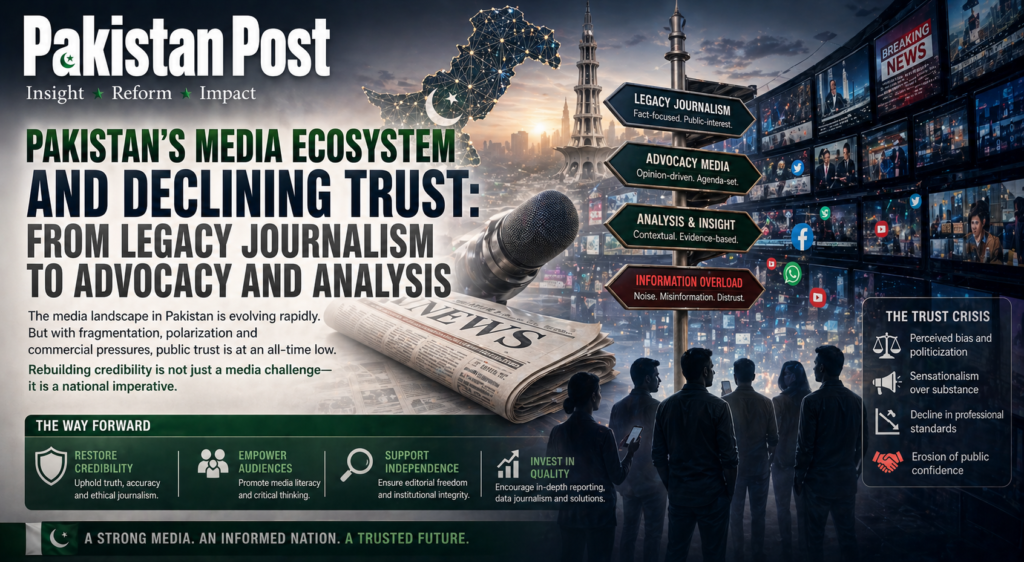
Pakistan’s media landscape is undergoing a structural transformation that is neither linear nor stable, but increasingly fragmented, contested, and shaped by forces that extend far beyond the newsroom. What was once a relatively centralized ecosystem dominated by print newspapers and state-regulated broadcast channels has evolved into a decentralized, algorithmically mediated information environment in which authority is dispersed, attention is monetized, and credibility is continuously negotiated in real time. In this shifting terrain, journalism in Pakistan appears to be moving along an uncertain continuum between two competing identities, one rooted in analytical reporting and public-interest investigation, the other increasingly shaped by advocacy, alignment, and narrative positioning.
This transformation cannot be understood without situating it within three overlapping pressures: political polarization, digital platform disruption, and a steady erosion of public trust in legacy media institutions. Each of these forces reinforces the others, creating a feedback loop that is reshaping not only how news is produced and consumed, but also how truth itself is socially constructed and contested.
Political polarization in Pakistan is not new, but its intensity and media expression have changed fundamentally in the digital era. Where once editorial lines were influenced by institutional affiliations, ownership structures, or state oversight, today they are increasingly shaped by audience segmentation and online engagement metrics. News organizations operate in an environment where neutrality is often perceived not as credibility but as ambiguity, and where taking a stance can generate more visibility than balanced reporting. In such conditions, journalism risks becoming a reflection of polarized public sentiment rather than a mediator of it.
This shift is amplified by the economic fragility of the traditional media industry. Advertising revenues, once the backbone of print and television journalism, have been steadily eroded by digital platforms that capture both audience attention and advertising spend. As revenue models weaken, editorial independence becomes more vulnerable to external pressures, including political influence, corporate ownership interests, and the pursuit of viral content. The newsroom, once a relatively insulated space for editorial judgment, is increasingly exposed to market logics that prioritize speed, engagement, and emotional resonance over verification, depth, and context.
Digital disruption has accelerated these dynamics by fundamentally altering the architecture of information dissemination. Social media platforms have become primary gateways to news consumption for a large segment of Pakistan’s population, particularly younger demographics. In this ecosystem, algorithmic curation replaces editorial selection. Visibility is determined less by journalistic significance and more by engagement signals such as shares, likes, comments, and watch time. This creates structural incentives that reward sensationalism, emotional framing, and polarizing narratives, while marginalizing slower forms of investigative or explanatory journalism.
At the same time, the rise of mobile-first consumption has compressed the attention span of news audiences. Complex socio-political issues are increasingly consumed in fragmented formats, often stripped of context and reduced to headline-level interpretation. This compression of meaning has profound implications for public understanding of governance, policy, and institutional accountability. When news is consumed as fragments rather than narratives, the capacity for sustained civic reasoning diminishes, and the space for informed democratic deliberation narrows.
Within this evolving ecosystem, trust in legacy journalism has experienced a measurable decline. Surveys and audience behavior patterns suggest that traditional news outlets are increasingly viewed through lenses of skepticism, with perceptions of bias, political alignment, or commercial influence shaping audience engagement. This erosion of trust is not uniform, but it is significant enough to alter the authority hierarchy of information. Journalists and news organizations no longer occupy an uncontested position as primary arbiters of truth. Instead, they compete with influencers, commentators, and algorithmically amplified voices that often operate outside established editorial standards.
This reconfiguration raises a central question about the identity of journalism itself in Pakistan’s contemporary media environment. Is journalism still primarily a discipline grounded in verification, balance, and contextual analysis, or is it gradually transforming into a form of structured advocacy, where narratives are constructed to align with ideological positions, audience expectations, or institutional pressures?
The evidence suggests that both trajectories are unfolding simultaneously, often within the same media organizations. On one hand, investigative journalism continues to exist, producing important work on corruption, governance failures, and social inequities. On the other hand, opinion-driven programming, talk shows, and digital commentary increasingly dominate visibility and influence. The boundary between reporting and interpretation has become increasingly porous, and in some cases, deliberately blurred.
This blending of analysis and advocacy is not unique to Pakistan, but its consequences are particularly pronounced in environments where political polarization is high and institutional trust is weak. In such contexts, journalism risks being interpreted not as an independent source of information, but as an extension of political identity. Audiences do not simply consume news; they decode it through pre-existing ideological frameworks, reinforcing their own beliefs rather than challenging them.
The implications for democratic governance are significant. A functioning democracy depends on a shared informational foundation, a baseline of facts and interpretations that enable collective decision-making. When media ecosystems fragment into competing narrative silos, this shared foundation erodes. Policy debates become polarized not only in substance but in perception, making consensus more difficult and institutional accountability more contested.
At the same time, it would be reductive to frame the transformation of Pakistan’s media solely in terms of decline or dysfunction. The digital shift has also enabled forms of democratization that were previously impossible. Citizen journalism, independent digital platforms, and regional content creators have expanded the diversity of voices in the public sphere. Marginalized communities, once excluded from mainstream media representation, now have the capacity to produce and distribute their own narratives. In this sense, the media ecosystem is not simply contracting around traditional institutions, but expanding into a more plural, if more chaotic, informational space.
However, this democratization comes with its own set of challenges. The lowering of barriers to entry has also lowered barriers to misinformation. The speed at which content circulates often exceeds the capacity for verification. In the absence of strong editorial gatekeeping, false or misleading narratives can achieve widespread reach before correction mechanisms activate. This creates an environment in which truth competes on unequal terms with virality.
Within legacy media institutions, adaptation strategies vary. Some organizations are investing in digital transformation, data journalism, and multimedia storytelling in an attempt to remain relevant. Others are leaning more heavily into opinion-based content, recognizing that in an attention-driven economy, interpretation often travels further than reporting. This strategic divergence reflects a broader uncertainty about the future role of journalism in Pakistan: whether it should double down on its traditional function as a fact-based watchdog, or evolve into a hybrid model that blends reporting with commentary to maintain audience engagement.
Regulatory pressures further complicate this landscape. Media regulation in Pakistan has often oscillated between liberalization and control, creating an environment of uncertainty for journalists and media owners alike. This uncertainty can encourage self-censorship, particularly in politically sensitive domains, while also reinforcing the perception among audiences that media content is shaped by external constraints rather than independent editorial judgment. The result is a double erosion of trust, from both perceived political bias and perceived lack of autonomy.
The question of whether journalism is transitioning into advocacy or analysis may ultimately be the wrong binary. In practice, journalism in Pakistan is increasingly characterized by hybridity. Reporting, analysis, commentary, and advocacy coexist within the same platforms, sometimes even within the same content formats. The distinction between informing and persuading has become less stable, shaped as much by platform incentives and audience expectations as by professional norms.
What emerges from this transformation is not the disappearance of journalism, but its reconfiguration. Journalism is no longer a singular institution with clearly defined boundaries, but a contested field in which multiple actors compete to define reality. Legacy media organizations remain important, but they no longer monopolize authority. Digital platforms amplify new voices, but they also fragment attention and intensify polarization. Audiences are more connected than ever, but also more divided in their interpretations of shared events. In this environment, the future of journalism in Pakistan will likely depend on its ability to rebuild credibility not through exclusivity of access or institutional legacy, but through demonstrable transparency, methodological rigor, and sustained public engagement. Whether this recalibration is possible within current economic and political constraints remains an open question. What is clear, however, is that the old model of journalism as a centralized gatekeeper of truth has already been replaced. What comes next is still being negotiated, in real time, across platforms, institutions, and audiences that are no longer aligned in their understanding of what journalism is, or what it should be.
A Public Service Message