Nuclear Deterrence Faces Instability in an Accelerating Fragmented Global Security Order

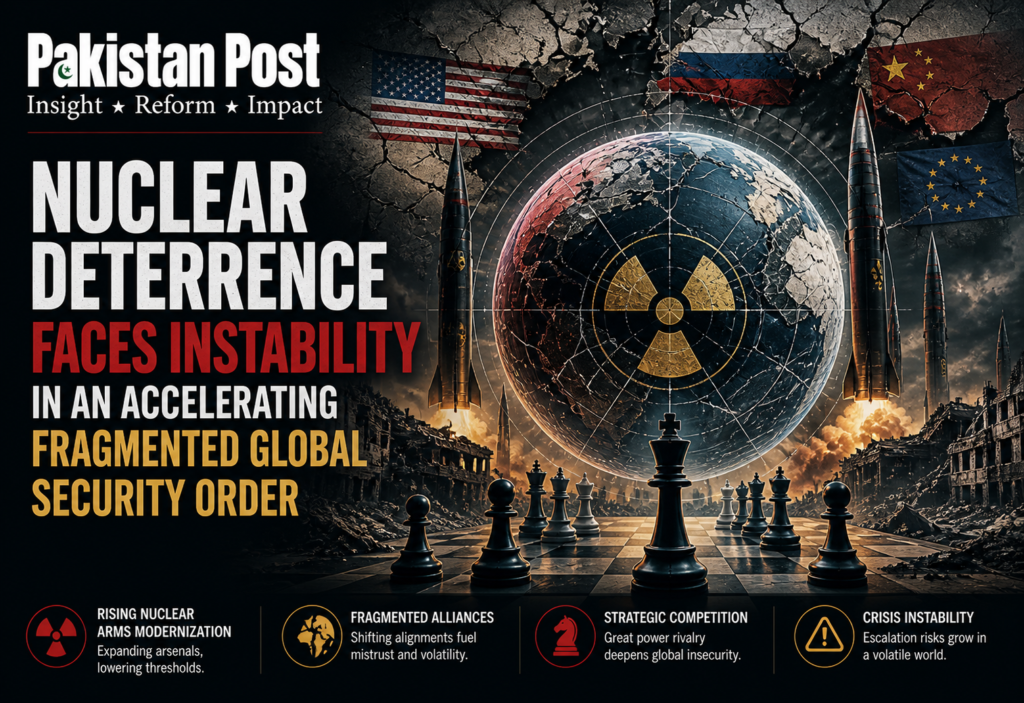
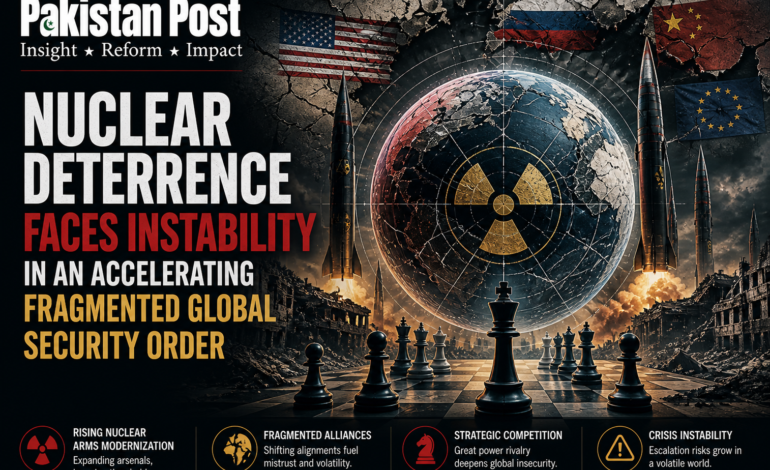
The architecture of nuclear deterrence was designed for a world that moved more slowly than the one that now exists. Its logic rested on time, clarity and a shared understanding of thresholds. Decisions could be weighed, signals interpreted and crises managed within a framework that, while perilous, was at least broadly comprehensible to its principal actors. That framework is eroding. The contemporary strategic environment is marked by speed, opacity and technological convergence, producing a condition in which deterrence persists but stability becomes increasingly contingent. The nuclear order has not collapsed, yet it no longer rests on the same foundations that sustained it through earlier decades of rivalry.
The disintegration of arms control regimes is both a symptom and a cause of this transformation. Agreements that once imposed limits, created transparency and fostered habits of communication have weakened or disappeared. Verification mechanisms have eroded, compliance has become contested and the political will to negotiate new constraints has diminished. In their place has emerged a more fragmented landscape in which states pursue capabilities with fewer shared rules. The absence of agreed frameworks does not eliminate restraint entirely, but it does make restraint more dependent on unilateral calculation and less on mutual assurance.
Technological change amplifies these trends. Advances in artificial intelligence, cyber capabilities and delivery systems are altering the parameters of deterrence in ways that are not yet fully understood. Hypersonic weapons compress decision timelines, reducing the window in which leaders can assess information and respond. AI enabled systems promise greater precision and speed, but they also introduce new vulnerabilities, particularly if algorithms are opaque or susceptible to manipulation. Cyber operations can target command and control systems, creating uncertainty about the reliability of communication and the integrity of information. Each of these developments complicates the calculus of deterrence, making it more difficult to predict how an adversary might act under pressure.
The classical doctrine of mutually assured destruction relied on a grim clarity. Both sides understood that a nuclear exchange would be catastrophic and that neither could escape unacceptable damage. This shared understanding created a form of stability, albeit one rooted in fear. Today, that clarity is being clouded. New technologies create the perception, if not the reality, of limited options. The idea that precision strikes or missile defences might mitigate the consequences of conflict introduces ambiguity into the equation. Even if such perceptions are misplaced, they can influence decision making, encouraging risk taking in situations that might previously have been approached with greater caution.
The integration of nuclear and non nuclear domains further blurs boundaries. Conventional conflicts now unfold alongside cyber operations, information campaigns and economic coercion. Actions in one domain can have unintended consequences in another. A cyber attack on early warning systems, for example, might be interpreted as a precursor to a broader strike, prompting escalation. The challenge lies not only in managing individual capabilities but in understanding how they interact. Deterrence becomes multidimensional, and stability depends on the management of complex interdependencies.
In South Asia, these global trends intersect with a regional context that has long been characterised by tension and periodic crisis. The relationship between India and Pakistan is marked by unresolved disputes, historical grievances and episodes of confrontation. Both countries possess nuclear capabilities, and both have developed doctrines that seek to deter aggression while preserving flexibility. The balance that has emerged is often described as stable, but it is a stability that has been tested repeatedly and that relies on assumptions that may be under strain.
One such assumption is the ability to control escalation. Past crises have demonstrated that both sides can mobilise forces and engage in limited actions without triggering a full scale war. This has led to a degree of confidence in crisis management, sometimes described as risk habituation. The danger is that familiarity with crisis does not necessarily equate to control. As the strategic environment becomes more complex, the margin for error may shrink. Misperception, miscalculation or technical failure could have more severe consequences in a system where warning times are shorter and signals are less clear.
Doctrinal ambiguity adds another layer of uncertainty. Both India and Pakistan have articulated positions on the use of nuclear weapons, but these positions are not static. They evolve in response to perceived threats, technological developments and political considerations. Changes in posture, whether explicit or implicit, can alter expectations and influence behaviour. In an environment where communication is imperfect, such changes may be misinterpreted, increasing the risk of escalation.
The role of external powers further complicates the picture. The strategic competition between major powers influences regional dynamics, shaping alliances, perceptions and capabilities. India’s growing partnerships with Western countries, particularly in the context of the Indo Pacific, have implications for Pakistan’s strategic calculus. China’s relationship with Pakistan, encompassing economic and security dimensions, adds another layer. These interactions do not determine outcomes, but they create a context in which regional actors make decisions.
Media narratives are integral to this context. They shape public perception, influence political discourse and can even affect the behaviour of decision makers. Nuclear issues are often framed in ways that oscillate between alarmism and complacency. On one hand, there are narratives that emphasise the catastrophic potential of nuclear conflict, highlighting the humanitarian and environmental consequences. On the other, there are depictions of nuclear deterrence as a stable equilibrium, a background condition that can be managed and even taken for granted. Both framings have limitations. Alarmism can desensitise audiences if it is not accompanied by credible pathways for action. Complacency can obscure the risks that arise from changing conditions.
In Pakistan, as in other nuclear armed states, the articulation of nuclear doctrine is both a strategic and a communicative act. It signals intent to adversaries, reassures domestic audiences and positions the country within the broader international system. The concept of minimum credible deterrence has been central to Pakistan’s approach, emphasising the maintenance of a capability sufficient to deter aggression without engaging in an open ended arms race. The challenge is to adapt this concept to a changing environment. What constitutes credibility in a world of new technologies and shifting doctrines is not a static question.
Adaptation may involve adjustments in force structure, investment in new capabilities or changes in command and control arrangements. It also involves engagement in international discussions on norms and risk reduction. Even in the absence of formal arms control agreements, there are opportunities for dialogue on issues such as crisis communication, transparency measures and the management of emerging technologies. Such engagement does not eliminate rivalry, but it can contribute to stability by reducing uncertainty.
Economic factors intersect with these strategic considerations. The costs of maintaining and modernising nuclear arsenals are significant. They compete with other priorities, particularly in countries with development challenges. At the same time, economic interdependence can create incentives for restraint. The disruption that would accompany a major conflict would have profound economic consequences, both domestically and globally. These considerations do not override security concerns, but they form part of the broader calculus.
There is also a generational dimension. The policymakers and strategists who shaped the original frameworks of deterrence are being replaced by new cohorts who have grown up in a different environment. Their experiences, assumptions and approaches may differ. The institutional memory of past crises remains, but it is filtered through changing contexts. Ensuring that lessons are retained and adapted is an ongoing task.
The environmental consequences of nuclear conflict are increasingly part of the discourse. Studies on nuclear winter, radiation effects and long term ecological damage have underscored the global stakes. These considerations have been invoked in arguments for disarmament and risk reduction. While progress on these fronts has been limited, the underlying concerns remain relevant. They highlight the fact that nuclear issues cannot be confined to the domain of high politics. They have implications for humanity as a whole.
The fragmentation of the global order complicates efforts to address these challenges collectively. Without strong institutions and shared norms, coordination becomes more difficult. Trust is in short supply, and suspicion can hinder cooperation. Yet the risks associated with nuclear instability are such that some level of engagement is necessary. Informal dialogues, track two processes and regional initiatives can play a role in bridging gaps, even if they do not produce formal agreements.
For Pakistan, navigating this environment requires a combination of prudence and initiative. Prudence in maintaining a credible deterrent and avoiding actions that could trigger unintended escalation. Initiative in engaging with regional and international partners to promote stability and to shape the evolving norms of nuclear conduct. This includes investing in communication channels, participating in discussions on emerging technologies and articulating clear positions on key issues.
The future of nuclear deterrence will not be a simple continuation of the past. It will be shaped by technological innovation, geopolitical shifts and the choices of individual states. Stability, if it is to be maintained, will require adaptation. It will require recognising that the conditions under which deterrence was originally conceived have changed and that new approaches may be needed to address new realities.
In an accelerating and fragmented global security order, the margin for error is narrowing. The systems that underpin deterrence are more complex, the interactions between domains more intricate and the pace of events more rapid. The challenge is to manage this complexity without losing sight of the fundamental objective, the prevention of nuclear conflict. For Pakistan, as for others, this involves balancing national security imperatives with a broader responsibility to contribute to a stable and secure international environment.
A Public Service Message