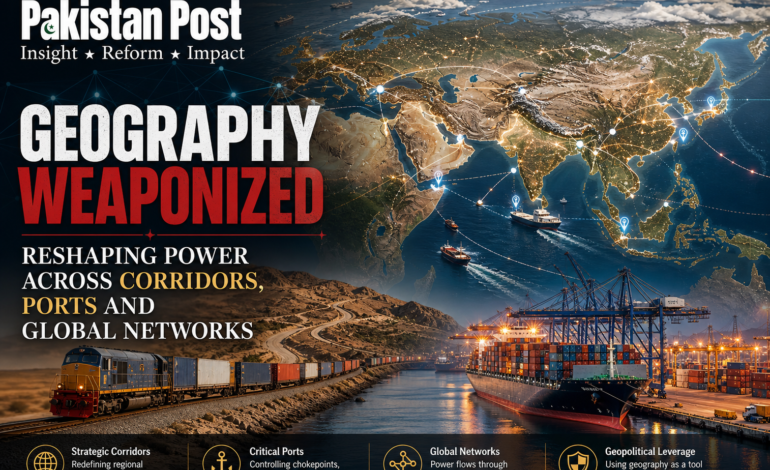
Geography Weaponized Reshaping Power Across Corridors Ports and Global Networks

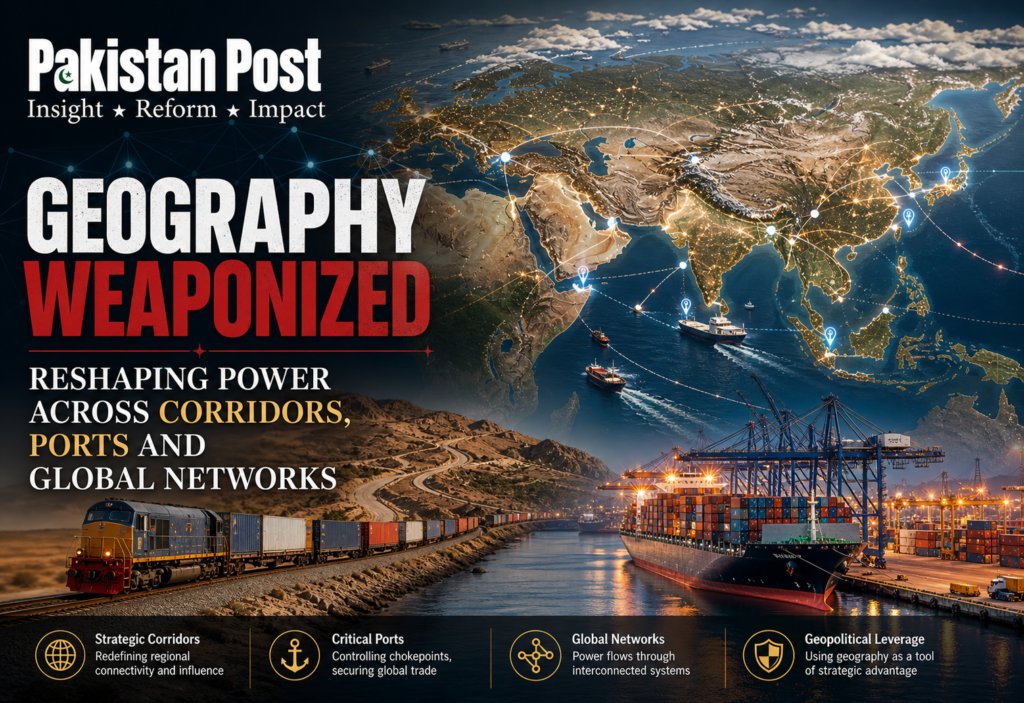
Geography has never been neutral, yet for much of the late twentieth and early twenty first century it was treated as though it were. Maps were read as static backdrops to the dynamic play of markets, technologies and institutions. Infrastructure was celebrated as connective tissue, dissolving distance and integrating regions into a single, increasingly seamless global economy. That vision has not disappeared, but it is being overtaken by a harsher recognition. Geography is once again an active instrument of power, and infrastructure has become a contested medium through which states project influence, impose costs and shape the strategic environment without crossing the threshold of open war.
The contemporary phase of hybrid warfare is defined less by dramatic confrontation and more by calibrated interference. It operates in the space between peace and war, exploiting ambiguity, deniability and the interconnectedness of modern systems. Ports, pipelines, railways and digital cables are no longer merely economic assets. They are leverage points. They can be disrupted, redirected or reinterpreted in ways that generate strategic advantage. The closure of a shipping lane, the sabotage of a pipeline, the delay of a corridor project or even the circulation of narratives that undermine confidence in infrastructure can have cascading effects across regions and sectors.
The events that have unfolded around key maritime chokepoints and transit routes in recent years illustrate this transformation with unusual clarity. The Strait of Hormuz, through which a significant proportion of global energy flows, has become a site of calibrated tension. Actions that stop short of full scale blockade nonetheless signal the possibility of disruption. The Red Sea, linking Asia to Europe through the Suez Canal, has witnessed attacks on shipping that force rerouting and recalibration. These are not isolated incidents. They are part of a broader pattern in which geography is weaponized not through occupation alone but through the manipulation of flows.
Hybrid warfare thrives on such manipulation. It does not seek decisive victory in the conventional sense. Instead, it aims to impose persistent costs, to erode confidence and to shape the choices of adversaries. Infrastructure is particularly suited to this purpose because it sits at the intersection of economic necessity and strategic vulnerability. A pipeline can be targeted physically or politically. A port can be rendered less attractive through security risks or reputational campaigns. A corridor can be delayed by regulatory pressure, local unrest or external lobbying. Each action may be limited in scope, but together they can alter the strategic landscape.
For Pakistan, this dynamic is embodied most prominently in the China Pakistan Economic Corridor. CPEC was conceived as a flagship of connectivity, linking China’s western regions to the Arabian Sea through a network of roads, railways and energy projects. It promised to transform Pakistan’s economic geography, to integrate remote areas into national and global markets and to position the country as a key node in transregional trade. Yet as the global environment has become more contested, CPEC has also become a focal point of strategic scrutiny.
The corridor is now interpreted through multiple lenses. For its proponents, it remains a developmental lifeline, a pathway to industrialisation, energy security and regional integration. For its critics, it raises concerns about debt sustainability, strategic dependency and the potential militarisation of infrastructure. International media narratives oscillate between these poles, sometimes emphasising opportunity, at other times highlighting risk. These narratives are not neutral. They shape investor perceptions, influence domestic debates and feed into broader geopolitical contestations.
The weaponization of geography is not limited to physical disruption. It extends into the realm of perception. Information campaigns, policy reports and media coverage can amplify or dampen the perceived viability of infrastructure projects. A corridor that is framed as insecure or politically contentious may struggle to attract investment, regardless of its underlying economic logic. Conversely, a project that is presented as stable and beneficial may draw support even in challenging environments. In this sense, the battle over geography is also a battle over narrative.
Competing transit regimes further complicate the picture. As vulnerabilities in traditional routes become more apparent, alternative pathways are explored and promoted. Pipelines that bypass chokepoints, overland corridors that reduce reliance on maritime routes, and new port developments all reflect an effort to diversify risk. These initiatives are not purely economic. They are strategic responses to a world in which access cannot be taken for granted. For Pakistan, the proliferation of alternatives poses both a challenge and an opportunity. It may dilute the centrality of any single corridor, but it also creates space for integration into a wider network of routes.
The interplay between geography and technology adds another layer of complexity. Digital infrastructure, from undersea cables to satellite networks, is increasingly intertwined with physical corridors. Disruptions in one domain can have effects in another. A cyber attack on a port’s management system can delay shipments. Interference with navigation systems can create uncertainty at sea. Surveillance technologies can enhance security but also raise concerns about control and sovereignty. Hybrid warfare operates across these domains, exploiting their interconnections.
State and non state actors both participate in this environment. States have the resources and capabilities to influence infrastructure at scale, whether through investment, regulation or coercion. Non state actors, however, can also play a significant role, particularly when they operate in areas where governance is weak or contested. Attacks on infrastructure, protests against projects and localised disruptions can all feed into broader strategic dynamics. The distinction between internal and external challenges becomes blurred, complicating responses.
For Pakistan, managing these complexities requires a multidimensional approach. Security measures are necessary but not sufficient. Protecting infrastructure from physical threats is essential, but it must be complemented by efforts to address underlying socio economic concerns, to ensure that projects are inclusive and to build local support. Diplomatic engagement is equally important. Communicating the benefits of connectivity, addressing concerns transparently and engaging with a range of stakeholders can help to shape perceptions.
Economic policy also plays a role. Ensuring that infrastructure projects are financially sustainable, that they generate tangible benefits and that they are integrated into broader development strategies can enhance resilience. Diversifying partnerships can reduce dependence and increase flexibility. At the same time, there is a need to recognise that infrastructure cannot be insulated from geopolitics. It will inevitably be interpreted through strategic lenses, and policy must account for that reality.
The global context reinforces the urgency of these considerations. As major powers compete for influence, infrastructure becomes a key arena. Initiatives that promise connectivity are often accompanied by strategic calculations. The Belt and Road is one example, but it is not the only one. Other powers are advancing their own visions, emphasising transparency, sustainability or strategic alignment. These competing frameworks create a crowded and contested space in which countries like Pakistan must navigate carefully.
Media narratives are central to this navigation. They do not simply reflect reality. They help to construct it. Coverage of CPEC, for instance, often frames it within broader debates about China’s role in the world. Stories about debt, sovereignty or strategic intent can influence how the corridor is perceived both domestically and internationally. For Pakistan, engaging with these narratives is a strategic task. It involves articulating a clear vision, providing credible information and responding to criticism in a way that builds trust.
There is also a temporal dimension to the weaponization of geography. Infrastructure projects unfold over years, sometimes decades. Hybrid warfare, by contrast, often operates in shorter cycles, exploiting moments of vulnerability. Delays in construction, changes in policy or shifts in the security environment can create windows of opportunity for disruption. Managing these temporal mismatches is part of the challenge. It requires planning for contingencies, building flexibility into projects and maintaining momentum even in the face of setbacks.
The concept of sovereignty is evolving in this context. Traditional notions emphasise control over territory. In a world of interconnected infrastructure, sovereignty also involves control over flows, data and systems. Hosting a corridor or a port brings benefits, but it also entails exposure. Decisions made by external partners can have domestic implications. Balancing openness with control is therefore a key policy question.
Environmental considerations add another layer. Infrastructure projects can have significant ecological impacts, which in turn can become sources of contention. Climate change, with its effects on sea levels, weather patterns and resource availability, interacts with these dynamics. Ports may face increased risks from extreme weather. Pipelines may be affected by changing conditions. Integrating environmental resilience into infrastructure planning is not only a matter of sustainability but also of security.
The financial dimension cannot be ignored. Funding large scale infrastructure requires capital, often from external sources. The terms of that funding, the associated conditions and the broader economic context all influence outcomes. Debt sustainability has become a focal point in discussions about connectivity projects. Ensuring that investments are viable and that they contribute to long term growth is essential for maintaining public support and strategic flexibility.
At a broader level, the weaponization of geography reflects a shift in how power is conceived and exercised. It is less about controlling territory in the traditional sense and more about shaping the flows that move through that territory. It is about influencing decisions, imposing costs and creating dependencies in ways that are often indirect. This form of power is more diffuse, more ambiguous and in some ways more difficult to counter.
For Pakistan, the path forward involves embracing the opportunities of connectivity while mitigating the risks of contestation. This requires a coherent strategy that integrates security, economic policy, diplomacy and communication. It also requires an awareness of the broader trends that are reshaping the global system. Geography, once taken for granted, is again at the centre of strategic thinking. How it is understood, managed and represented will have lasting implications.
The corridors, ports and networks that crisscross the region are not just lines on a map. They are the material expression of competing visions of order. They carry goods, energy and data, but they also carry meaning. They signal alignment, ambition and intent. In a world where geography is being weaponized, understanding and shaping that meaning is as important as building the infrastructure itself.
A Public Service Message