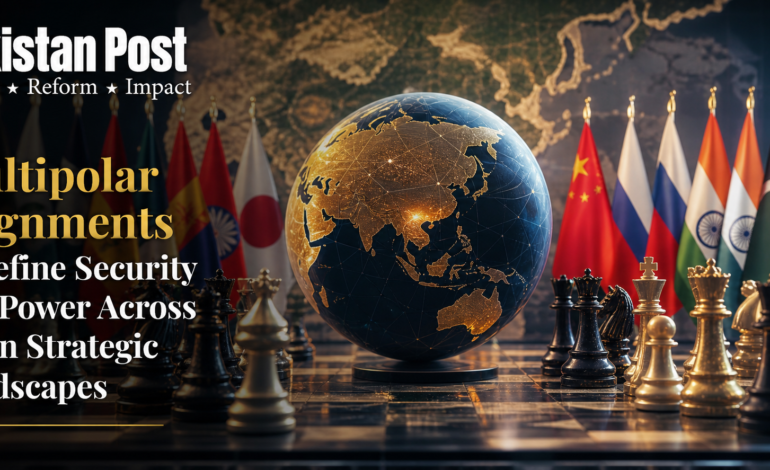
Multipolar Alignments Redefine Security and Power Across Asian Strategic Landscapes

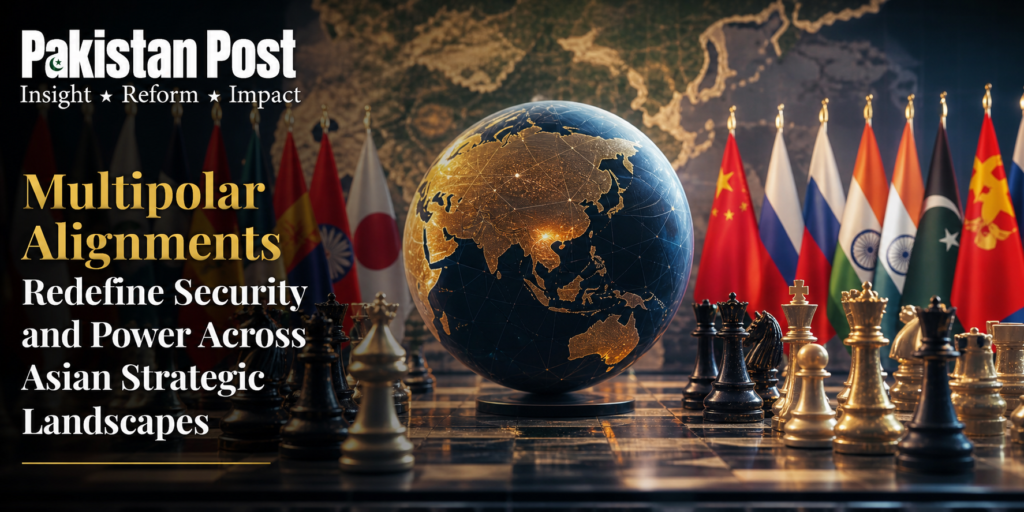
The vocabulary of global order is undergoing a quiet but profound mutation. Where once the language of international security was anchored in alliances, treaties and institutional predictability, it is now increasingly articulated through alignments that are fluid, interest driven and often deliberately ambiguous. Nowhere is this transformation more visible than in Asia, where the convergence of China, Russia and Iran is being read, contested and reframed across diplomatic cables, media narratives and policy circles as either the embryonic core of a counter hegemonic bloc or merely a situational compact born of overlapping grievances against Western power. The distinction matters, but perhaps less than the fact that such a distinction is becoming harder to sustain.
The events surrounding the ongoing crises in the Middle East and the recalibration of Western engagement have accelerated a trend that was already underway. The United States, while still formidable, is increasingly selective in its commitments, prioritising the Indo Pacific and burden sharing arrangements over direct entanglement in complex regional theatres. This recalibration has created perceptual vacuums as much as material ones. In those spaces, other actors are not simply stepping in to replace American influence. They are reshaping the grammar of engagement itself. The China Russia Iran convergence is emblematic of this shift, not because it constitutes a formal alliance, but because it operates effectively without one.
China brings economic weight, technological capacity and a long term vision of connectivity that is both developmental and strategic. Russia contributes military experience, diplomatic assertiveness and a willingness to challenge Western norms openly. Iran offers geostrategic depth, control over critical geography and a demonstrated capacity to operate under sustained sanctions. Together, they form not a bloc in the traditional sense but a triangulated resistance to a system perceived as asymmetrically structured. Their cooperation is often informal, sometimes opaque, and frequently issue specific. Yet it produces cumulative effects that are difficult to ignore.
Sanctions have been a binding force in this convergence. What began as a tool of Western coercion has, over time, encouraged alternative networks of trade, finance and energy exchange. Discounted oil flows, currency swaps, and parallel payment systems are not merely economic adaptations. They are infrastructural foundations of a different kind of order, one that seeks to reduce vulnerability to external pressure. In this sense, multipolarity is not just about the distribution of power. It is about the diversification of mechanisms through which power is exercised and resisted.
Security in this emerging landscape is no longer confined to military balances. It is diffused across domains that were once considered peripheral. Energy corridors become instruments of influence, digital infrastructure becomes a site of contestation, and intelligence sharing extends beyond traditional alliances. The China Russia Iran alignment exemplifies this multidimensionality. Joint exercises, coordinated diplomatic positions and complementary economic arrangements create a web of interactions that enhances collective resilience without requiring the rigidity of a formal pact.
For South and Central Asia, the implications are significant. The region has long been shaped by external influences, from colonial legacies to Cold War alignments. Today, it finds itself at the intersection of competing visions of order. On one side are frameworks associated with the United States and its partners, emphasising rules based systems, open markets and security cooperation through established institutions. On the other are emerging configurations that prioritise sovereignty, non interference and flexible arrangements. The tension between these visions is not always explicit, but it is increasingly consequential.
Pakistan occupies a particularly complex position within this matrix. Its historical relationship with the United States, its deepening partnership with China, and its geographical proximity to Iran and Central Asia place it at the crossroads of multiple strategic currents. The country’s foreign policy has often been described as balancing, but the nature of that balance is changing. It is no longer simply about managing bilateral relationships. It is about navigating an environment where alignments overlap, diverge and occasionally collide.
The notion of Pakistan as a bridge state has gained renewed attention. In theory, Islamabad could leverage its position to facilitate dialogue, to act as an intermediary in crises, and to connect disparate regions through infrastructure and diplomacy. There are precedents for such a role, particularly in moments when communication channels between adversaries have been strained. Yet the feasibility of this role depends on credibility, consistency and the ability to maintain a degree of autonomy. Being perceived as too closely aligned with one camp can limit the willingness of others to engage.
At the same time, the risks of marginalisation are real. As larger powers define the contours of regional order, smaller and middle powers can find their agency constrained. Decisions taken in distant capitals can have immediate effects on local economies and security environments. For Pakistan, this underscores the importance of proactive engagement. Rather than reacting to external shifts, there is a need to anticipate them, to shape narratives and to articulate clear positions on key issues.
Deterrence, a cornerstone of security thinking, is also being redefined in this multipolar context. Traditional models, centred on the balance of military capabilities, are being supplemented by considerations of economic interdependence, technological advantage and informational control. Cyber capabilities, for instance, introduce new dimensions of vulnerability and response. Energy dependencies create incentives for both cooperation and coercion. Digital platforms influence public opinion and can be used to amplify or dampen crises.
In South Asia, these dynamics intersect with enduring rivalries. The relationship between India and Pakistan remains a central axis of regional security. India’s growing alignment with the United States and its partners, particularly within the framework of the Indo Pacific, adds another layer to the equation. For Pakistan, this raises questions about strategic parity, diplomatic outreach and the management of escalation. The presence of external powers does not necessarily stabilise the region. In some cases, it can introduce new variables that complicate crisis management.
Media narratives play a critical role in shaping how these developments are understood. The idea of a China Russia Iran axis is often presented in stark terms, as either a coherent challenge to the West or a fragile alignment with limited cohesion. Such binary framings can obscure the nuances of cooperation and competition within the grouping. They can also influence policy by creating expectations that may not align with reality. For Pakistan, engaging with these narratives is essential. It involves not only responding to external portrayals but also projecting its own vision of regional order.
The concept of multipolarity itself is contested. For some, it represents a more equitable distribution of power, reducing the dominance of any single actor and allowing for greater diversity in approaches. For others, it signals fragmentation, a weakening of institutions and an increase in uncertainty. Both perspectives have merit. Multipolarity can create space for manoeuvre, but it can also complicate coordination. It can enable innovation in governance, but it can also undermine collective action on global challenges.
Economic considerations are deeply intertwined with these strategic shifts. Trade routes, investment flows and development projects are all influenced by the broader security environment. Initiatives such as the Belt and Road, of which Pakistan is a key participant, are both economic and geopolitical in nature. They promise connectivity and growth, but they also embed countries within networks of influence. The success of such initiatives depends not only on their economic viability but also on their political sustainability.
Energy remains a critical factor. The alignment between China, Russia and Iran is partly driven by complementarities in this domain. Russia and Iran possess significant resources, while China represents a major market. Sanctions have encouraged the development of alternative channels, but they have also introduced inefficiencies and risks. For Pakistan, energy security is a persistent concern. Diversifying sources, improving infrastructure and managing costs are ongoing challenges that are affected by the broader geopolitical context.
Diplomacy in this environment requires a different set of skills. It is less about adhering to fixed positions and more about navigating fluid situations. It involves building relationships across divides, identifying areas of convergence and managing differences without escalation. For Pakistan, this means engaging with a wide range of actors, from traditional partners to emerging powers, and doing so in a way that preserves its interests.
There is also a normative dimension. The principles that underpin international order, such as sovereignty, non interference and the rule of law, are being interpreted in different ways by different actors. The China Russia Iran convergence emphasises sovereignty and resistance to external pressure. Western frameworks often stress rules based systems and collective security. The tension between these interpretations is not merely academic. It affects how crises are managed, how conflicts are resolved and how legitimacy is constructed.
Public perception, shaped by media and political discourse, feeds back into policy. Narratives of decline, resurgence, threat and opportunity influence how societies understand their place in the world. In Pakistan, as elsewhere, these narratives can support or constrain policy choices. A perception of encirclement may encourage defensive postures, while a narrative of opportunity may promote engagement and reform. Managing these perceptions is part of the broader challenge of governance in a complex environment.
The future of the China Russia Iran alignment is uncertain. It may deepen, particularly if external pressures persist. It may also encounter internal limits, as differences in interests and priorities become more pronounced. What is clear is that its existence, even in its current form, has already altered the strategic landscape. It has introduced new options, new risks and new dynamics that cannot be ignored.
For Pakistan, the task is to navigate this landscape with clarity and purpose. This involves recognising the opportunities presented by multipolarity, such as the ability to engage with multiple partners and to pursue diversified strategies. It also involves acknowledging the risks, including the potential for entanglement in conflicts and the challenges of maintaining autonomy. The balance between these considerations will shape Pakistan’s role in the region and beyond.
The transformation of Asia’s security architecture is not a distant phenomenon. It is unfolding in real time, influenced by events, decisions and narratives that are constantly evolving. In this context, static strategies are unlikely to succeed. Adaptability, foresight and a willingness to engage with complexity are essential. Pakistan’s position at the crossroads of these changes gives it both a stake and a voice. How it chooses to use that voice will determine not only its own trajectory but also its contribution to the broader search for stability in an increasingly multipolar world.
A Public Service Message