
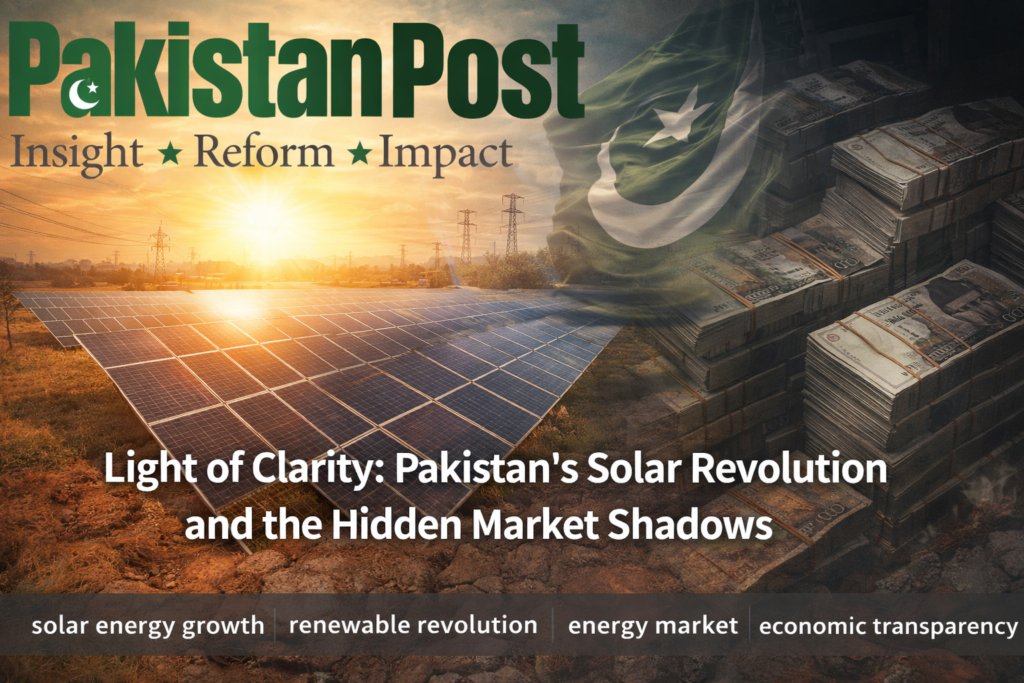
Light of Clarity: Pakistan’s Solar Revolution and the Hidden Market Shadows

Pakistan’s embrace of rooftop solar energy has reshaped the national energy landscape in a way few other developments have in recent years. With millions of consumers across the country turning to solar panels to offset rising electricity costs and to insulate their households and businesses from frequent outages, the promise of a clean, distributed, and resilient energy future has moved from aspiration to active reality. The extraordinary reduction in dependence on imported energy has not only eased pressure on foreign exchange reserves but also provided a hedge against volatile global fuel prices and the geopolitical risk associated with vital supply corridors such as the Strait of Hormuz where disruptions can send shockwaves through import-dependent economies. Solarization represented a pathway to not only energy autonomy but fiscal relief and economic stability.
Yet beneath the surface of this compelling narrative lies an underbelly of market dysfunction that now threatens to dilute and squander some of the very advantages that this energy transformation promised. While solar expansion has accelerated across Pakistan’s urban and rural landscapes, serious structural issues have emerged in the functioning of the solar market, particularly in the realms of pricing transparency, trader conduct, customer experience, and regulatory oversight. What was once regarded as a straightforward energy transition has increasingly become a labyrinth of opaque price quotations, inflated invoices, questionable import practices, mismatched policies, and frustrated consumers struggling to make sense of a market that is at once vibrant and deeply confusing.
Much of the disruption stems from the gap between the real cost of solar equipment and what the end user ultimately pays. Imported panels, primarily originating in China and increasingly dominating Pakistan’s renewable energy supply, cost a relatively modest amount at the point of origin. Yet a significant portion of that price advantage never reaches the consumer because of opaque intermediaries, unclear invoicing, and deliberate overpricing by unscrupulous traders and retailers. In one of the most stark illustrations of how deep these malpractices run, a massive solar import racket was uncovered by the Federal Board of Revenue’s customs audit division where a money laundering and over‑invoicing scheme worth more than Rs106 billion was exposed, involving a network of fake companies operating across Lahore and Peshawar. Panels that commercially should have been invoiced at a low per watt value were declared at vastly inflated rates, sometimes more than five times their real cost, allowing the cartel to launder huge sums while wreaking financial damage on the economy.
The scale of this corruption underscores a fundamental failure in regulatory oversight and enforcement. Not only did these entities use shell firms to skew prices and evade accurate tax reporting, but they also used complex cash deposit schemes and international transfers to conceal the illicit proceeds. Such schemes have barely scratched the surface of scrutiny, and they highlight the extent to which the solar supply chain has been infiltrated by opportunistic actors seeking to exploit regulatory gaps while harming both the public treasury and the consumer. The fact that shell companies with no legitimate financial standing were able to import billions of rupees’ worth of equipment without proper checks demonstrates the depth of lax governance in a market that urgently requires systemic reform.
Consumer experiences mirror this systemic distress. Across cities and provinces, countless individuals share stories that reveal how misleading quotations, unclear contracts, and exaggerated price components have eroded consumer confidence. Many homeowners seeking to install solar systems report that consultants and salespeople quote prices without itemised breakdowns, bundling hardware costs with installation fees, net‑metering hookup expenses, earthing and cabling charges in a way that suppresses true pricing clarity. Prospective buyers, unfamiliar with technical specifications and market benchmarks, are often left to take these quotes at face value. In many instances, they end up paying significantly more than the real market cost of equipment and services, and in some cases they discover only later that they could have gotten better terms elsewhere.
These pricing discrepancies are compounded by a policy environment that has been in flux. Changes to net‑metering rules and proposed transitions to net‑billing have created additional uncertainty for consumers, particularly those who already made investments under earlier regulatory assumptions. Net‑metering, which allowed users to offset the electricity they exported to the grid against their consumption from the grid on a unit‑for‑unit basis, was long hailed as an incentive that made rooftop solar financially attractive. But recent policy discussions seeking to lower buyback rates or shift toward net‑billing have sown confusion. Business groups, farmers, and industry stakeholders have voiced concerns that the proposed regulations, which would drastically widen the gap between the price at which surplus solar electricity is purchased from consumers and the price at which grid electricity is sold, will extend the payback period and undermine the financial rationale for solar investment. Many users now face the possibility of receiving as little as a fraction of the cost they anticipated for surplus energy they feed into the grid, eroding the financial logic that drove widespread adoption in the first place.
This regulatory uncertainty has been further amplified by incidents where net‑metering consumers received unusually high electricity bills under the revised billing practices. Distribution companies, critics say, have failed to accurately credit exported solar units on customer bills, leaving many solar users perplexed and financially strained. Some reports indicate that distribution companies did not include millions of exported units in billing calculations, effectively ignoring energy that users sent to the grid. This has caused many household and commercial consumers to face unexpectedly high charges even in periods when they generated and exported significant amounts of solar power, causing serious financial stress and eroding trust between consumers and utility providers.
Alongside the confusion about net‑metering and billing lies a broader dissatisfaction among consumers about the entire process of acquiring and integrating solar systems. A significant number of users report long delays in installation, lack of responsiveness from service providers, and inconsistent after‑sales support. This has, in some cases, led to squandered investments or systems that underperform expectations. A survey conducted by independent researchers pointed to experiences where consumers felt compelled to pay unofficial fees, including bribes, to navigate net‑metering applications and approval processes, creating a sense that the system is not just opaque but also unfair in practice. Consumers cited long wait times, unclear procedural requirements, and informal costs as barriers to adopting solar technology with confidence.
The Ministry of Finance and the Federal Board of Revenue have particularly critical roles in addressing these challenges. Tax incentives designed to promote solar adoption have unintentionally opened the door to exploitation, as traders and importers manipulate valuations to minimise tax liabilities while marking up prices disproportionately at the retail level. Proper enforcement of import valuations, invoice verification, and stringent customs audits must become routine components of tax administration rather than reactive strikes against a few high‑profile cases. Standardized digital invoicing, real‑time reporting of imports, and cross‑agency data integration can help align declared values with actual transaction prices, reducing the opportunity for over‑invoicing and tax evasion.
At the same time, the Ministry of Commerce and related trade authorities must impose and enforce clear labelling, product certification, and quality standards for all solar equipment sold in Pakistan. The absence of readily available, verifiable quality information burdens consumers with the costly task of distinguishing genuine from inferior products. A national quality assurance framework that tracks the origin, certification, and performance guarantees of panels and inverters would help protect buyers, especially in rural and less regulated areas where fraudulent practices are most pervasive.
Consumer awareness and education must also be elevated. Far too many potential solar customers lack basic understanding of net‑metering rules, battery integration economics, payback calculations, and system performance expectations. This lack of knowledge not only exposes them to exploitation but also hampers informed decision‑making, leaving the market open to manipulation by self‑interested vendors. Public information campaigns, easily accessible online resources, and town‑level outreach programs by energy agencies can help bridge this knowledge gap. When consumers understand both the technical and financial dimensions of solar adoption, they are better equipped to compare quotations, spot inflated pricing, and demand transparent documentation.
A comprehensive national database that monitors solar installations, net‑metering connections, billing outcomes, and performance metrics across regions could provide regulators and policy makers with vital insights into the health of the market. This data resource would allow the Federal Board of Revenue, Ministry of Finance, and trade authorities to detect patterns of anomalous pricing, compliance irregularities, and systemic exploitation more effectively than isolated audits or reactive enforcement actions. Evidence‑based policy interventions, informed by reliable data, are far more likely to yield lasting improvements in market integrity than ad hoc adjustments.
The consequences of failing to address these structural challenges are profound. If corruption, opaque pricing, and consumer confusion continue unchecked, Pakistan risks undermining public faith in solar technology and slowing the pace of clean energy adoption at a time when strategic resilience and fiscal prudence are urgently needed. Corruption and misinformation do not merely distort market transactions for individual buyers; they erode collective confidence in an energy transition that people across the socioeconomic spectrum have embraced with enthusiasm.
Pakistan’s solar surge has delivered tangible benefits, including significant import savings, reduced carbon emissions, and increased energy autonomy. However, real energy independence is not achieved simply by counting megawatts of installed capacity. It depends on transparent markets, fair and predictable regulatory environments, vigilant enforcement against corruption, and empowered consumers who can participate in the energy transition with clarity and confidence.
For Pakistan to realise the full promise of its solar revolution, it must confront the shadows now obscuring its market mechanisms. Stronger governance, clearer pricing transparency, consumer protection, coordinated policy stability, and an unwavering commitment to accountability are essential. Only by aligning the incentives of consumers, traders, regulators, and fiscal authorities can Pakistan build an energy market that is not only technologically progressive but economically just and socially resilient.
This is the core task now facing policy makers and institutional leaders. The decisions they make today will determine whether Pakistan’s solar growth remains a beacon of economic transformation or becomes mired in avoidable dysfunction. The path forward demands courage, coherence, and clarity. When those elements converge, the light of solar energy will shine not only on rooftops but also in the lives and livelihoods of people across the nation.
A Public Service Message