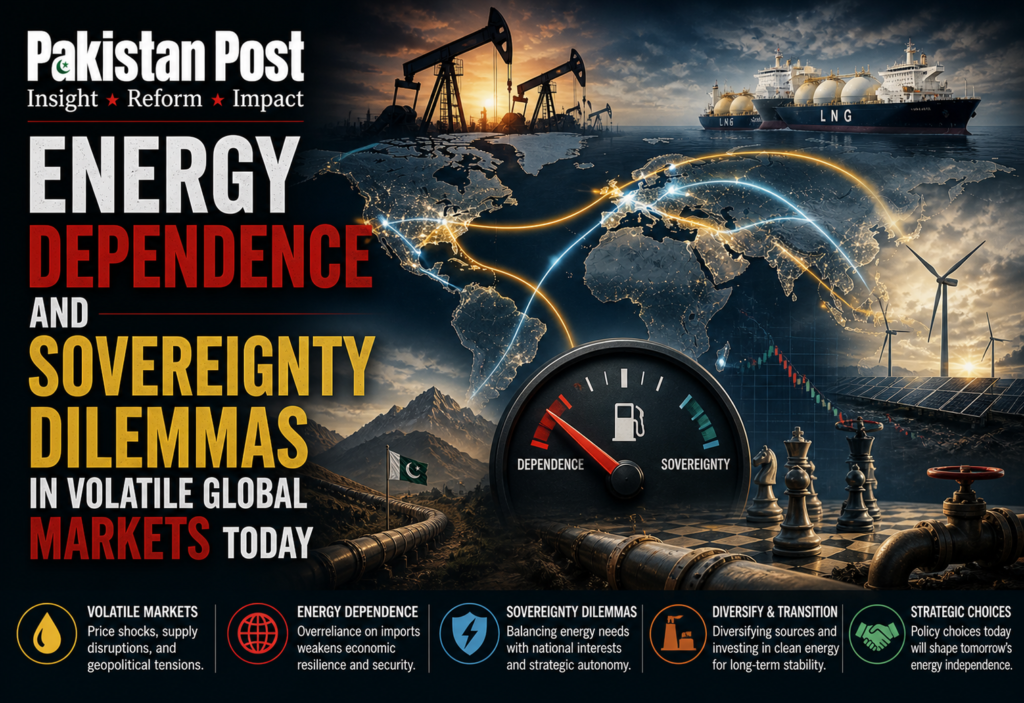
Energy dependence and sovereignty dilemmas in volatile global markets today

The meaning of sovereignty is being quietly rewritten, not through grand declarations or territorial conflicts, but through the invisible yet deeply consequential circuits of energy flows, pricing mechanisms, and supply dependencies. For Pakistan, the question is no longer confined to how energy is acquired, but how that acquisition reshapes the boundaries of economic autonomy, fiscal stability, and strategic decision making. In a world unsettled by the aftershocks of the Russia-Ukraine War, the architecture of global energy has shifted from predictable pipelines to volatile markets, from long term contracts to spot pricing anxieties, from geography to geopolitics.
Energy importing states have historically lived with a degree of vulnerability, yet the present moment amplifies that condition into a structural constraint. The transition from pipeline based energy security to liquefied natural gas dependence has altered not just the logistics of supply but the very economics of energy governance. LNG markets are inherently fluid, shaped by global demand surges, shipping constraints, and speculative pricing. For Pakistan, this has translated into a recurring cycle of procurement uncertainty, where tenders fail, cargoes are diverted, and domestic shortages become political crises.
The narrative being constructed in policy and media discourse increasingly frames this as an erosion of sovereignty. Not in the classical sense of external domination, but in the subtler form of constrained choice. When energy prices spike in distant markets, fiscal policy in Islamabad must adjust. When suppliers prioritise higher paying buyers, domestic planning becomes reactive rather than strategic. Sovereignty, in this context, is less about control over territory and more about insulation from external volatility.
This redefinition is not unique to Pakistan. The experience of European economies following disruptions in Russian gas supplies has demonstrated how even advanced markets can be rendered vulnerable. Yet for developing economies, the consequences are more acute. Limited fiscal space, weaker currencies, and higher import dependence magnify the impact of global shocks. Energy becomes not just an economic input but a determinant of macroeconomic stability, influencing inflation, exchange rates, and public debt.
Pakistan’s energy mix reflects these tensions. A significant reliance on imported fuels coexists with underutilised domestic resources and an evolving but still nascent renewable sector. The expansion of LNG infrastructure was initially conceived as a solution to chronic energy shortages, offering flexibility and cleaner alternatives to furnace oil. However, the globalisation of LNG markets has exposed the risks of overreliance on a single modality. Spot market purchases, once seen as cost effective, have become sources of unpredictability.
Policy responses must therefore grapple with a paradox. Diversification is essential, yet each pathway carries its own vulnerabilities. Long term LNG contracts can provide price stability but may lock the country into unfavourable terms if global prices decline. Spot market engagement offers flexibility but exposes the economy to price spikes. Renewable energy promises sustainability and reduced import dependence, yet requires substantial upfront investment, grid modernisation, and technological adaptation.
The discourse around renewable energy in Pakistan is gaining momentum, framed within both environmental and economic narratives. Solar and wind potential is considerable, particularly in regions with high irradiation and wind corridors. Yet the transition is not merely a technical challenge. It involves regulatory reforms, financing mechanisms, and institutional capacity. The intermittency of renewables necessitates storage solutions and grid resilience, areas where investment and expertise are still developing.
At the same time, regional energy connectivity remains an underexplored avenue. Projects such as cross border electricity trade with Central Asia and pipeline initiatives linking resource rich regions to energy deficient markets have long been discussed. However, their realisation is hindered by geopolitical complexities. Instability in neighbouring regions, particularly Afghanistan, continues to impede projects like the Turkmenistan Afghanistan Pakistan India pipeline. Energy corridors, in this sense, are not just economic constructs but geopolitical alignments that require sustained diplomatic engagement.
The role of Gulf suppliers, particularly Saudi Arabia and Qatar, remains central to Pakistan’s energy security. Long standing relationships have facilitated access to oil and LNG under concessional arrangements, including deferred payment facilities. These arrangements provide critical relief during periods of fiscal stress, yet they also underscore the asymmetry inherent in energy dependence. Supplier relationships are shaped by broader strategic considerations, including political alignment and regional dynamics.
Media narratives increasingly highlight this intersection of energy and geopolitics, portraying energy agreements as extensions of foreign policy rather than purely commercial transactions. This framing reflects a broader global trend, where energy is weaponised, negotiated, and leveraged within geopolitical contests. For Pakistan, navigating this landscape requires balancing immediate needs with long term strategic positioning.
Fiscal implications of energy dependence are profound. Energy imports constitute a significant portion of the country’s import bill, exerting pressure on foreign exchange reserves. Subsidies, often used to shield consumers from price increases, strain public finances and complicate engagements with institutions such as the International Monetary Fund. The tension between social protection and fiscal discipline becomes particularly acute in this sector, where price adjustments have direct political and social consequences.
Energy pricing reforms are therefore both necessary and contentious. Moving toward cost reflective tariffs can improve efficiency and reduce fiscal burdens, yet it risks exacerbating inflation and public discontent. The challenge lies in designing mechanisms that balance economic rationality with social equity. Targeted subsidies, improved efficiency in distribution, and reduction of losses within the power sector are critical components of this equation.
The concept of circular debt in Pakistan’s energy sector exemplifies the structural challenges that persist. Accumulated liabilities across generation, transmission, and distribution entities create a cycle of inefficiency and financial strain. Addressing this requires comprehensive reform, including governance improvements, investment in infrastructure, and enhanced accountability mechanisms. Without such reforms, external energy dependence will continue to interact with internal inefficiencies, amplifying vulnerabilities.
Technological transformation offers both opportunities and challenges. Advances in energy storage, smart grids, and efficiency technologies can enhance resilience and reduce dependence. However, accessing these technologies requires capital, expertise, and supportive policy frameworks. International partnerships, whether through bilateral agreements or multilateral initiatives, can play a role in facilitating this transition.
Climate considerations add another dimension to the energy sovereignty debate. As global efforts to reduce carbon emissions intensify, energy choices are increasingly scrutinised through an environmental lens. Pakistan, highly vulnerable to climate change impacts, faces the dual challenge of ensuring energy security while transitioning toward cleaner sources. This requires aligning domestic policies with global climate commitments, accessing climate finance, and integrating sustainability into energy planning.
The narrative of economic sovereignty is thus evolving into one of strategic resilience. It is not about eliminating dependence, an unrealistic goal in an interconnected world, but about managing it in ways that minimise vulnerability and maximise agency. This involves diversification across energy sources, suppliers, and technologies. It requires institutional capacity to plan, negotiate, and implement policies effectively. It demands transparency and public engagement to build consensus around difficult choices.
Global energy markets are unlikely to stabilise in the near term. Geopolitical tensions, technological disruptions, and climate policies will continue to reshape supply and demand dynamics. For Pakistan, this means that uncertainty is not a temporary condition but a structural feature of the environment in which it operates. Policy frameworks must therefore be designed with flexibility and adaptability in mind.
The private sector has a critical role in this transition. Investment in renewable energy, energy efficiency, and innovative technologies can complement public efforts. However, this requires a conducive regulatory environment, including clear policies, stable tariffs, and protection of investor rights. Public private partnerships can mobilise resources and expertise, accelerating the pace of transformation.
Regional cooperation, though challenging, remains a potential avenue for enhancing energy security. Shared infrastructure, coordinated policies, and collective bargaining can reduce costs and improve resilience. Yet such cooperation is contingent upon political will and trust, factors that are often in short supply in South Asia. Overcoming these barriers is as much a diplomatic challenge as it is an economic one.
In the broader discourse, energy is increasingly seen as a determinant of national power and autonomy. Countries that can secure reliable, affordable, and sustainable energy supplies are better positioned to pursue independent policies and withstand external pressures. Those that cannot are more susceptible to economic shocks and geopolitical leverage.
For Pakistan, the path forward is complex but navigable. It requires a shift from reactive crisis management to proactive strategic planning. It involves integrating energy policy with broader economic, environmental, and foreign policy objectives. It demands investment in institutions, infrastructure, and human capital.
The narratives constructed in media and policy circles will continue to influence perceptions and priorities. Moving beyond simplistic binaries of dependence versus independence toward a more nuanced understanding of interdependence and resilience is essential. Energy sovereignty in the twenty first century is not about isolation but about the capacity to engage with global markets on favourable terms.
As the world moves toward a more fragmented and uncertain energy landscape, Pakistan’s choices will shape its economic future and its position within the global order. The challenge is not merely to secure energy supplies but to do so in a manner that enhances stability, supports development, and preserves policy autonomy. This requires vision, coordination, and sustained commitment.
In the end, energy is more than a commodity. It is a foundation upon which economies are built, societies function, and states exercise power. Managing it effectively is therefore central to the broader project of national development and sovereignty. In a volatile global market, the ability to navigate this complexity will determine not only economic outcomes but the very contours of state capacity and independence.
A Public Service Message