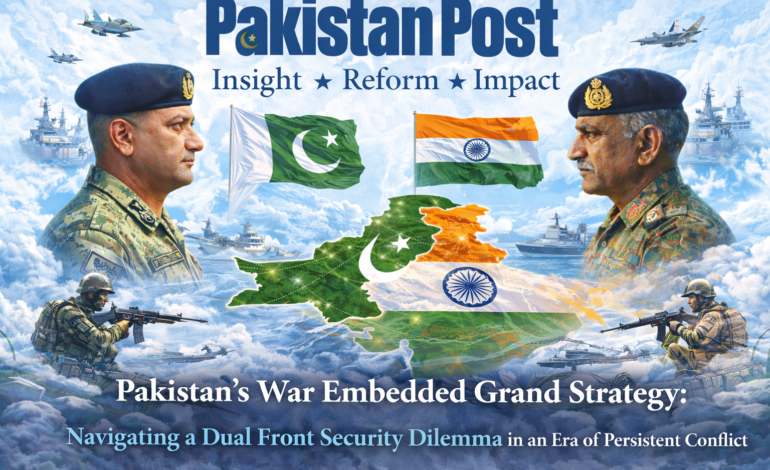
Pakistan’s War Embedded Grand Strategy: Navigating a Dual‑Front Security Dilemma in an Era of Persistent Conflict


In the realm of strategic studies, the concept of a “war embedded grand strategy” describes a state whose external security environment is not episodically hostile but constitutively warfare‑like. Pakistan exemplifies this condition as a medium power state locked within a persistent, dual‑front security dilemma. To the east lies India, a nuclear‑armed peer whose strategic competition with Pakistan remains unresolved and structurally antagonistic. To the west sprawls Afghanistan, a polity fractured by insurgent and transnational militancy, where Taliban dynamics and Tehreek‑e‑Taliban Pakistan (TTP) linkages have elevated cross‑border insecurity into quasi‑warfare. These two fronts are entrenched within a broader geopolitical contest that sees Sino‑American competition influence Gulf and Russian strategic postures, making Pakistan’s external environment one of sustained, high‑risk contestation rather than episodic crises.
Theoretical anchoring in strategic literature situates war embedded environments as generators of institutional preferences that privilege security over developmental or normative political imperatives. When a state perceives its security landscape as persistently hostile across multiple vectors, its grand strategy tends toward structural resilience: a combination of robust deterrence, adaptive conventional capabilities, and institutional mechanisms that prioritize threat response. For Pakistan, this dynamic has reinforced nuclear deterrence as a foundational stabilizing logic while simultaneously compelling modernization of conventional and asymmetric capabilities. Persistent low‑intensity but high‑risk warfarecharacterised by drone‑assisted strikes, border skirmishes, and tension around the China Pakistan Economic Corridor (CPEC) security theatre—illustrates a strategic environment where kinetic escalation risks coexist with the imperative to avoid full‑scale war. The entrenchment of nuclear deterrence has reduced the probability of total war, yet the continued proliferation of grey zone conflict instruments has forced Pakistan to reorganise its military and strategic culture around multi‑domain resilience.
The war embedded security environment is not an abstract construct for Islamabad; it is grounded in tangible regional realities that shape strategic posture. Relations with Afghanistan have deteriorated into what many analysts now describe as a quasi‑war phase. Mutual accusations of cross border drone attacks, the intensification of TTP linked insurgency emanating from Afghan territory, and intermittent clashes along the Durand Line have compelled Pakistan to oscillate between border closures and tactical reopenings. These policy swings are not merely administrative but strategic levers: trade access and conditional reopening of transit routes become instruments of coercive persuasion, aimed at incentivising Afghan restraint while preserving Pakistan’s own economic interests. Pakistan’s external security environment thus merges militarised border management with economic conditionality, reflecting a strategy that cannot neatly separate war from normalcy.
Simultaneously, friction with India remains structurally unresolved and perpetually volatile. Frequent border incidents, drone‑based probing operations, and hybrid escalations encompassing cyber intrusions and information warfare keep both capitals in a state of high alert. This dynamic pushes Islamabad toward a multi‑layered deterrence posture: the nuclear umbrella remains the bedrock, but it is complemented by an evolving doctrine of limited conventional preemption and an internal stability guarantee. The interplay of these layers illustrates a strategic recognition that deterrence must be both credible and dynamic, capable of signalling resolve without triggering irreversible escalation. Pakistan’s defense portfolio, therefore, reconfigures itself to anticipate not only classical interstate war but also the ambiguities of grey zone warfare where the threshold of violence remains intentionally blurred.
Pakistan’s regional alignments have also evolved under the weight of this war embedded reality. China has become the central axis of Pakistan’s strategic partnerships, with CPEC infrastructure and Gwadar port security forming a core pillar of bilateral cooperation. China’s provision of anti‑air and anti‑drone platforms, along with joint security arrangements, underscores an alignment rooted in both economic ambition and shared threat perceptions. Yet, this alignment is not exclusive. Islamabad has pursued a more nuanced engagement with the United States and Gulf Arab states, recognising the strategic utility of hedging within a tripartite asymmetric alignment. Selective access to Western technology, counter‑terrorism finance mechanisms, and Saudi‑backed regional diplomatic initiatives reflect Pakistan’s effort to diversify its strategic options while avoiding over‑dependence on any single patron. The result is a complex lattice of alignments that serves immediate security needs while preserving strategic agency within a competitive global order.
The external pressures of a war embedded environment have profound implications for Pakistan’s internal political and institutional order. One of the most salient effects has been the expansion of military institutional autonomy in security policy, border management, and counter‑terrorism doctrine, often at the expense of civilian strategic initiative and long‑term institutional development. Civil‑military relations have become rebalanced in favor of the military as the primary architect of responses to external threats. Security policy, which in many states would be subject to broad civilian oversight and legislative engagement, in Pakistan increasingly reflects military prerogatives. This is not to suggest the civilian sphere is absent; rather, it is constrained within an environment where the logic of survival and threat response overshadows long‑term political and economic planning. The institutional dominance of the military in strategic domains has, by necessity or design, compressed civilian space for initiating alternative strategic visions that might prioritize regional dialogue or socio‑economic reform.
This internal recalibration is mirrored in Pakistan’s security governance. Internal security order is being hardened through the expansion of surveillance architectures, internal operations logics borrowed from counter‑insurgency frameworks, and the militarisation of border zones. Snipers at the Gates syndrome—where internal administrative processes become militarised in anticipation of external threats—illustrates how security logic begins to override political space. Expanded surveillance capabilities, often justified in the name of counter‑terrorism, create layers of observation that extend beyond kinetic targets to encompass domestic political activity. Border zone militarisation, particularly along the Afghan frontier, has given rise to fortified enclaves that challenge civil society’s capacity to function independently of security imperatives. In this environment, socio‑economic policy latitude shrinks as resources and policy attention funnel toward threat containment and suppression.
The broader question confronting Pakistan’s strategic community is whether the state’s incentive structure is converging toward what might be described as securitised autonomy or whether there remains space for an institutional adaptive strategy that balances security imperatives with democratic, economic, and regional integration imperatives. Securitised autonomy refers to a strategic logic where the central regime stability, bolstered by military dominance, becomes the principal objective, and where external balancing is executed primarily through military and security instruments. This path yields a state apparatus that privileges centralized decision‑making, prioritises defense spending above developmental investment, and views political dissent through the lens of security risk. While this model can deliver short‑term stability in conditions of persistent threat, it risks long‑term strategic stagnation, fiscal strain, and erosion of democratic legitimacy.
By contrast, an institutional adaptive strategy would seek to embed security design within broader governance frameworks. Such a strategy recognizes that sustainable security is co‑constituted with political inclusivity, economic resilience, and regional engagement. Civilian embedded security design would entail formal mechanisms for coordinated strategy formulation that include civilian leadership in defense planning, budget prioritization, and alliance posture decisions. Regional dialogue engagement would involve proactive diplomatic initiatives aimed at reducing frontier tensions with both India and Afghanistan, underpinned by confidence‑building measures and reciprocal verification regimes. Fiscal sustainability aware force planning would constrain defense expenditure within realistic projections of economic capacity, ensuring that long‑term infrastructure development, human capital investment, and connectivity projects are not starved of resources.
To operationalise a war embedded grand strategy that reconciles security exigencies with institutional balance, a three‑tier framework is instructive. The first tiernuclear, conventional, and counter‑drone resilienceacknowledges that credible deterrence remains indispensable. Nuclear deterrence as the bedrock must be supported by conventional capabilities capable of limited, precise responses within a contested environment. This includes counter‑drone systems that can neutralise emerging threats without triggering escalation, and surveillance‑based border intelligence that can anticipate and de‑escalate cross border hostilities. Resilience in this tier is measured not only in platforms and arsenals but in doctrines that articulate thresholds, signals, and escalation control mechanisms suited to grey zone warfare.
The second tiercivil‑military coordination and institutional balance, addresses the risk that security logic can permanently crowd out developmental policy and democratic deliberation. Mechanisms such as civilian‑led strategic planning bodies must be empowered to set long‑term force posture and alliance guidelines, ensuring that military expertise informs but does not unilaterally determine national strategy. Legislative oversight committees with classified access can provide a platform for civilian stakeholders to engage with existential threat assessments and resource allocations. Institutionalised dialogue between civilian policymakers and military strategists can mitigate misalignments and reinforce shared strategic ownership.
The third tier—fiscal sustainability and domestic stability—recognises that war embedded environments exert pressure on national budgets. Without prudent management, security spending can erode fiscal space required for strategic infrastructure, human capital development, and regional connectivity projects that underpin long‑term resilience. Guidelines for force planning must be integrated with fiscal projections, and multi‑year budgets should be transparent, accountable, and calibrated to economic growth trajectories. Domestic stability, in turn, is reinforced when citizens perceive that security measures do not come at the cost of basic services, employment opportunities, or personal liberties.
A critical component of Pakistan’s war embedded strategy is the security architecture surrounding CPEC and the Arabian Sea littoral. Historically, Pakistan’s strategic geography has been dominated by concerns emanating from its land frontiers, particularly the India‑facing eastern theatre. However, CPEC linked security architecture—manifest in Gwadar‑oriented military presence, Corridor Protection Units, and enhanced China Pakistan special security cooperation—is transforming the Arabian Sea littoral into a core security backbone rather than a subsidiary strategic space. The militarisation of this littoral reflects a recognition that economic corridors, maritime access, and connectivity infrastructure are strategic assets requiring protective envelopes. This shift in strategic geography has implications for force deployment, alliance commitments, and domestic politics. Security investments in the littoral augment Pakistan’s capacity to project deterrence across new axes while deepening its integration into China’s strategic economy. Yet, it also requires balancing maritime security imperatives with inland defense exigencies, necessitating doctrinal innovation and resource prioritization that reconcile competing demands.
Pakistan’s war embedded grand strategy is therefore neither static nor reducible to singular priorities. It is a dynamic synthesis of deterrence postures, institutional balances, fiscal constraints, and geopolitical alignments. The persistent, war‑like external environment compels Islamabad to maintain resilient deterrence and adaptive conventional capabilities. Yet, the strategic dividends of internal stability, democratic legitimacy, and economic sustainability must not be sacrificed at the altar of perpetual insecurity. Reconciling these imperatives demands a grand strategy that is both militarily credible and institutionally inclusive, capable of navigating the treacherous currents of a contested neighborhood without forfeiting the prospects of a prosperous, stable, and diplomatically engaged Pakistan.
A Public Service Message