
The Pick-a-Side Imperative: U.S. Strategic Pressure on Europe Amid the Sino-American Contest

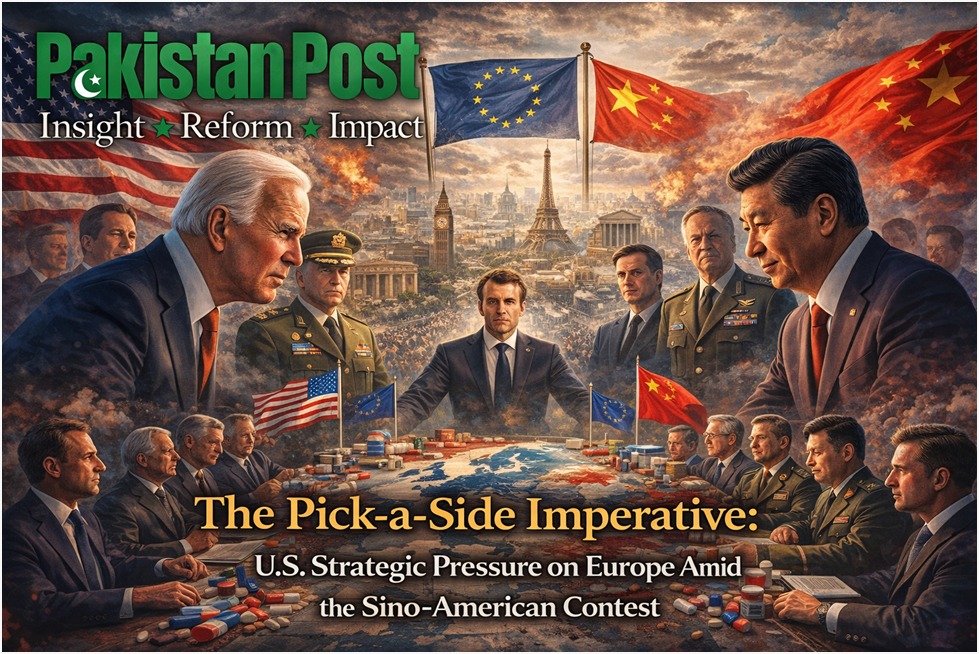
The contemporary international system is undergoing a profound structural transformation. The post-Cold War era, characterized by a largely unipolar liberal order under U.S. hegemony, is giving way to a multipolar world in which systemic competition between great powers defines the architecture of global governance. Nowhere is this transition more evident than in the evolving dynamics of U.S.-European relations, particularly as they intersect with the rise of China. The insistence by Washington that Europe explicitly “pick a side” in its strategic competition with Beijing represents not only a policy preference but a deliberate instrument of alliance management and geopolitical signaling. This doctrine reflects the intersection of economic leverage, technological governance, and security obligations, and carries implications that extend across diplomatic, institutional, and strategic dimensions.
The underlying rationale for this insistence stems from the United States’ strategic assessment that China’s trajectory in technological innovation, infrastructure development, and military modernization constitutes a structural challenge to American primacy. U.S. policymakers perceive China’s initiatives—ranging from its leadership in 5G telecommunications to the Belt and Road Initiative and indigenous high-tech industrial programsas elements of a coherent strategy to assert influence across global systems. In this context, Europe is not a peripheral actor but a critical strategic space whose alignment materially affects the balance of power. Washington’s insistence on a choice between alignment or strategic distancing is thus a reflection of its perception that Europe’s decisions on trade, technology, and defense policy have immediate and long-term ramifications for systemic competition.
At the operational level, the “pick-a-side” doctrine manifests in an integrated set of economic, technological, and security measures designed to incentivize alignment and discourage ambivalence. Foremost among these measures are restrictions on Chinese participation in critical infrastructure projects, particularly 5G networks. U.S. officials argue that allowing Chinese companies such as Huawei and ZTE to operate in European telecommunications networks creates vulnerabilities that could be exploited in the context of hybrid conflict, cyber espionage, or economic coercion. These security arguments are reinforced by the broader American framing of technological domains as strategic commons: the control and governance of key infrastructure, data flows, and supply chains are no longer purely economic considerations but central components of national security. The European response to these restrictions has been uneven, reflecting both domestic political debates and the structural dependency of European economies on Chinese markets.
In parallel, economic instruments are leveraged to reinforce the alignment imperative. Tariffs on strategic sectors, particularly electric vehicles, have been selectively applied to influence European industrial policy in ways that complement American security objectives. The imposition of such tariffs signals to European governments and corporate actors that continued economic engagement with the United States is contingent upon alignment with U.S. strategic priorities. The logic extends further through the application or threat of secondary sanctions, which extend the reach of U.S. regulatory influence beyond its borders and create systemic incentives for compliance. By linking access to the U.S. market with security-oriented alignment, Washington effectively operationalizes a form of coercive diplomacy that merges economic and strategic instruments into a single integrated framework.
The implications of this approach for Europe are both structural and political. European states are confronted with a multi-layered balancing act between commercial imperatives and alliance obligations. Germany, whose industrial base is deeply intertwined with Chinese supply chains and export markets, faces acute exposure. The country’s automotive and manufacturing sectors rely on access to Chinese markets not only for revenue but also for supply continuity. France, while possessing a stronger inclination toward strategic autonomy, contends with the structural realities of its position in the EU and the broader transatlantic alliance. Eastern European states, conversely, often perceive security dependence on the United States as more acute due to historical experiences of vulnerability to Russian aggression, and therefore may be more inclined to acquiesce to alignment demands. This creates an environment in which intra-European divergences risk undermining institutional cohesion at a time when collective decision-making is essential for both economic stability and security resilience.
At a conceptual level, the “pick-a-side” doctrine reflects a deliberate attempt by the United States to shape systemic polarization. In contrast to the permissive framework of the post-Cold War era, in which overlapping interests and shared norms permitted relative autonomy for European partners, the contemporary strategic environment imposes a binary logic. Neutrality or hedging is increasingly framed as nonviable: European nations are confronted with the prospect that indecision or partial alignment may result in exclusion from critical technological networks, economic penalties, or diminished access to security guarantees. In essence, the doctrine operationalizes a form of structural realignment designed to reinforce American primacy while constraining the strategic maneuverability of Europe in relation to China.
This approach, however, is not without inherent risk. By emphasizing coercion and conditionality, the United States exposes itself to potential resistance, both at the national and institutional levels. European governments may pursue policies that mitigate exposure to U.S. sanctions, diversify supply chains, or enhance indigenous technological capabilities to reduce dependency on external actors. Such responses could erode the effectiveness of the alignment imperative and accelerate European initiatives toward strategic autonomy. Moreover, the coercive framing of the doctrine risks politicizing long-standing alliances, introducing transactionalism into relationships that have traditionally been rooted in shared norms, collective defense obligations, and historical experience. Consequently, the “pick-a-side” doctrine embodies a delicate tension between the immediate consolidation of strategic cohesion and the long-term resilience of alliance structures.
From the European vantage point, the implications extend beyond mere policy adjustments. The doctrine compels a reassessment of strategic priorities, resource allocation, and institutional mechanisms. National decision-makers must navigate the intersection of economic interdependence, technological sovereignty, and security commitments. This may catalyze the development of robust industrial and technological policies designed to mitigate dependency on external powers, enhance resilience in critical sectors, and secure alternative sources of strategic advantage. In this sense, the U.S. insistence on alignment functions as both a constraint and a catalyst, compelling European actors to clarify policy positions and institutional capabilities in ways that may have long-term implications for intra-European cohesion and external strategic positioning.
Beyond the bilateral or regional dimensions, the “pick-a-side” doctrine has broader implications for the architecture of global governance. By imposing alignment conditions, the United States seeks to shape not merely bilateral economic and security relationships, but systemic networks of regulation, standard-setting, and market access. Secondary sanctions, technological restrictions, and trade measures serve as instruments to enforce a coherent geopolitical logic across multiple domains. European responses will therefore not only influence transatlantic cohesion but also the evolution of global norms, regulatory regimes, and institutional practices within high-technology sectors. The alignment imperative thus operates as a microcosm of broader systemic dynamics, illustrating how great powers seek to integrate coercion, institutional influence, and normative guidance in the context of multipolar competition.
Strategically, the doctrine highlights the evolving conceptualization of sovereignty and agency in European policymaking. States are compelled to negotiate the tension between autonomous decision-making and structural alignment within the transatlantic framework. The binary framing of the U.S. approach accelerates debates on European defense modernization, technological sovereignty, and economic diversification. It also magnifies the political salience of intra-European differences, potentially incentivizing coordinated institutional mechanisms to preserve strategic coherence in the face of external pressures. The cumulative effect is a heightened focus on strategic foresight, scenario planning, and institutional innovation within Europe, with implications for both domestic governance and external diplomatic engagement.
The “pick-a-side” doctrine also exemplifies the interplay between perception and strategic signaling in international relations. Washington’s insistence on alignment communicates not only a preference but a credible threat of consequences for non-compliance. This dynamic underscores the importance of credibility, enforcement mechanisms, and perception management in alliance politics. European actors must assess both the short-term incentives and the long-term strategic consequences of alignment, weighing immediate economic costs against structural security benefits. The doctrine, therefore, functions as a multidimensional test of both European cohesion and the adaptability of transatlantic institutions to systemic challenges.
In conclusion, the U.S. insistence that Europe align economically and technologically against China represents a deliberate, multidimensional instrument of strategic management. It reflects a convergence of security imperatives, economic leverage, and alliance discipline designed to consolidate coherence in the face of systemic competition. For Europe, the doctrine imposes a dual imperative: to reconcile economic interdependence with security obligations, and to navigate intra-regional divergences while sustaining institutional cohesion. The “pick-a-side” imperative thus constitutes both a structural constraint and a strategic catalyst, shaping the contours of European policy, transatlantic relations, and the broader architecture of global power for the foreseeable future. Its unfolding will define not only the operational dynamics of U.S.-European cooperation but also the strategic evolution of Europe as a decisive actor in the multipolar competition with China, with consequences for global governance, technological sovereignty, and the strategic resilience of allied coalitions.
A Public Service Message