
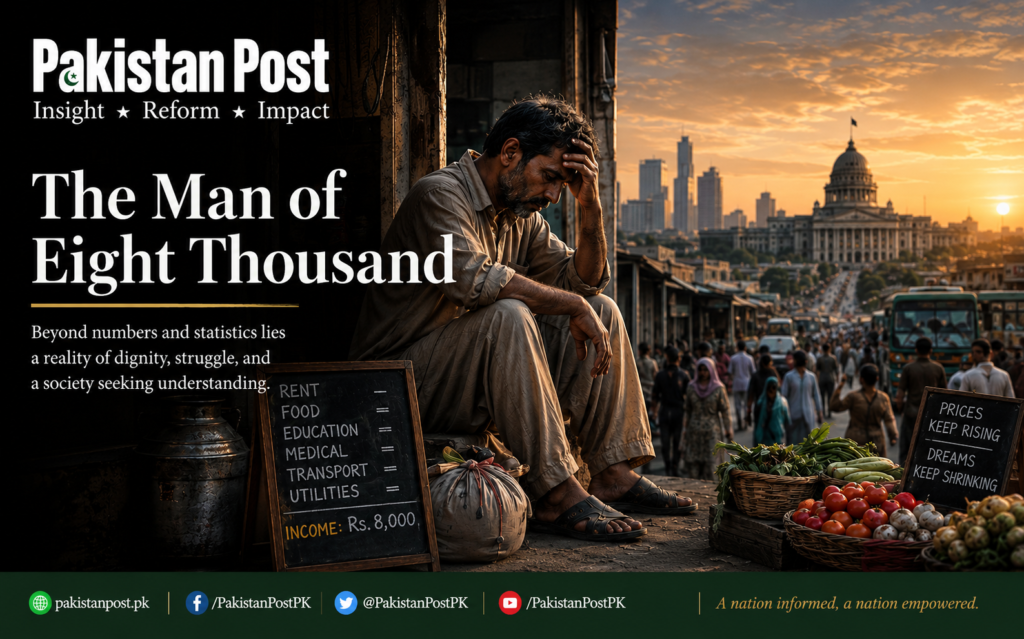
The Man of Eight Thousand

There is an old Urdu verse that says: “If a man’s hands tremble while he drinks, know that he has been tormented by love.” The image is deceptively simple. The trembling hand is not merely a physical condition; it is evidence of an invisible wound. The body becomes a witness to an internal reality. A person who has suffered deeply often carries symptoms that outsiders misinterpret. What appears to be weakness may in fact be grief. What appears to be instability may be the residue of loss.
In contemporary political life, societies frequently experience a similar phenomenon. Governments present statistics, percentages, and fiscal indicators as objective realities, while citizens live through experiences that often contradict those numbers. Between the official narrative and lived reality emerges a tension that philosophers, sociologists, and critical theorists have long attempted to explain. It is in this context that a recent political claim, that a person possessing eight thousand rupees should not be considered poor deserves examination not merely as an economic statement but as a symbolic reflection of how power perceives society.
The issue is not the number itself. Eight thousand is only a figure. The deeper question concerns the relationship between numerical measurement and human experience. Can poverty be defined exclusively through numbers? Can a government determine well-being by statistical thresholds while ordinary citizens experience increasing insecurity, anxiety, and deprivation? More importantly, what happens when public discourse begins to disconnect from social reality?
The story of eight thousand rupees is ultimately not about money. It is about perception. It is about the distance between rulers and the ruled, between macroeconomic indicators and household budgets, between official optimism and private suffering.
The German philosopher Karl Marx argued that material conditions shape consciousness. For Marx, poverty was never simply an absence of money; it was a condition embedded within social structures that determine who controls resources and who remains dependent upon them. A worker may technically earn an income, yet still experience exploitation if that income cannot sustain a dignified life. Viewed through this lens, the question is not whether eight thousand rupees exists in someone’s pocket but whether that amount permits meaningful participation in society.
Marx’s insight remains relevant because inflation alters the social meaning of money. A number that once represented modest security may gradually become insufficient as prices rise. Economic value is never static. The purchasing power of money changes, and with it changes the lived experience of ordinary people. Thus, the debate surrounding eight thousand rupees reflects a broader reality: numbers may remain constant while their social significance undergoes radical transformation.
The French sociologist Pierre Bourdieu extended this discussion by introducing the concept of symbolic power. According to Bourdieu, dominant institutions possess the authority not only to govern resources but also to define reality itself. When governments declare who is poor and who is not, they are exercising symbolic power. They are establishing categories through which society understands itself. Yet these categories may not always correspond to lived experience.
A laborer struggling to pay rent, purchase food, educate children, and cover medical expenses may find little comfort in being told that statistical models classify him as non-poor. The discrepancy between official language and personal experience creates frustration because individuals trust their daily realities more than abstract classifications.
This tension has been explored extensively by Michel Foucault, who argued that modern states govern populations through systems of measurement, classification, and surveillance. Census data, poverty lines, economic indicators, and demographic categories are not merely neutral instruments; they are mechanisms through which states organize social reality. While such tools are necessary for governance, they also possess limitations. They may reduce complex human experiences into administrative categories that fail to capture emotional, psychological, and social dimensions of life.
Consider a household surviving on eight thousand rupees. Statistical analysis may identify income levels, expenditure patterns, and consumption rates. Yet numbers cannot fully measure anxiety about unpaid bills, fear regarding children’s futures, or the humiliation associated with economic insecurity. Human beings do not experience poverty solely through economics. They experience it through emotions, relationships, aspirations, and dignity.
The Nobel Prize-winning economist Amartya Sen offered a particularly influential critique of narrow economic definitions of poverty. Sen argued that poverty should be understood in terms of capabilities rather than income alone. The crucial question is not merely how much money a person possesses but what that person is capable of doing and becoming. Can they access education? Can they obtain healthcare? Can they participate in public life? Can they pursue opportunities that allow personal growth?
From Sen’s perspective, eight thousand rupees becomes meaningful only when evaluated in relation to actual capabilities. If inflation erodes purchasing power and restricts access to essential services, then nominal income figures provide an incomplete picture of reality.
Eastern intellectual traditions have approached these questions from different yet equally profound angles. The fourteenth-century scholar Ibn Khaldun observed that civilizations decline not merely because of military weakness but because ruling elites gradually lose touch with the conditions of ordinary people. In his Muqaddimah, Ibn Khaldun described how luxury and distance from productive labor can create distorted perceptions among governing classes. As elites become insulated from everyday struggles, their understanding of society grows increasingly abstract.
The symbolic significance of eight thousand rupees can be interpreted through Ibn Khaldun’s framework. The controversy emerges not because citizens disagree with arithmetic but because they perceive a disconnect between official assessments and lived realities. The issue is ultimately one of social distance.
Similarly, the poet-philosopher Muhammad Iqbal repeatedly warned against systems that measured human worth through material abstractions while neglecting spiritual and moral realities. For Iqbal, economic questions could never be separated from human dignity. A society’s health depended not only upon wealth generation but also upon justice, self-respect, and collective purpose.
Iqbal’s critique resonates strongly in an era where economic debates often revolve around percentages and projections. Citizens rarely judge prosperity through national statistics alone. They judge it through their ability to provide for families, pursue aspirations, and maintain dignity. Economic growth becomes meaningful only when it translates into lived improvement.
The Chinese philosopher Confucius offered another relevant insight. He argued that social stability depends upon trust between rulers and the governed. In one famous dialogue, Confucius suggested that a state may survive shortages of food and military weakness, but it cannot survive the loss of public trust. Trust constitutes the invisible foundation upon which political legitimacy rests.
Statements regarding poverty thresholds therefore carry significance beyond economics. They influence public perceptions of whether leaders understand social realities. When citizens feel misunderstood, trust begins to erode. The resulting gap cannot be repaired through statistical explanations alone because the problem is fundamentally relational.
Contemporary critical theorists have described this phenomenon as the politics of recognition. Individuals seek not only material support but also acknowledgment of their experiences. Being told that one is not poor while struggling to meet basic needs can feel like a denial of lived reality. Recognition becomes as important as redistribution.
The British social historian E.P. Thompson emphasized that ordinary people possess their own moral economies shared understandings of fairness, justice, and legitimacy. Economic policies are evaluated not merely according to efficiency but according to whether they align with these moral expectations. Citizens often tolerate hardship when they perceive sacrifices as fairly distributed. Conversely, even modest difficulties can generate resentment when they appear disconnected from official narratives.
Inflation intensifies these dynamics because it transforms everyday experiences. Rising prices do more than increase expenses; they reshape social behavior. Families postpone medical treatments. Parents reduce educational expenditures. Young people delay marriage. Workers take multiple jobs. Small luxuries disappear. Aspirations shrink.
The psychological consequences of inflation have attracted increasing scholarly attention. Behavioral economists such as Daniel Kahneman demonstrated that individuals experience losses more intensely than equivalent gains. A person who loses purchasing power feels the decline acutely because it directly affects expectations and plans. Thus, inflation often generates dissatisfaction even in contexts where nominal incomes remain unchanged.
The symbolism of eight thousand rupees becomes particularly striking when viewed against this backdrop. The number functions as a metaphor for broader anxieties concerning economic uncertainty. It represents the shrinking distance between survival and vulnerability. What was once considered a modest resource now appears increasingly fragile.
Literature often captures these realities more effectively than economic reports. Charles Dickens portrayed poverty not merely as material deprivation but as an atmosphere affecting relationships, identities, and aspirations. Similarly, Saadat Hasan Manto revealed how social suffering manifests through ordinary lives rather than abstract theories. Their works remind us that human realities cannot be fully reduced to numerical categories.
In South Asian societies, where inflation affects millions of households, economic debates inevitably become moral debates. Citizens ask not only whether policies are effective but whether they are fair. They seek evidence that leaders understand the realities of everyday life. They expect acknowledgment that economic hardship involves emotional as well as financial dimensions.
The metaphor of trembling hands therefore acquires renewed relevance. Just as the trembling lover carries invisible wounds, societies experiencing inflation exhibit symptoms that statistics alone cannot explain. Anxiety, frustration, cynicism, and declining trust become collective expressions of underlying insecurity.
The American philosopher John Dewey argued that democracy depends upon communication between governing institutions and citizens. Effective governance requires more than technical expertise; it requires continuous engagement with lived experience. Numbers provide valuable information, but they cannot substitute for social understanding.
This insight becomes especially important during periods of economic stress. Governments naturally rely upon data to formulate policies. Yet citizens evaluate those policies through everyday encounters with markets, workplaces, schools, hospitals, and households. The challenge lies in bridging these perspectives rather than privileging one over the other.
Ultimately, the debate surrounding eight thousand rupees reveals a deeper philosophical truth. Human beings inhabit two worlds simultaneously. One consists of measurable realities—income levels, inflation rates, fiscal deficits, and economic indicators. The other consists of subjective experiences hope, fear, dignity, trust, and aspiration. Successful societies recognize the importance of both worlds.
When policymakers focus exclusively upon numerical realities, they risk overlooking human experiences. When citizens focus exclusively upon subjective perceptions, they may ignore structural constraints. Sustainable governance requires dialogue between these dimensions.
The controversy surrounding eight thousand rupees therefore transcends economics. It becomes a reflection upon how societies define poverty, dignity, and well-being. It challenges assumptions about the relationship between measurement and reality. It invites us to reconsider whether prosperity should be evaluated solely through numbers or through the broader quality of human life.
The old verse about trembling hands reminds us that visible symptoms often point toward invisible causes. Likewise, public reactions to economic statements reveal more than disagreement over statistics. They express concerns about recognition, trust, and lived experience. Citizens are not merely responding to a number. They are responding to what that number symbolizes.
In the end, eight thousand rupees is not simply an amount of money. It is a mirror reflecting the relationship between state and society, power and perception, measurement and meaning. Like the trembling hand of the lover, it tells a story that extends far beyond what appears on the surface. The real question is not whether eight thousand rupees defines poverty. The real question is whether societies possess the wisdom to recognize that human realities can never be fully captured by numbers alone.
A Public Service Message