
Survival First: Operational Doctrine for a Post-Nuclear World

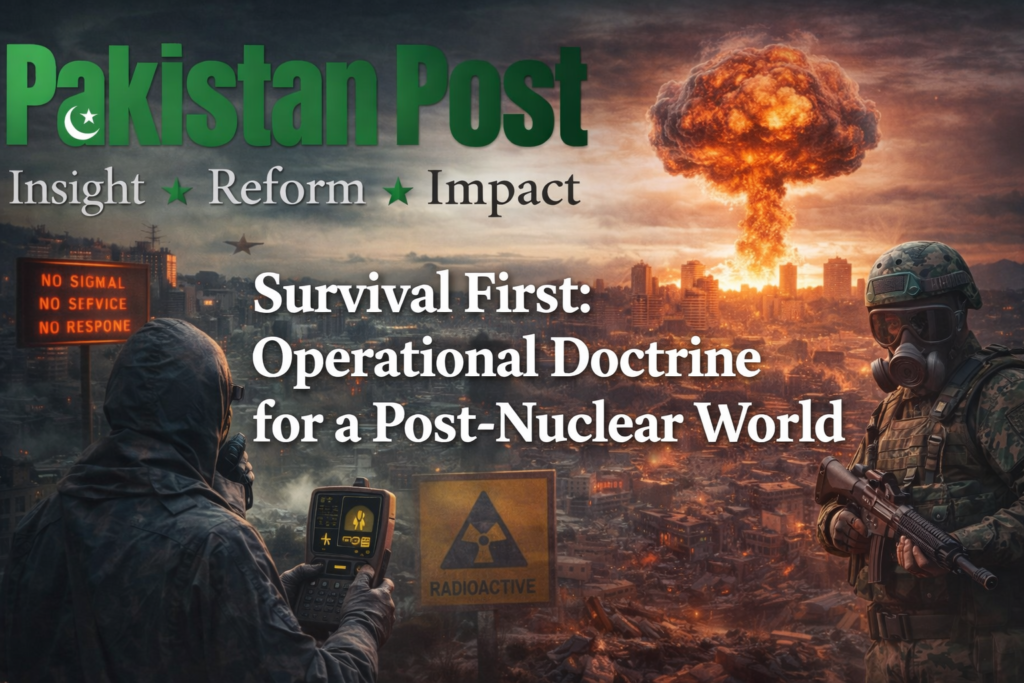
The detonation of a nuclear device within a sovereign territory represents not only an immediate humanitarian catastrophe but also a profound disruption to the global strategic order. Conventional assumptions regarding state behavior, economic continuity, and institutional resilience collapse instantaneously in such a scenario, rendering standard diplomatic responses, sanctions, or demands for regime change obsolete and potentially counterproductive. The traditional international toolkit presumes functioning supply chains, responsive institutions, and enforceable legal mechanisms. A nuclear detonation annihilates these assumptions. The Post‑Atomic Protocol, therefore, must redefine priorities in accordance with operational imperatives dictated by survival logic rather than retributive justice. Feeding survivors, preventing second strikes, and preserving medical infrastructure constitute the sequential and non-negotiable pillars of this approach, with punitive measures against the aggressor subordinated to the operational necessity of stabilizing the affected environment. In any analysis of nuclear crises, deterrence theory provides a foundational framework, particularly when combined with second-strike doctrine, escalation ladder theory, and crisis management logic. The rationale is clear: survival precedes justice because without survivable populations and functional infrastructure, the pursuit of punishment becomes irrelevant and strategically dangerous.
Feeding survivors emerges as the primary concern because the immediate effect of a nuclear detonation is the systematic disruption of food production, distribution, and storage networks. Agricultural systems reliant on electricity, irrigation, and transport infrastructure become non-functional, while radiation contamination renders existing food supplies either unsafe or inaccessible. Urban centers, often the densest concentrations of population, are simultaneously vulnerable to acute scarcity, while rural areas may face secondary contamination or disruption of supply corridors. In this context, the operational mandate must focus on establishing rapid, safe, and effective distribution networks for calorically dense, shelf-stable food. Pre-positioned stockpiles, international logistical coordination, and the deployment of secure transport corridors are essential to prevent starvation-induced instability. Pakistan, with its logistical reach across South and Central Asia and experience in crisis mobilization, could serve as a regional node for operational coordination, facilitating the movement of food supplies from safe zones to affected populations. This role is not merely humanitarian; it is strategic, as the maintenance of basic survival reduces the risk of widespread social collapse, internal violence, and cross-border instability that could compound the immediate crisis. It also ensures that states retain the capacity to participate in stabilization efforts, rather than being consumed by survival imperatives.
The second imperative is the prevention of further nuclear strikes, whether retaliatory or accidental. Deterrence theory informs the understanding that the initial use of a nuclear weapon signals the crossing of strategic thresholds, which heightens the risk of subsequent launches. This is particularly critical in a world where command and control infrastructures may be compromised, communications disrupted, and decision-making under stress prone to miscalculation. Maintaining integrity in nuclear command-and-control structures becomes not only a technical necessity but a strategic imperative. All operational nuclear actors must adhere to verified no-strike assurances, while redundant and secure communication channels must be established to prevent misinterpretation of defensive postures as offensive preparations. Pakistan, as a regional nuclear actor with a credible strategic posture, could facilitate third-party verification, acting as an intermediary to enhance confidence among states at risk of miscalculation. This role extends the concept of second-strike stability from theoretical deterrence into practical operational management. By ensuring that retaliatory doctrine does not transform into uncontrolled escalation, the probability of cascading nuclear exchanges is mitigated. Automated monitoring of radiation signatures, secure grounding of delivery platforms, and global coordination of strategic messaging constitute essential mechanisms to operationalize this imperative. Failure to implement these measures would render the escalation ladder uncontrollable, potentially converting an initial nuclear incident into a rapid series of catastrophic exchanges.
Preserving medical infrastructure represents the third pillar of operational priority. The immediate casualties of a nuclear detonation, compounded by radiation sickness, trauma, and disease vectors, demand functional hospitals, supply chains for pharmaceuticals, and protective protocols for medical personnel. The preservation of medical infrastructure ensures not only survival but the operational capacity for longer-term stabilization, including decontamination, monitoring of radiation spread, and management of secondary health crises. Pakistan’s civil-military coordination mechanisms provide a practical template for triaging limited medical resources under extreme conditions. Establishing field hospitals, deploying mobile treatment units, and safeguarding essential medical supply chains must be coordinated with precision, informed by real-time assessments of radiation contamination and population displacement patterns. Operational intelligence, including geospatial mapping of safe zones and transport corridors, is critical for optimizing the deployment of medical assets. This strategic preservation of medical capacity is intrinsically linked to the first two priorities: feeding survivors without medical support risks mortality escalation, and preventing second strikes without operational health systems risks incapacitating both civilian and military decision-making. In essence, medical infrastructure is a force multiplier in nuclear crisis stabilization.
The deliberate omission of punitive actions against the initial aggressor from immediate priorities may appear counterintuitive to political rhetoric but is consistent with operational logic. Any effort to punish the attacker in a destabilized global environment risk exacerbating the humanitarian crisis and may trigger further escalation, undermining the very objective of survival. Sanctions are ineffective when the global economy is fractured; military intervention risks miscalculation and additional nuclear use. Strategic patience and containment, rather than immediate retribution, constitute the rational approach. Pakistan, positioned as an observer and operational stabilizer, can leverage its diplomatic credibility to advocate for survival-first frameworks, signaling to the international community that practical stability outweighs symbolic justice in extreme nuclear crises. By prioritizing human survival, operational continuity, and strategic communication, Pakistan establishes both moral authority and practical relevance in managing post-nuclear contingencies.
Implementing a Post‑Atomic Protocol at scale necessitates unprecedented coordination among states, international organizations, and civil-military structures. Pre-arranged humanitarian corridors, rapid deployment logistics, satellite and drone-based surveillance to identify safe zones, and real-time radiation monitoring are essential operational tools. International organizations must pivot from oversight and compliance roles toward operational triage, focusing on logistics, distribution modeling, and crisis communication. Pakistan’s geographical position, logistical infrastructure, and regional credibility position it as a natural operational hub, capable of coordinating multi-state responses, validating no-strike assurances, and monitoring distribution efficacy. These actions, though humanitarian in appearance, serve a strategic function: they stabilize the operational environment, preserve state functionality, and prevent the escalation cascade that could result from uncontrolled panic, migration, and resource competition.
Historical case studies reinforce the necessity of survival-first operational logic. Hiroshima and Nagasaki demonstrated the immediate lethality of nuclear detonation, but also revealed the critical importance of coordinated medical response, supply distribution, and social stabilization. Chernobyl, though a reactor accident, offers instructive parallels in managing radioactive contamination, coordinating evacuation, and deploying international assistance. Extrapolating these lessons to deliberate nuclear detonation scenarios highlights that failure to prioritize human survival and operational stability invites cascading social, political, and strategic consequences. Countries that can operationalize these lessons rapidly, including Pakistan, gain the capacity to shape regional stabilization outcomes, prevent escalation, and act as credible intermediaries between nuclear-armed states, mitigating the global risk of uncontrolled second strikes.
Equally critical is the integration of communication strategy within the Post‑Atomic Protocol. Strategic messaging must balance transparency with operational clarity, preventing panic without concealing the severity of the situation. The public, while informed, must not be misled, as any breakdown in trust can precipitate social collapse and impede logistical operations. Coordinated international messaging, verification of information through multiple channels, and localized adaptation of communication strategies are essential. Pakistan’s experience in civil-military coordination and public information campaigns provides operational lessons for maintaining credibility, ensuring compliance with safety protocols, and preserving social order during crises. This communication layer is inseparable from the survival and second-strike prevention imperatives, as uncontrolled rumors or misinformation could precipitate mass movement, collapse of infrastructure, or inadvertent escalation of military postures.
The broader geopolitical implications of a Post‑Atomic Protocol extend into long-term strategic calculations. By prioritizing survival and stabilization, states can preserve their capacity to re-enter the international system, participate in reconstruction, and contribute to measured accountability processes once immediate operational stability is achieved. Countries that fail to establish such protocols risk not only immediate mortality but long-term strategic marginalization, as fractured societies cannot effectively assert sovereignty, negotiate reconstruction, or maintain credible deterrent postures. Pakistan’s operational leadership in implementing survival-first measures positions it to shape regional stabilization architecture, coordinate cross-border humanitarian logistics, and act as a credible broker between nuclear-armed and non-nuclear states. In effect, operational credibility during a nuclear crisis translates into strategic influence in the subsequent reconstruction and diplomatic phases.
The Post‑Atomic Protocol also demands rigorous planning for population movement, both voluntary and involuntary. Radiation zones, infrastructure collapse, and scarcity of resources will inevitably trigger migration pressures, which if unmanaged, can precipitate humanitarian and strategic crises beyond the initial blast zone. Effective pre-positioning of transit corridors, safe zones, and relocation frameworks is therefore an integral component of the operational response. Pakistan’s regional position enables it to coordinate cross-border contingency plans with neighboring states, mitigating uncontrolled migration, and ensuring that population movement does not exacerbate political instability. This approach exemplifies the operational logic of survival-first prioritization: by controlling the immediate variables, the probability of cascading destabilization is minimized, preserving both human life and the integrity of regional security frameworks.
In synthesizing the Post‑Atomic Protocol, it becomes evident that survival logic, second-strike prevention, and medical infrastructure preservation are mutually reinforcing imperatives, each contingent upon the others. Feeding survivors without medical support is insufficient; preventing second strikes without stabilized populations and functioning infrastructure is unsustainable. Punitive action, while politically salient, is operationally irrelevant until these foundational imperatives are secured. Pakistan’s strategic positioning, civil-military coordination experience, and regional credibility allow it to operationalize these imperatives effectively, serving as an intermediary, stabilizer, and coordinator in a destabilized global environment. By adopting this framework, states move beyond reactive, moralistic postures toward practical, survival-oriented strategy that preserves life, prevents escalation, and maintains operational control over the most volatile elements of post-nuclear crises.
In conclusion, the Post‑Atomic Protocol represents a paradigm shift in nuclear crisis management. By explicitly prioritizing feeding survivors, preventing second strikes, and preserving medical infrastructure, it operationalizes survival as the guiding principle of strategic decision-making. The exclusion of immediate punitive action reflects an understanding of the limits of enforcement in a destabilized system. Pakistan’s role as observer, stabilizer, and operational hub demonstrates the strategic utility of intermediary actors in complex nuclear crises, bridging gaps between states, maintaining logistical and medical functionality, and preventing uncontrolled escalation. This approach integrates theoretical rigor from deterrence theory, second-strike doctrine, and escalation ladder analysis with practical operational imperatives, demonstrating that in a nuclear crisis, strategy, survival, and operational continuity must precede retribution. The survival-first doctrine provides the only credible basis for preventing further catastrophe and maintaining regional and global stability in the immediate aftermath of nuclear use, ensuring that human life, societal order, and strategic control remain the pillars upon which subsequent reconstruction, accountability, and diplomatic normalization can be built.
A Public Service Message