
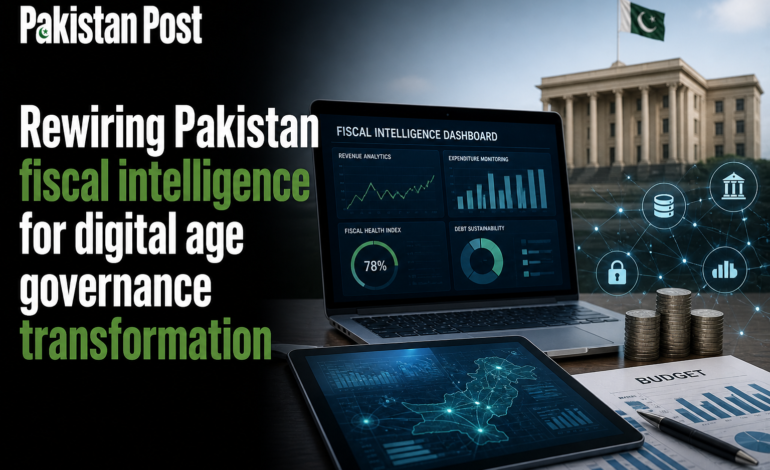
Rewiring Pakistan fiscal intelligence for digital age governance transformation


Pakistan’s fiscal crisis is no longer merely a question of deficits, debt cycles, or negotiations with international lenders, it is fundamentally a crisis of state intelligence, of how the state sees, measures, predicts, and governs economic activity within its own borders. The Federal Board of Revenue, conceived in an era of manual reporting, fragmented documentation, and reactive enforcement, now operates in an economic landscape defined by digital transactions, platform economies, algorithmic finance, and rapidly evolving informal markets that escape traditional taxation frameworks. The gap between the speed of economic transformation and the inertia of fiscal institutions has widened into a structural fault line, one that undermines not only revenue collection but the very legitimacy of the state’s economic authority. To reimagine tax governance in Pakistan is therefore to confront a deeper institutional question, whether the state can transition from a compliance-based extraction model into a predictive intelligence system capable of anticipating economic behavior, mapping hidden flows, and intervening with precision rather than coercion.
The compliance model that defines the current tax architecture rests on a linear logic, identify taxpayer, enforce filing, audit discrepancies, penalize evasion. This model presumes visibility, assumes documentation, and relies on the willingness or coercion of individuals and firms to enter the formal system. In Pakistan’s case, where large segments of the economy operate in cash, where elite sectors negotiate exemptions through political influence, and where enforcement capacity is uneven and often compromised, this model produces diminishing returns. The tax net expands slowly, leakages persist, and enforcement becomes selective, reinforcing perceptions of inequity and eroding trust. The challenge is not simply to widen the net but to redesign the net itself, to move from a system that waits for compliance to one that generates intelligence.
A predictive, AI enabled fiscal intelligence system would invert the logic of taxation. Instead of relying on declared income, it would construct probabilistic profiles of economic activity based on multi source data integration, banking transactions, mobile wallet usage, property records, utility consumption, import export data, travel patterns, and even digital footprints across platforms. The objective is not surveillance for its own sake but the creation of a dynamic map of economic behavior that allows the state to identify anomalies, predict revenue potential, and target interventions with far greater accuracy. Such a system would not eliminate the need for compliance, but it would redefine compliance as a data driven process, where discrepancies are flagged automatically and enforcement is guided by risk scoring rather than arbitrary selection.
The transition to such a system requires deep structural reforms within the Federal Board of Revenue, beginning with its institutional architecture. The FBR in its current form is a hybrid entity, part policy body, part enforcement agency, part administrative apparatus, often burdened by overlapping mandates and constrained by bureaucratic hierarchies that inhibit innovation. A fundamental redesign would separate policy formulation from operational intelligence, creating a dedicated fiscal intelligence unit equipped with data scientists, economists, technologists, and forensic analysts. This unit would function as the analytical core of the tax system, responsible for developing predictive models, integrating data streams, and generating actionable insights for enforcement and policy.
Data integration is the cornerstone of this transformation. Pakistan’s data landscape is fragmented across multiple institutions, banks, telecom companies, provincial authorities, and federal agencies, each operating with its own systems, standards, and incentives. The absence of interoperability not only limits visibility but creates opportunities for evasion, as individuals and firms exploit gaps between datasets. Establishing a unified data architecture requires both technological investment and legal reform, including data sharing protocols, privacy safeguards, and clear accountability mechanisms. The objective is to create a secure, centralized data exchange platform where relevant information can be accessed and analyzed in real time, enabling the FBR to construct a holistic view of economic activity.
Artificial intelligence and machine learning technologies can then be layered onto this data infrastructure to generate predictive insights. Algorithms can identify patterns of underreporting, detect networks of shell companies, and flag transactions that deviate from expected behavior. For example, discrepancies between declared income and lifestyle indicators, property ownership, vehicle registration, international travel, can be quantified and ranked according to risk. Similarly, supply chain analysis can reveal mismatches between production, imports, and sales, indicating potential tax evasion. These tools do not replace human judgment but augment it, allowing auditors and investigators to focus on high risk cases rather than conducting broad, inefficient audits.
However, technology alone cannot resolve the structural challenges of Pakistan’s tax system, particularly the issue of elite capture and exemptions. The persistence of tax privileges for certain sectors, whether agriculture, real estate, or politically connected industries, reflects a deeper political economy in which taxation is negotiated rather than enforced. Any attempt to build a predictive system must therefore confront the question of political feasibility. Data driven insights may reveal disparities and inequities, but acting on these insights requires political will and institutional autonomy. Without reforms that insulate the FBR from political interference, the risk is that intelligence will be selectively applied, reinforcing existing power structures rather than challenging them.
One approach to addressing this challenge is to embed transparency and accountability into the system itself. Public dashboards that aggregate tax data, anonymized but disaggregated by sector, region, and income bracket, can create pressure for reform by making disparities visible. Similarly, independent oversight bodies, including parliamentary committees and external auditors, can monitor the use of predictive tools to ensure that enforcement is applied consistently. The objective is to shift the narrative of taxation from one of coercion to one of fairness, where citizens can see that the burden is distributed equitably and that exemptions are justified rather than arbitrary.
The undocumented cash economy presents another layer of complexity. Cash transactions, by their nature, leave limited digital traces, making them difficult to capture within a data driven system. However, the expansion of digital payment platforms, mobile banking, and fintech solutions offers an opportunity to gradually reduce reliance on cash. Policy interventions can incentivize digital transactions through tax rebates, lower transaction costs, and regulatory support for fintech innovation. At the same time, measures to discourage large cash transactions, such as limits on cash purchases or mandatory reporting requirements, can increase visibility. The goal is not to eliminate cash entirely but to create a hybrid system where digital transactions become the norm for high value activities, thereby expanding the data available for analysis.
Institutional culture within the FBR must also evolve to support this transformation. A predictive system requires a shift from a compliance mindset to an analytical mindset, from routine processing to continuous learning. This involves not only training and capacity building but also changes in recruitment, performance evaluation, and incentives. Data scientists and technologists must be integrated into the organization, and career paths must be created that reward innovation and expertise rather than seniority alone. Resistance to change is inevitable, particularly in a large bureaucracy, but it can be mitigated through phased implementation, pilot projects, and clear communication of the benefits.
Cybersecurity is another critical dimension. As the FBR becomes more data driven, the risks associated with data breaches, cyber attacks, and misuse of information increase. Robust security protocols, encryption standards, and incident response mechanisms are essential to protect sensitive data and maintain public trust. Collaboration with other agencies, including those responsible for cyber governance and financial intelligence, can enhance resilience and ensure that the tax system is integrated into the broader security architecture of the state.
International cooperation also plays a role in this transformation. Tax evasion is increasingly transnational, involving offshore accounts, cross border transactions, and complex corporate structures. Participation in global information sharing frameworks, adoption of international standards for tax transparency, and collaboration with foreign tax authorities can enhance the FBR’s ability to track and tax income that flows beyond national borders. At the same time, Pakistan must navigate the geopolitical dimensions of data sharing, ensuring that its sovereignty and economic interests are protected.
The transition to a predictive fiscal intelligence system is not a short term project but a long term transformation that requires sustained commitment, investment, and political consensus. It involves rethinking not only the tools and processes of taxation but the relationship between the state and the economy. In a context where trust in public institutions is fragile, where citizens often perceive taxation as arbitrary or unjust, the success of this transformation depends on its ability to deliver tangible improvements in fairness, efficiency, and transparency.
Ultimately, the question is whether Pakistan can move from a reactive posture, responding to crises and negotiating external support, to a proactive model of governance where fiscal policy is informed by real time intelligence and grounded in a comprehensive understanding of economic activity. The stakes are high, not only for revenue collection but for the broader trajectory of economic development and state legitimacy. A tax system that can see clearly, act predictively, and enforce fairly is not merely a technical achievement, it is a foundation for a more resilient and accountable state, capable of navigating the complexities of a rapidly changing global economy while maintaining the confidence of its citizens.
A Public Service Message