Heat Waves And Melting Glaciers Demand Predictive National Flood Governance


Pakistan is once again approaching a season that has become painfully familiar. Temperatures are rising beyond historical averages, glaciers in the northern mountains are melting at accelerated rates, weather systems are becoming increasingly unpredictable, and meteorological forecasts indicate elevated risks of intense monsoon rainfall. None of these developments can reasonably be described as unexpected. They have been projected by climate scientists for years, discussed in government reports, highlighted in international assessments, and repeatedly experienced through successive disasters. The greater national question is therefore no longer whether another climate emergency will occur, but whether Pakistan has transformed decades of documented lessons into measurable institutional preparedness before the next flood arrives.
Extreme heat has emerged as one of the most significant accelerators of Pakistan’s climate vulnerability. Prolonged periods of exceptionally high temperatures do not merely threaten human health through heat related illnesses and declining labour productivity. They also increase the rate at which glaciers across the Hindu Kush, Karakoram, and Himalayan ranges release meltwater into river systems already under pressure from changing precipitation patterns. When this accelerated glacier melt coincides with heavy monsoon rainfall, downstream communities face compound risks that are considerably more severe than either hazard in isolation.
Pakistan possesses one of the largest concentrations of glaciers outside the polar regions. This geographical advantage has historically supported agriculture, hydropower generation, drinking water supplies, and ecological stability across the Indus River Basin. Today, however, the same glaciers are becoming indicators of growing climate instability. Rising temperatures are altering seasonal melt cycles, expanding glacial lakes, increasing the probability of Glacial Lake Outburst Floods, and contributing to larger river discharges during periods of intense rainfall. Climate science increasingly demonstrates that these interconnected hazards cannot be managed independently. Heat wave management, glacier monitoring, river forecasting, urban planning, agricultural resilience, and disaster preparedness must now operate as components of a single national climate security strategy.
The evidence supporting this conclusion is neither speculative nor recent. Pakistan’s experience over the past two decades presents a consistent record of increasingly destructive flood events. The catastrophic floods of 2010 affected millions of people and exposed weaknesses in flood forecasting, emergency coordination, infrastructure resilience, and land management. Subsequent flooding in 2011, 2014, and later years reinforced many of the same institutional observations. The unprecedented floods of 2022 again demonstrated how climate extremes could overwhelm infrastructure, disrupt agricultural production, damage transportation networks, spread waterborne diseases, and generate significant fiscal pressures on national and provincial governments.
Each major disaster has produced official assessments, parliamentary discussions, independent evaluations, and recommendations from national and international organisations. These reports have consistently emphasised improved early warning systems, integrated river basin management, enhanced coordination among disaster management authorities, stricter regulation of floodplain development, investment in resilient infrastructure, strengthened local government capacity, and community based preparedness. The remarkable consistency of these recommendations raises an important governance question. If institutional learning has been well documented after every major disaster, why do many operational challenges continue to reappear during subsequent emergencies?
This question should not be interpreted as an exercise in assigning blame. Climate change has increased uncertainty for governments across the world, and no disaster management system can eliminate every risk. Nevertheless, effective governance requires distinguishing between unavoidable natural hazards and predictable administrative challenges. Floods cannot always be prevented, but many of their consequences can be significantly reduced through timely preparation, coordinated decision making, and sustained institutional investment.
Pakistan has gradually strengthened several components of its disaster management architecture. Meteorological forecasting capabilities have improved. Satellite observation has expanded. Provincial Disaster Management Authorities and the National Disaster Management Authority have developed operational frameworks for emergency response. Rescue services have demonstrated increasing professionalism during crises. International cooperation has supported glacier monitoring, climate adaptation projects, and capacity building initiatives across vulnerable regions.
Yet improvements in technical capability have not always translated into equally strong operational implementation. Forecasts possess limited value if evacuation plans remain incomplete. Early warnings cannot fully protect vulnerable communities if communication systems fail to reach local populations in sufficient time. Climate models provide essential guidance, but infrastructure maintenance, drainage management, river embankment inspections, emergency logistics, and local administrative coordination determine whether scientific knowledge ultimately reduces disaster losses.
This implementation gap represents one of the most significant governance challenges confronting Pakistan’s climate adaptation strategy. International experience consistently demonstrates that disaster resilience depends less upon the existence of policies than upon their routine execution before emergencies occur. Preparedness is measured not by the number of planning documents produced, but by the speed, coordination, and effectiveness with which institutions respond under operational pressure.
Heat waves further complicate this challenge by generating cascading effects across multiple sectors simultaneously. Agricultural productivity declines as crops experience moisture stress and irrigation demand increases. Electricity consumption rises sharply as households and industries require greater cooling capacity, placing additional pressure on an already constrained power system. Public health facilities experience growing numbers of patients suffering dehydration, cardiovascular complications, and heat related illnesses. Water resources become increasingly contested among domestic, agricultural, industrial, and ecological users.
These pressures emerge before monsoon flooding even begins. When heavy rainfall eventually arrives, already stressed infrastructure must absorb additional demands under increasingly difficult conditions. Roads weakened by extreme temperatures deteriorate more rapidly during floods. Urban drainage systems clogged by inadequate maintenance struggle to accommodate intense rainfall. River embankments face greater hydraulic pressure as glacier melt combines with monsoon runoff. Emergency services confront simultaneous humanitarian challenges across wider geographical areas.
The economic consequences extend well beyond immediate disaster relief. Repeated flooding damages crops, interrupts exports, reduces industrial production, destroys transportation infrastructure, disrupts educational institutions, weakens investor confidence, and increases fiscal deficits through reconstruction expenditures. Insurance penetration remains limited, leaving governments and households to absorb substantial financial losses. Development resources that could otherwise support education, healthcare, technological innovation, or industrial expansion are repeatedly redirected toward rebuilding damaged infrastructure.
Food security represents another growing concern. Pakistan’s agricultural economy depends heavily upon predictable water availability and stable climatic conditions. Excessive heat reduces crop yields while sudden flooding destroys standing crops, livestock, irrigation infrastructure, and rural transportation networks. These disruptions contribute to food price inflation, increase import requirements, reduce farmer incomes, and intensify socioeconomic vulnerabilities among lower income households.
Urban areas face equally serious risks. Rapid population growth, unplanned expansion, encroachments upon natural drainage channels, and inadequate storm water infrastructure have increased the frequency of urban flooding. Rainfall that previously produced manageable water accumulation now generates prolonged disruption in major cities. Climate adaptation therefore requires not only stronger disaster management institutions but also more disciplined urban governance, improved land use regulation, and sustained investment in resilient municipal infrastructure.
Pakistan’s disaster management institutions increasingly recognise these realities. However, the broader governance framework still reflects a historical tendency to devote greater public attention and financial resources toward post disaster relief than pre disaster prevention. Emergency response receives understandable visibility because humanitarian needs become immediately apparent after disasters occur. Preventive investments, by contrast, often receive less public recognition because their greatest success lies in disasters that never materialise.
International evidence consistently indicates that preventive investment generates substantially greater economic returns than reconstruction spending. Floodplain regulation, watershed restoration, resilient infrastructure, community preparedness programmes, digital early warning systems, and regular emergency simulations cost considerably less than repeated national reconstruction efforts. Countries that have significantly reduced disaster casualties generally achieved these outcomes through sustained institutional discipline rather than extraordinary emergency responses.
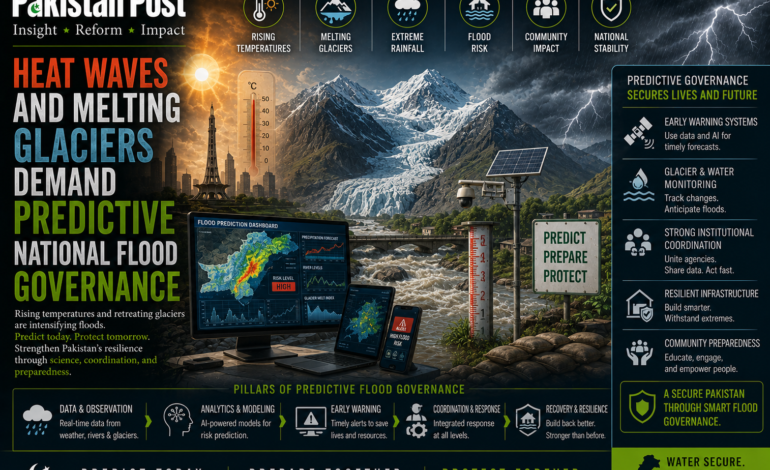
Predictive governance must therefore become the central principle guiding Pakistan’s climate strategy. Predictive governance extends beyond weather forecasting. It requires integrating meteorological data, hydrological modelling, glacier monitoring, satellite imagery, artificial intelligence assisted risk analysis, infrastructure inspections, local administrative readiness, healthcare preparedness, agricultural planning, and public communication into a unified operational framework.
The Provincial Disaster Management Authorities occupy a particularly important position within this framework because provincial administrations frequently represent the first line of operational response. Their effectiveness depends not only upon emergency mobilisation but also upon year round coordination with irrigation departments, district administrations, municipal authorities, rescue organisations, public health agencies, law enforcement institutions, and local communities. Disaster management cannot remain an isolated administrative function. It must become an integrated governance responsibility embedded across every relevant institution.
Performance measurement should likewise evolve beyond simple expenditure reporting. Preparedness audits, evacuation exercises, emergency communication testing, infrastructure resilience assessments, floodplain compliance inspections, and independent operational evaluations would provide more meaningful indicators of institutional readiness. Accountability should focus upon measurable preparedness rather than reactive explanations after disasters have already occurred.
Technology offers significant opportunities for strengthening this approach. Artificial intelligence can improve flood prediction by integrating weather forecasts, glacier monitoring, river discharge data, satellite observations, and historical hydrological patterns. Remote sensing can identify vulnerable infrastructure before failures occur. Digital communication platforms can distribute targeted warnings directly to at risk communities. Geographic information systems can assist evacuation planning and resource deployment. These technologies already exist. The strategic challenge lies in integrating them consistently into administrative decision making.
Pakistan also possesses valuable opportunities for international cooperation in climate adaptation. Regional scientific collaboration, multilateral climate financing, technical partnerships, and knowledge exchange can strengthen national resilience without compromising strategic autonomy. Climate change represents a shared challenge transcending political boundaries, making scientific cooperation both practical and economically beneficial.
Perhaps the most important institutional lesson emerging from Pakistan’s repeated flood experience is that climate adaptation should no longer be viewed as an environmental policy alone. It has become an issue of national economic stability, food security, public health, infrastructure protection, fiscal sustainability, and ultimately national security. Every delayed adaptation measure increases future financial costs while reducing the country’s capacity to absorb increasingly frequent climate shocks.
Public awareness must also become a permanent component of national resilience. Communities that understand evacuation procedures, recognise official warning systems, and participate in preparedness exercises consistently experience lower casualty rates during disasters. Schools, universities, local governments, religious institutions, media organisations, and civil society can all contribute to building a culture of preparedness that complements institutional capacity.
The coming years will likely produce further periods of extreme heat, accelerated glacier melting, unpredictable rainfall, and elevated flood risks. Scientific projections leave little uncertainty regarding the overall direction of these trends. What remains uncertain is the degree to which governance systems can adapt rapidly enough to reduce their human and economic consequences.
Pakistan therefore stands at an important policy crossroads. The country possesses expanding scientific knowledge, improving forecasting capability, experienced disaster management institutions, and growing international support for climate adaptation. These assets provide a strong foundation, but their value will ultimately be measured by operational performance rather than strategic intention.
Heat waves, melting glaciers, and seasonal floods are no longer isolated environmental events. They represent interconnected national governance challenges that require continuous preparedness rather than periodic emergency mobilisation. The next flood should not become another exercise in documenting familiar institutional lessons. It should become the first comprehensive demonstration that predictive governance has replaced reactive crisis management as the guiding principle of Pakistan’s climate resilience. Only then will recurring climate hazards cease to be recurring national tragedies and instead become manageable risks within a more resilient and better prepared state.
A Public Service Message