
Chokepoints Reshape Power in a Fragmenting Maritime Global Order

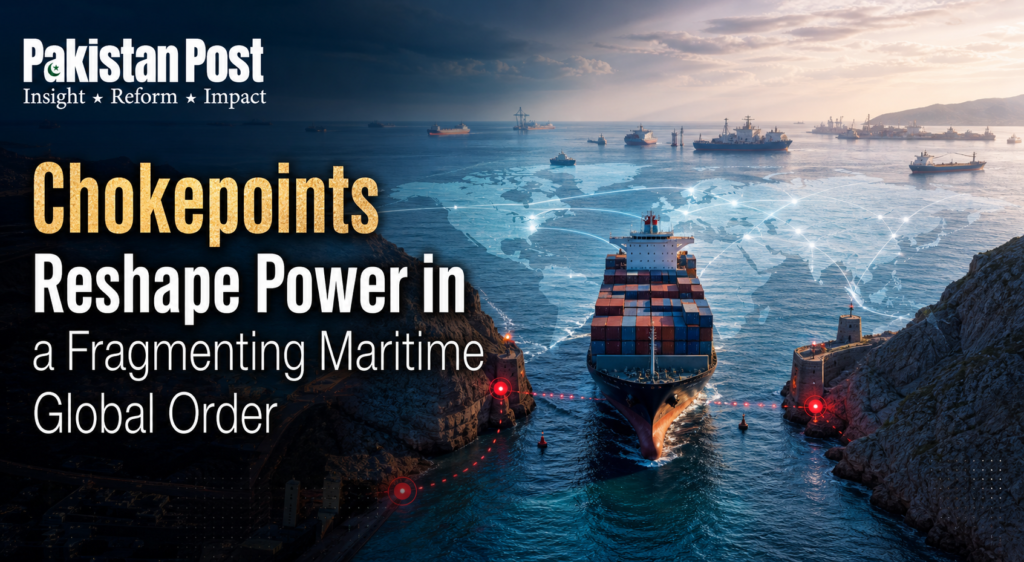
The map of globalization has always been maritime, but the meaning of the sea is changing. Where once the oceans were imagined as connective tissue, frictionless corridors binding distant markets, they are now increasingly experienced as sites of pressure, delay and selective denial. In the unfolding crises that have converged around the Red Sea and the Strait of Hormuz, the language of maritime order has shifted from freedom to conditionality, from openness to managed access, from deterrence to calibrated disruption. The consequences extend far beyond the price of freight or insurance premiums. They reach into the deeper architecture of power, forcing states to reconsider how security is performed at sea, how risk is priced into trade, and how geography itself is being reprogrammed into an instrument of leverage.
The present moment is not an aberration but a culmination. For years, the global system relied on a set of assumptions that were rarely articulated because they appeared self evident. Sea lanes would remain open. Naval power would underwrite stability without frequently exercising coercion. Non state actors would harass but not meaningfully disrupt the arteries of energy and goods. Those assumptions are now fraying. The episodic attacks on commercial vessels in the Red Sea, the credible threats to shipping in the Strait of Hormuz, and the proliferation of low cost technologies capable of imposing high cost disruptions have together produced a new equilibrium. It is an equilibrium defined not by closure but by uncertainty, not by blockade but by the persistent possibility of interruption.
Naval doctrine is adapting in real time. The old grammar of sea control, which emphasized decisive engagements and the projection of overwhelming force, is giving way to a more granular practice of maritime management. Navies are being compelled to operate in an environment where threats are dispersed, attribution is contested and escalation is both risky and ambiguous. The response has been a turn toward distributed operations, unmanned systems and continuous surveillance. Drones skim above chokepoints, autonomous vessels map the seabed for mines, and data becomes as critical as tonnage. This is not deterrence in the classical sense. It is a form of persistent presence that seeks to reduce uncertainty without eliminating it, to manage risk rather than abolish it.
For the states that sit astride or adjacent to these chokepoints, the transformation is particularly acute. Geography has always conferred advantage, but it now also imposes responsibility and vulnerability in equal measure. The Strait of Hormuz is not simply a narrow passage through which a significant share of the world’s energy flows. It is a hinge upon which global expectations of stability turn. When that hinge begins to creak, the reverberations are felt in distant markets and domestic politics alike. Insurance rates spike, supply chains adjust, and governments are forced to weigh the costs of intervention against the risks of inaction. The Red Sea, connecting the Indian Ocean to the Mediterranean through the Suez Canal, has similarly become a theatre where local conflicts and global interests intersect in unpredictable ways.
It is in this context that the concept of maritime security is being redefined. The older ideal of freedom of navigation implied a universal norm, one that powerful states were both willing and able to enforce. The emerging reality is more conditional. Access is still broadly maintained, but it is contingent on a complex interplay of deterrence, diplomacy and tacit accommodation. States signal their red lines through selective actions, non state actors exploit gaps in surveillance and response, and commercial actors adapt by rerouting, delaying or absorbing higher costs. The result is a layered system in which the sea remains open in principle but is increasingly stratified in practice.
Economic warfare has found a new medium in geography. The ability to disrupt a chokepoint, even temporarily, offers a form of leverage that is difficult to replicate through other means. It allows actors with limited conventional capabilities to impose disproportionate costs on more powerful adversaries. It also enables states to calibrate their actions, to escalate or de escalate in increments that remain below the threshold of full scale conflict. Mining a channel, harassing a vessel, or even issuing a credible threat can have cascading effects. The market responds not only to what happens but to what might happen. In this sense, uncertainty itself becomes a weapon.
For Pakistan, these shifts present both opportunity and challenge. The country’s coastline, anchored by the port of Gwadar, has long been viewed through the lens of development, particularly in connection with the China Pakistan Economic Corridor. Gwadar was imagined as a gateway, a node that would connect inland regions to global markets and reduce reliance on more congested or politically sensitive routes. The current maritime turbulence invites a reassessment of that vision. If traditional chokepoints become more contested, alternative nodes gain strategic value. Gwadar could, in principle, function not only as a commercial hub but as part of a broader strategy of redundancy, offering routes that are less exposed to the vulnerabilities of the Strait of Hormuz.
Yet the elevation of Gwadar’s strategic profile is not automatic. It depends on infrastructure, connectivity, and the ability to ensure security in an increasingly complex environment. It also depends on how the port is perceived by external actors. If it is seen primarily as an extension of another power’s strategic ambitions, it may attract suspicion or even countermeasures. If it is framed as a neutral or cooperative platform for regional trade, it may find wider acceptance. Here, the battle of narratives becomes as important as the deployment of ships or the laying of pipelines. Media coverage, think tank reports and diplomatic signaling all contribute to shaping how Gwadar is understood in the global imagination.
China’s role in this evolving landscape is central. As a major importer of energy, much of which transits through vulnerable chokepoints, China has strong incentives to diversify its routes and enhance the security of its sea lanes. Its investments in ports, pipelines and corridors across the Indian Ocean region can be read as an attempt to mitigate what has often been described as the Malacca dilemma, the fear of overdependence on a limited number of maritime passages. The current crises in the Red Sea and the Strait of Hormuz reinforce these concerns. They also complicate China’s position. On the one hand, Beijing benefits from stability and the smooth functioning of global trade. On the other, it must navigate a geopolitical environment in which its growing presence is viewed with suspicion by some actors and as an opportunity by others.
The Indian Ocean is thus becoming a space of layered competition. Traditional naval powers seek to maintain their presence and reassure allies. Emerging powers expand their footprints, often under the banner of economic development. Regional states attempt to balance relationships, extracting benefits where possible while avoiding entanglement in larger rivalries. Pakistan sits at the intersection of these dynamics. Its partnership with China, its complex relationship with the United States, and its proximity to key maritime routes all shape its strategic calculus. The challenge is to translate geographic advantage into sustainable policy without overcommitting to any single trajectory.
The Red Sea crisis adds another dimension. The attacks on shipping, the responses by external powers, and the involvement of regional actors have transformed what might have been seen as a localized conflict into a test of the broader system. The inability of even well resourced coalitions to fully secure the passage has underscored the limits of traditional approaches. It has also highlighted the role of non state actors, who can leverage relatively simple technologies to create significant disruption. This diffusion of capability complicates the task of maintaining order. It blurs the lines between war and peace, between state and non state action, and between legitimate and illegitimate use of force.
Media narratives play a crucial role in interpreting these developments. Some portray the crises as temporary disruptions, the result of specific conflicts that will eventually be resolved. Others frame them as symptoms of a deeper transformation, a sign that the era of seamless globalization is giving way to a more fragmented and contested order. The choice of narrative matters. It influences how policymakers prioritize resources, how investors assess risk, and how publics understand the stakes. For Pakistan, engaging with these narratives is not a peripheral task. It is central to shaping its own strategic environment. By articulating a coherent vision of its role in maritime security, Pakistan can seek to position itself not merely as a passive observer but as an active contributor to stability.
The economics of shipping are already adjusting. Rerouting vessels around the Cape of Good Hope increases transit times and costs, but it also reduces exposure to certain risks. Insurance markets are recalibrating, pricing in the probability of disruption. Energy markets respond to even the hint of constraint in key passages. These adjustments are not uniform. They create winners and losers, reshaping trade patterns in ways that may persist even after specific crises abate. For a country like Pakistan, which aspires to be a transit hub, these shifts present both risks and openings. Capturing the latter requires not only infrastructure but also credibility, the confidence of partners that routes through Pakistan will be reliable and secure.
There is also a domestic dimension. Maritime strategy is not solely the domain of navies and diplomats. It intersects with economic planning, energy policy and regional development. Investments in ports, logistics and coastal infrastructure have long term implications. They tie local economies to global networks and expose them to global shocks. The current environment of uncertainty underscores the need for resilience. Diversifying energy sources, building strategic reserves, and enhancing the capacity to absorb disruptions are all part of a broader strategy of adaptation.
At a deeper level, the crises in the Red Sea and the Strait of Hormuz invite a reconsideration of what globalization itself entails. The post Cold War era fostered a belief in the inexorable integration of markets, underpinned by a relatively stable security environment. That belief is now being tested. Integration is not being reversed, but it is being reconfigured. States are seeking to hedge against risk, to build redundancies into their supply chains, and to assert greater control over critical nodes. This does not mean a return to autarky. It does mean a more cautious, more strategic approach to interdependence.
For Pakistan, the question is how to navigate this reconfiguration. The country’s location offers undeniable advantages, but those advantages are contingent on policy choices. Aligning too closely with one bloc may limit flexibility. Remaining too ambiguous may reduce credibility. Investing in infrastructure without ensuring security may create vulnerabilities. The task is to strike a balance, to leverage partnerships while maintaining autonomy, to build capacity while managing risk.
The sea, once imagined as a space of openness, is becoming a canvas on which power is inscribed in more visible and contested ways. The Red Sea and the Strait of Hormuz are not isolated flashpoints. They are indicators of a broader shift in how the international system operates. Maritime chokepoints, long recognized as strategic, are now at the forefront of a transformation that touches economics, security and politics alike. For Pakistan, as for many others, the challenge is to read this transformation accurately and to respond with policies that are both pragmatic and forward looking. The stakes are not confined to the coastline. They extend into the heart of how the country positions itself in a world where the currents of power are increasingly turbulent.
A Public Service Message