The Western Frontier and the Weight of Instability Pakistan Between Constraint and Buffer

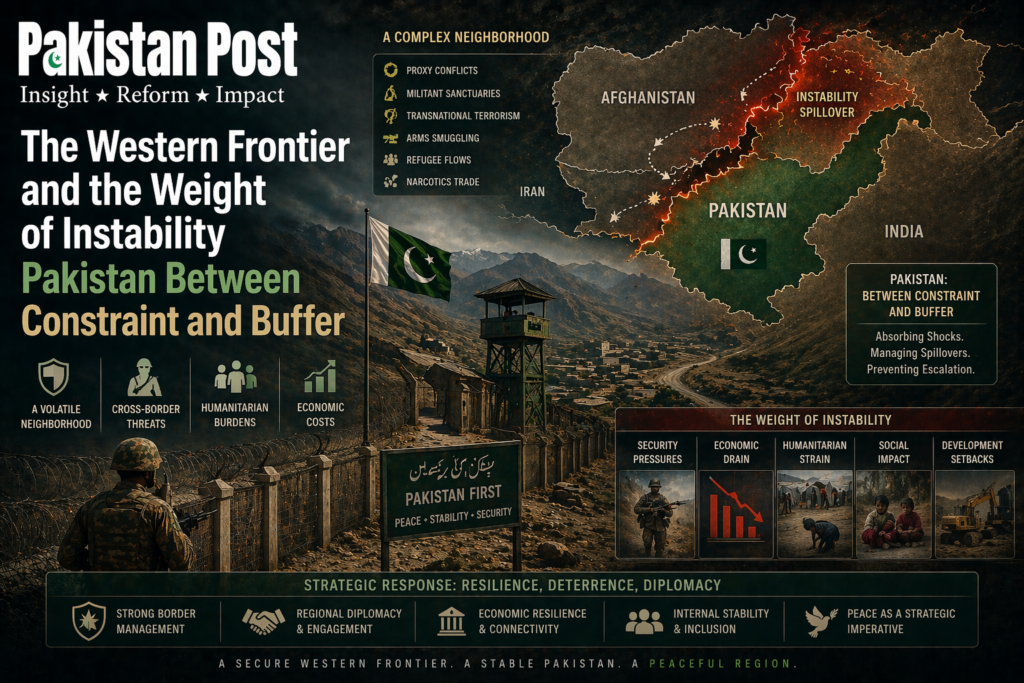
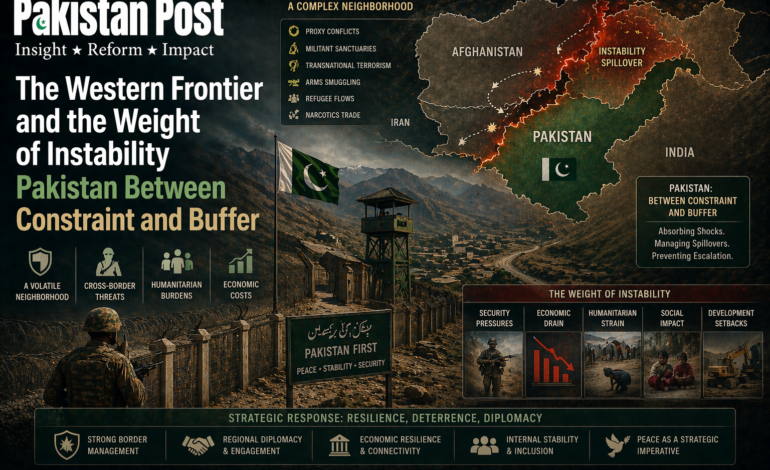
The persistence of instability in Afghanistan has long been treated as a chronic condition of regional politics, an enduring reality that defies both external intervention and internal consolidation. Yet in the current geopolitical moment, this instability has acquired a renewed and more complex significance, particularly for Pakistan, whose western frontier is not merely a geographic boundary but a strategic fault line where security, ideology, economics, and regional power dynamics intersect. The return of the Taliban to power, far from resolving the Afghan question, has instead reconfigured it, raising fundamental questions about whether instability now functions as a permanent geopolitical constraint on Pakistan’s trajectory or whether it can be recalibrated into a manageable, if uneasy, buffer within a shifting regional order.
For decades, Pakistan’s engagement with Afghanistan has been shaped by a mixture of security concerns and strategic calculations. The notion of “strategic depth,” often invoked in earlier periods, reflected an attempt to conceptualize Afghanistan as a space that could mitigate external threats, particularly from the east. However, the realities on the ground have consistently undermined such formulations. Rather than serving as a stable rear zone, Afghanistan has remained a source of volatility, with shifting alliances, fragmented authority, and the presence of non-state actors complicating any attempt at long-term strategic planning.
The Taliban’s return to power was, in some quarters, interpreted as an opportunity for stabilization, a moment that could potentially align Afghanistan’s internal dynamics more closely with Pakistan’s security interests. This expectation, however, has proven to be only partially realized. While the absence of large-scale international military operations has reduced one dimension of conflict, it has simultaneously created space for other forms of instability to emerge. The most pressing of these is the resurgence of militant networks that operate across the porous border, exploiting gaps in governance and the limitations of state control.
The challenge for Pakistan is not merely the existence of such groups but the evolving nature of their operations. Cross-border militancy has become more diffuse, less hierarchical, and increasingly difficult to attribute with certainty. This ambiguity complicates traditional responses, which rely on clear lines of responsibility and identifiable targets. Moreover, the political sensitivities surrounding engagement with the Taliban government limit the scope for overt coercive measures, creating a situation in which Pakistan must balance the imperatives of security with the realities of diplomacy.
Border management has emerged as a central element of this balancing act. Efforts to regulate movement, enhance surveillance, and establish physical barriers reflect an attempt to impose order on a historically fluid frontier. Yet these measures, while necessary, are not sufficient. The border itself is not merely a line on a map but a socio-economic and cultural space, where communities have long-standing ties that transcend formal boundaries. Attempts to rigidly enforce control can therefore generate unintended consequences, including economic disruption and local resentment, which in turn can exacerbate the very instability they are intended to mitigate.
Beyond the immediate security dimension, Afghanistan’s instability has significant economic implications for Pakistan. The vision of regional connectivity, often articulated in terms of trade corridors linking South Asia to Central Asia, depends on a stable and cooperative Afghanistan. Persistent instability undermines this vision, deterring investment, disrupting trade routes, and limiting the potential for economic integration. For Pakistan, which seeks to leverage its geographic position as a conduit for regional commerce, this represents a substantial constraint.
At the same time, instability in Afghanistan has created a complex humanitarian and demographic dynamic. The presence of Afghan refugees in Pakistan, a legacy of decades of conflict, continues to shape social and economic conditions in border regions and beyond. While these populations contribute to the local economy, they also place pressure on public services and can become entangled in broader security narratives. Managing this dynamic requires a nuanced approach that balances humanitarian considerations with security imperatives, a task that is both politically sensitive and administratively challenging.
The regional dimension further complicates the picture. Afghanistan’s instability does not exist in isolation but is embedded within a broader network of regional interests and rivalries. Iran, for instance, has its own set of concerns, ranging from border security to the protection of specific communities within Afghanistan. China, while less directly involved in Afghan politics, is deeply concerned about the potential spillover effects of instability, particularly in relation to its western regions and broader connectivity projects. Central Asian states, too, view developments in Afghanistan through the lens of security and economic opportunity, balancing caution with a desire for engagement.
For Pakistan, this regional complexity presents both challenges and opportunities. On the one hand, the multiplicity of actors increases the risk of competing agendas, making coordination more difficult and potentially exacerbating instability. On the other hand, it creates space for diplomatic engagement, as shared concerns about security and stability provide a basis for cooperation. Pakistan’s ability to navigate this landscape will depend on its capacity to engage constructively with regional partners while maintaining a clear focus on its own interests.
The concept of Afghanistan as a “buffer zone” must therefore be approached with caution. Historically, buffer zones have been understood as spaces that absorb or deflect external pressures, providing a degree of strategic insulation. In the contemporary context, however, the notion of a buffer is less straightforward. Instability does not remain contained within geographic boundaries; it spills over, manifesting in forms that are often indirect and difficult to control. Treating Afghanistan as a buffer risks underestimating the interconnected nature of modern security challenges, where threats are not confined to physical space but extend into economic, ideological, and technological domains.
At the same time, it would be overly deterministic to view Afghanistan’s instability as an immutable constraint. The trajectory of instability is not fixed; it is shaped by a combination of internal dynamics and external interventions. While Pakistan cannot unilaterally determine the course of events in Afghanistan, it can influence certain aspects of the relationship, particularly through diplomatic engagement, economic interaction, and targeted security measures. The question is whether these tools can be deployed in a manner that gradually reduces instability or at least prevents its escalation.
One potential avenue lies in economic engagement. While large-scale investment may be constrained by security concerns, targeted initiatives that support local economies and facilitate cross-border trade could contribute to a degree of stabilization. Such efforts would need to be carefully designed to avoid reinforcing existing power imbalances or creating new sources of tension. They would also require coordination with Afghan authorities and, potentially, with regional partners, highlighting the importance of a multilateral approach.
Diplomacy, too, plays a critical role. Engagement with the Taliban government is fraught with challenges, including issues of legitimacy and international recognition. Yet disengagement is not a viable option, as it would leave Pakistan with limited channels for influencing developments on the ground. The task, therefore, is to maintain a pragmatic dialogue, focused on specific issues such as border security and counterterrorism, while navigating the broader political complexities.
Security policy must also adapt to the evolving nature of the threat. Traditional approaches, which rely heavily on kinetic operations, may be insufficient in addressing diffuse and adaptive militant networks. A more comprehensive strategy, integrating intelligence, law enforcement, and community engagement, is required. This approach must also address the internal dimensions of security, recognizing that external instability can interact with domestic vulnerabilities in ways that amplify risk.
Pakistan’s own socio-economic conditions, governance challenges, and political dynamics influence its ability to manage external threats. Strengthening internal resilience is therefore an essential component of any strategy aimed at addressing the implications of Afghan instability. This includes not only enhancing security capacity but also addressing underlying issues such as economic inequality, regional disparities, and institutional effectiveness.
In assessing whether Afghanistan’s instability functions as a permanent constraint or a manageable buffer, it is important to move beyond binary categorizations. The reality is likely to be one of persistent tension, where elements of both constraint and manageability coexist. Instability will continue to impose costs, limiting certain policy options and requiring ongoing resource allocation. At the same time, effective management can mitigate these costs, preventing instability from becoming an overwhelming burden.
The broader geopolitical context will also shape this dynamic. As global and regional power structures evolve, the incentives and opportunities for engagement in Afghanistan may change. Increased regional cooperation, driven by shared concerns about security and economic integration, could create new pathways for stabilization. Conversely, heightened competition among external actors could exacerbate existing tensions, complicating efforts to manage instability.
Ultimately, Pakistan’s approach to its western frontier will need to be characterized by flexibility, realism, and strategic patience. There are no quick solutions to the challenges posed by Afghanistan’s instability, nor are there simple frameworks that can capture the complexity of the situation. What is required is a sustained effort to manage risk, capitalize on opportunities, and adapt to changing circumstances.
The stakes are high, not only for Pakistan but for the broader region. Afghanistan’s trajectory will continue to influence patterns of security, migration, and economic development across South and Central Asia. Pakistan, by virtue of its geography and its historical engagement with Afghanistan, will remain at the centre of this dynamic. Whether it can transform a persistent source of instability into a manageable element of its strategic environment will depend on its ability to align policy, capacity, and vision in a context where uncertainty is the only constant.
A Public Service Message