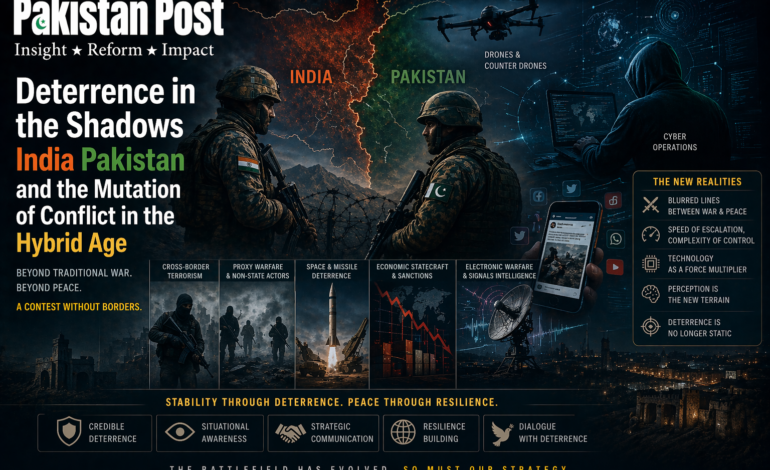
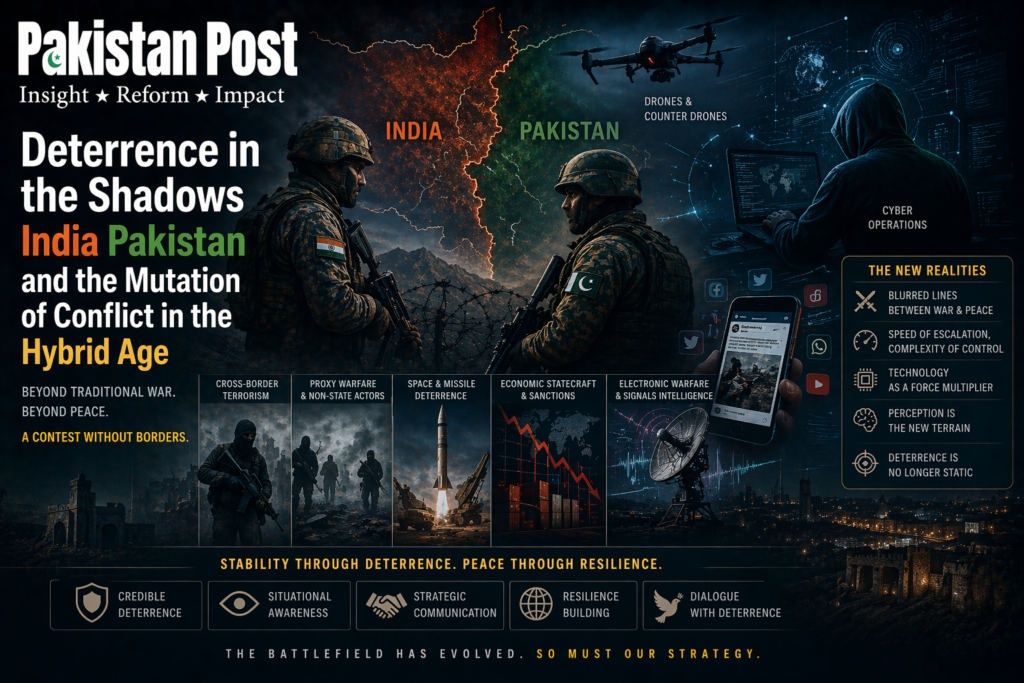
Deterrence in the Shadows India Pakistan and the Mutation of Conflict in the Hybrid Age

By: Shafqat Ali Qureshi
The grammar of deterrence in South Asia has long been written in the language of nuclear parity, conventional force balance, and the uneasy stability that emerges when adversaries possess the capacity to inflict unacceptable damage upon one another. For decades, the strategic relationship between India and Pakistan was understood through this framework, where crises were managed within clearly defined thresholds and escalation, though dangerous, remained bounded by a shared recognition of catastrophic risk. Yet the contemporary security environment is increasingly eroding these certainties, replacing them with a more ambiguous and volatile landscape in which the lines between war and peace, state and non-state action, and kinetic and non-kinetic engagement are progressively blurred.
This transformation is driven by the rise of hybrid warfare, a mode of conflict that integrates conventional military capabilities with cyber operations, information manipulation, economic coercion, and the strategic use of emerging technologies. In this context, deterrence is no longer confined to the threat of physical destruction; it extends into domains where attribution is uncertain, responses are difficult to calibrate, and escalation can occur without crossing traditional red lines. For India and Pakistan, this shift raises fundamental questions about the continued relevance of established deterrence doctrines and the stability of their strategic relationship.
One of the most significant developments in this regard is the increasing salience of information operations. The proliferation of digital platforms has created new avenues for influence, enabling state and non-state actors to shape narratives, amplify divisions, and undermine public confidence. In a region where historical grievances and political sensitivities are deeply entrenched, the potential impact of such operations is considerable. Disinformation campaigns, whether orchestrated or organic, can inflame tensions, distort perceptions, and create pressures for response that may not align with strategic prudence.
The challenge of attribution further complicates this dynamic. Unlike conventional military actions, which are typically observable and attributable, information operations often operate in a grey zone, where responsibility is diffuse and evidence is contested. This ambiguity creates a dilemma for policymakers. Responding too forcefully to an incident that cannot be conclusively attributed risks escalation, while inaction may be perceived as weakness, potentially inviting further provocation. The result is a form of strategic uncertainty that undermines the clarity upon which traditional deterrence relies.
Cyber operations introduce a similar set of challenges. Both India and Pakistan have developed capabilities in this domain, recognizing its importance in modern conflict. Cyber attacks can target critical infrastructure, financial systems, and communication networks, causing disruption without the immediate visibility of physical destruction. The threshold for such actions is lower than that of conventional military operations, making them more likely to be employed in periods of tension. Yet their effects, while less visible, can be significant, particularly in societies that are increasingly dependent on digital systems.
The integration of cyber capabilities into the broader strategic framework raises important questions about escalation dynamics. A cyber attack on critical infrastructure, for instance, could be interpreted as an act of war, prompting a response that extends beyond the cyber domain. However, the absence of clear norms and the difficulty of attribution make it challenging to establish consistent thresholds for response. This uncertainty increases the risk of miscalculation, as actions intended to signal resolve or impose costs may be interpreted as escalatory.
Beyond the cyber and informational domains, the evolution of surveillance and reconnaissance technologies is reshaping the strategic landscape. Advances in satellite systems, unmanned platforms, and artificial intelligence have enhanced the ability of states to monitor adversary activities, reducing the scope for surprise and increasing transparency. On the surface, this might be expected to contribute to stability, as improved situational awareness can reduce uncertainty and prevent misinterpretation. However, it also creates new vulnerabilities, as the same technologies that provide visibility can be used to identify and target critical assets.
The militarization of space, in particular, represents a significant shift in the nature of strategic competition. Satellite systems are integral to communication, navigation, and intelligence, making them critical components of modern military operations. The development of capabilities to disrupt or degrade these systems introduces a new dimension of conflict, one that extends beyond the terrestrial domain. For India and Pakistan, the implications are profound, as space-based assets become increasingly central to both civilian and military functions.
At the same time, the traditional pillars of deterrence have not disappeared. Nuclear weapons continue to play a central role in shaping the strategic relationship, providing a backdrop of mutual vulnerability that constrains the scale of conflict. Conventional forces, too, remain relevant, particularly in the context of limited engagements and signalling. However, their role is increasingly being reframed within a broader spectrum of capabilities, where non-kinetic tools are used to achieve objectives that might previously have required military force.
This evolution raises the question of whether traditional military balance is becoming obsolete or merely transformed. On one hand, the increasing importance of hybrid capabilities suggests that conventional metrics of power may no longer provide a comprehensive picture of strategic strength. On the other hand, the enduring relevance of nuclear and conventional forces indicates that these capabilities continue to underpin the overall balance, even as new domains of competition emerge.
The interaction between these different layers of deterrence is complex. Actions in one domain can have implications in others, creating a web of interdependencies that complicates strategic planning. For example, an information campaign that escalates tensions could create pressure for a conventional response, while a cyber attack might trigger concerns about broader vulnerabilities, influencing decision-making in unrelated areas. Managing these interactions requires a level of coordination and foresight that goes beyond traditional military planning.
The role of external actors further adds to this complexity. India’s growing integration with Western security architectures, including partnerships that enhance its technological and military capabilities, has implications for the regional balance. These relationships provide access to advanced systems and intelligence, potentially shifting the balance in subtle but significant ways. For Pakistan, this dynamic necessitates a reassessment of its own capabilities and partnerships, as it seeks to maintain strategic equilibrium in a changing environment.
At the same time, the global context of great power competition influences regional dynamics. As major powers invest in hybrid capabilities and develop new doctrines of warfare, their approaches are likely to shape the behaviour of regional actors. This diffusion of technology and strategy can accelerate the pace of change, making it more difficult for existing frameworks of deterrence to keep pace.
In this environment, the risk of escalation is not necessarily reduced by the absence of large-scale military conflict. On the contrary, the proliferation of low-intensity, ambiguous actions can create a constant state of tension, where the cumulative effect of multiple incidents increases the likelihood of a larger confrontation. The challenge lies in managing this “grey zone” of conflict, where actions are designed to achieve strategic objectives without triggering a full-scale response.
For India and Pakistan, this requires a rethinking of deterrence, moving beyond a focus on punishment to include elements of denial and resilience. Deterrence by denial seeks to make it more difficult for adversaries to achieve their objectives, whether through enhanced cyber security, counter-disinformation measures, or the protection of critical infrastructure. Resilience, meanwhile, focuses on the ability to absorb and recover from attacks, reducing their overall impact and diminishing their strategic value.
Developing these capabilities is not merely a technical challenge but a political and institutional one. It requires coordination across multiple sectors, from defense and intelligence to civil society and the private sector. It also necessitates a shift in mindset, recognizing that security is no longer confined to the battlefield but extends into the digital and informational domains that underpin modern societies.
Confidence-building measures, long a feature of India-Pakistan relations, may also need to be adapted to this new environment. Traditional mechanisms, such as communication hotlines and agreements on military conduct, remain important, but they may not be sufficient to address the challenges posed by hybrid warfare. New forms of engagement, potentially including norms for cyber conduct or mechanisms for addressing information-related incidents, could play a role in reducing the risk of miscalculation.
Yet the prospects for such initiatives are uncertain, given the broader political context. Relations between India and Pakistan remain marked by deep mistrust, and the incentives for cooperation are often overshadowed by domestic and strategic considerations. In this environment, unilateral measures to enhance stability may be more feasible than bilateral agreements, at least in the short term.
Ultimately, the evolution of deterrence in South Asia reflects a broader transformation in the nature of conflict. The clear boundaries that once defined war and peace are being replaced by a continuum of competition, where states engage across multiple domains simultaneously. For India and Pakistan, this transformation presents both risks and opportunities. The risk lies in the potential for miscalculation and unintended escalation, as actions in one domain spill over into others. The opportunity, if it can be realized, lies in the possibility of managing competition in ways that avoid catastrophic conflict, even as rivalry persists.
Whether traditional military balance is becoming obsolete or merely transformed depends on how effectively both states adapt to this new environment. If hybrid capabilities are integrated into a coherent strategic framework that complements existing deterrence structures, stability may be preserved, albeit in a different form. If, however, these capabilities are employed in ways that undermine clarity and increase ambiguity without corresponding mechanisms for control, the result may be a more fragile and unpredictable equilibrium.
In the end, deterrence in the hybrid age is less about the accumulation of power than about the management of complexity. It requires not only capabilities but understanding, not only strength but restraint. For India and Pakistan, the challenge is to navigate this complexity in a manner that preserves stability while adapting to change, recognizing that in the shadows of hybrid conflict, the margin for error is both narrower and more consequential than ever before.
A Public Service Message