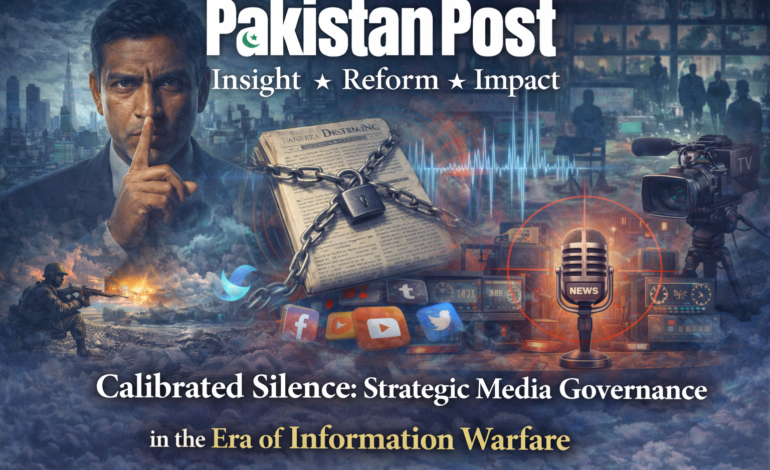
Calibrated Silence: Strategic Media Governance in the Era of Information Warfare

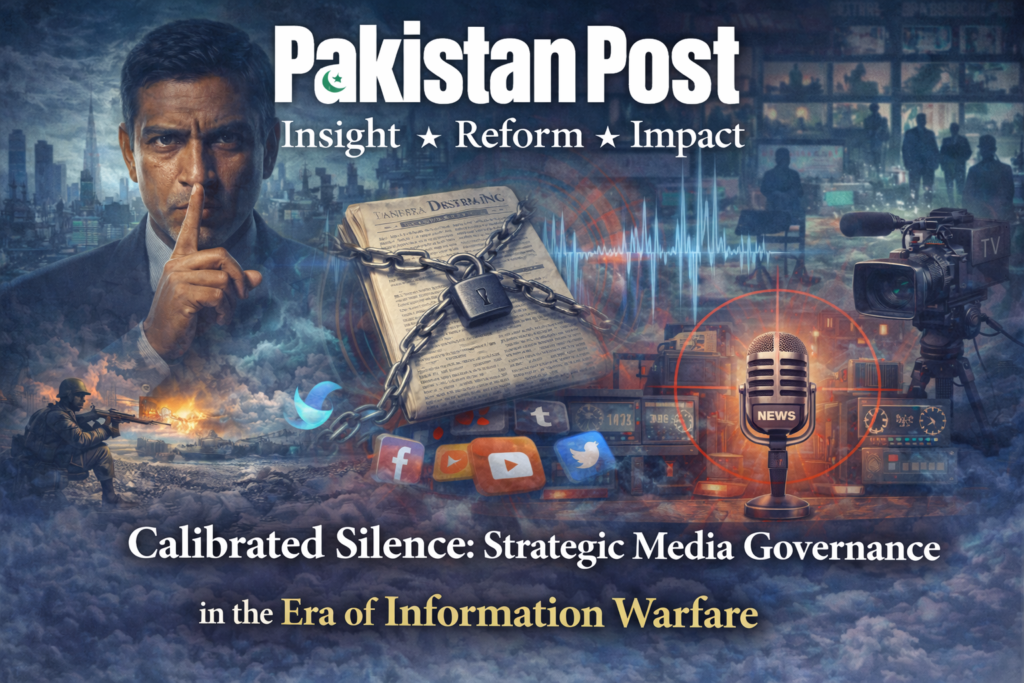
Across the world, the struggle over media is no longer framed simply as freedom versus censorship. It has evolved into a contest over narrative sovereignty, institutional legitimacy, and strategic stability. States are not merely suppressing speech. They are redesigning the architecture through which speech circulates, gains authority, and translates into political consequence. In this recalibrated landscape, information is treated as infrastructure, discourse as security terrain, and digital platforms as geopolitical actors. What appears to some as shrinking civic space is, from another perspective, the consolidation of narrative power within a turbulent global order.
From consolidated powers such as China and Russia, to electoral democracies like India and the United States, regulatory assertiveness over media ecosystems is justified through a shared vocabulary. National security. Counter disinformation. Public order. Electoral integrity. Social cohesion. These terms now form the moral grammar of contemporary governance. The liberal era assumption that digital platforms represent neutral marketplaces of ideas has eroded. Instead, governments increasingly view them as unregulated territories vulnerable to foreign manipulation, algorithmic extremism, and domestic destabilisation.
Pakistan’s current information environment mirrors this global recalibration. The visible spectacle of blanket bans has given way to something more intricate. Instead of loud prohibitions, there is calibrated silence. Certain narratives are amplified. Others are quietly displaced from mainstream visibility. Some topics trend organically. Others disappear into algorithmic obscurity. This is not chaotic repression. It is structural narrative management in a geo multivector world where states balance Western platforms, Chinese technological ecosystems, Gulf financial capital, and regional security alignments. The question confronting civil society is not whether speech exists. It is who designs the channels through which it flows, and to what strategic end.
Narrative sovereignty has emerged as a core principle of twenty first century statecraft. The concept reflects an understanding that political stability and economic strategy are inseparable from communicative control. Governments are reclaiming authority over digital infrastructure through data localisation laws, platform licensing regimes, cyber security frameworks, and content moderation directives. In the European regulatory space, the European Union has enacted comprehensive digital governance structures that compel global technology companies to comply with regional standards of transparency and accountability. In China, platform ecosystems operate within a clearly articulated doctrine of cyber sovereignty that places the state at the apex of information management. In the United States, national security debates increasingly focus on foreign influence operations, platform responsibility, and algorithmic accountability. India, for its part, advances a model of strategic media nationalism that blends democratic procedure with assertive digital oversight.
The convergence across these different systems is revealing. Despite ideological divergence, all recognise that uncontrolled information flows can produce political volatility. Disinformation campaigns, externally amplified polarisation, viral misinformation, and digitally coordinated unrest have exposed the fragility of open information systems. Elections have been contested not only at ballot boxes but on timelines and feeds. Public health crises have been aggravated by conspiracy narratives spreading faster than institutional clarifications. Financial markets have reacted to viral rumours. In such an environment, the state perceives unmanaged speech not simply as expression but as a variable within the security equation.
For countries navigating complex regional pressures, narrative sovereignty becomes even more consequential. Pakistan sits at the intersection of great power competition, geo economic corridors, and ideological contestations. It engages with Western financial institutions, participates in the Belt and Road Initiative, and operationalises infrastructure projects such as the China Pakistan Economic Corridor. Each alignment carries narrative implications. Domestic discourse about development, sovereignty, debt, regional partnerships, and strategic autonomy does not unfold in isolation. It is observed, interpreted, and sometimes amplified by external actors whose interests may not align with domestic stability. In such a multivector environment, the temptation to curate the national conversation intensifies.
The shift from media freedom versus censorship to media governance versus information warfare reflects this reality. Information warfare is no longer confined to battlefield propaganda. It encompasses cyber intrusions, bot networks, manipulated videos, and algorithmic amplification of divisive content. The objective is not merely persuasion but fragmentation. When states interpret digital volatility as a theatre of hybrid conflict, regulatory intervention becomes framed as defensive action rather than authoritarian impulse. The legitimacy of such intervention depends on proportionality, transparency, and institutional accountability. Without these, governance risks sliding into opacity and distrust.
Civil society, however, does not vanish under calibrated silence. It transforms. Spontaneous discourse may contract, yet structured platforms often expand. Academic conferences, policy think tanks, and curated digital forums increasingly become preferred arenas for engagement. Activism adapts by aligning itself with legally permissible frameworks, framing demands in developmental or institutional language rather than overt confrontation. Journalists internalise invisible boundaries, practicing anticipatory self restraint to avoid professional risk. This self censorship is rarely codified. It operates through perception of red lines, economic vulnerability of media houses, and the precarious employment conditions of reporters.
The psychological effect on civil society is subtle but profound. When discourse appears open yet selectively permeable, individuals recalibrate expectations. Citizens may continue to speak, but they learn which themes invite amplification and which invite invisibility. Over time, the public sphere becomes layered. There is the official narrative space, visible and institutionally endorsed. There is the semi formal space of moderated critique. And there is the coded digital subculture where satire, symbolism, and indirect commentary flourish. Youth political expression increasingly migrates to memes, metaphors, and cultural references that evade algorithmic detection while sustaining peer recognition. Language becomes strategic. Irony becomes shield.
This reconfiguration does not necessarily extinguish civic intelligence. It can, paradoxically, refine it. Under constraint, societies often cultivate nuanced modes of articulation. Yet the cost is fragmentation. When discourse disperses into coded enclaves, collective deliberation weakens. Trust in mainstream journalism erodes if audiences perceive alignment with power. Conversely, unregulated alternative platforms may incubate misinformation. The erosion of shared epistemic ground becomes a structural risk.
At the heart of this transformation lies the conglomerate nature of contemporary media. Global technology corporations operate across jurisdictions, negotiating compliance with diverse regulatory regimes. Advertising revenues tie media houses to corporate interests. Data flows intersect with surveillance anxieties. Satellite channels, streaming services, and social networks form a dense communicative web in which sovereignty is constantly negotiated. States can pressure local broadcasters. They can fine or temporarily restrict platforms. Yet complete control is elusive when servers reside abroad and users access content through virtual networks. Hence, calibrated silence replaces total prohibition. It is adaptive, flexible, and often informal.
For policymakers, the central dilemma is not abstract freedom but strategic equilibrium. How can a state protect itself from disinformation campaigns without stifling legitimate critique. How can it secure digital infrastructure while preserving innovation. How can it maintain social cohesion in a polarised environment without enforcing uniformity. These are not rhetorical questions. They define the governance challenge of the digital century.
The emergence of what may be termed a post liberal media order complicates inherited frameworks. In the classical liberal imagination, the marketplace of ideas was expected to self correct through competition. Falsehood would be exposed by truth. Extremism would be marginalised by moderation. Digital acceleration disrupted this equilibrium. Algorithms reward engagement, not accuracy. Outrage travels faster than nuance. Coordinated manipulation exploits cognitive biases. In such an environment, non intervention may amplify instability rather than safeguard liberty. Yet over intervention risks suffocating democratic dynamism. The equilibrium is delicate.
A post liberal media order does not necessarily imply the abandonment of pluralism. It signals the recognition that expressive freedom now competes with sovereignty, security, and cohesion as co equal values. The task is to institutionalise this competition transparently rather than conceal it beneath ad hoc measures. Clear digital rights frameworks, independent oversight bodies, judicial review of content restrictions, and publicly articulated criteria for platform regulation can mitigate arbitrary application. Without procedural clarity, calibrated silence breeds suspicion.
Pakistan’s trajectory will likely reflect broader global experimentation. Regulatory authorities will continue to refine digital policies. Media houses will recalibrate editorial strategies within economic constraints. Civil society organisations will navigate between advocacy and compliance. The critical variable will be institutional credibility. If citizens believe that narrative management serves collective stability rather than partisan advantage, social cohesion may strengthen. If they perceive asymmetry and opacity, distrust will deepen.
The multivector character of contemporary geopolitics adds urgency. As great power competition intensifies, information spaces become arenas of influence. Narratives about infrastructure projects, defence partnerships, and economic reforms carry strategic implications. External actors may seek to shape domestic opinion through overt or covert means. In such circumstances, safeguarding narrative sovereignty can appear synonymous with safeguarding territorial integrity. Yet sovereignty in the digital age cannot be absolute. It must coexist with transnational connectivity. The art of governance lies in managing this coexistence without collapsing into isolation.
Ultimately, the recalibration of media ecosystems forces a philosophical reconsideration of civil society itself. If civil society is understood merely as oppositional space, it may wither under constraint. If it is reconceptualised as a sphere of organised, policy engaged, and institutionally literate participation, it may adapt more sustainably. The challenge is to preserve its critical capacity while integrating it into national development discourse. This requires educational reform, media literacy initiatives, and economic models that reduce dependency on volatile advertising revenues.
Calibrated silence, therefore, should not be analysed solely as repression. It is a symptom of a world in which information has become strategic capital. The danger lies not in regulation per se but in imbalance. A society that suppresses all dissent stagnates. A society that permits unchecked informational chaos risks fragmentation. Between these extremes lies a narrow corridor where stability and freedom negotiate continuously. The durability of that corridor depends on institutional integrity, transparency, and civic maturity.
We are witnessing the consolidation of geo multivector media orders, where states, corporations, and citizens operate within overlapping sovereignties. The vocabulary of the past is insufficient. Freedom and censorship, openness and closure, democracy and control. These binaries obscure more than they reveal. The emerging reality is layered, negotiated, and dynamic. For policymakers, the imperative is to craft governance frameworks that acknowledge security imperatives without extinguishing intellectual vitality. For civil society, the responsibility is to cultivate strategic literacy, to understand the geopolitical forces shaping discourse, and to innovate modes of engagement that sustain critical thought within constraint.
The future of media will not be determined solely by legislation or algorithms. It will be shaped by the ethical imagination of societies confronting complexity. In an age where narratives travel faster than institutions can respond, calibrated silence may seem prudent. Yet long term stability requires more than silence. It requires trust. Trust emerges from consistency, fairness, and openness to measured critique. If narrative sovereignty evolves into narrative exclusion, civil society will retreat into shadows. If it matures into accountable governance of information flows, it may strengthen the social contract.
The age of geo multivector information warfare is not a temporary aberration. It is the structural condition of our time. Navigating it demands intellectual humility and strategic clarity. The objective cannot be to restore an idealised past of unregulated speech. Nor can it be to entrench permanent informational control. The task is to design a media order where sovereignty, security, and expressive freedom coexist in tension yet remain mutually reinforcing. Whether societies achieve this balance will determine not only the vitality of their civil spheres but the resilience of their states in an era where power increasingly resides in the management of meaning.
A Public Service Message