
The Death of Gatekeepers and the Birth of Noise

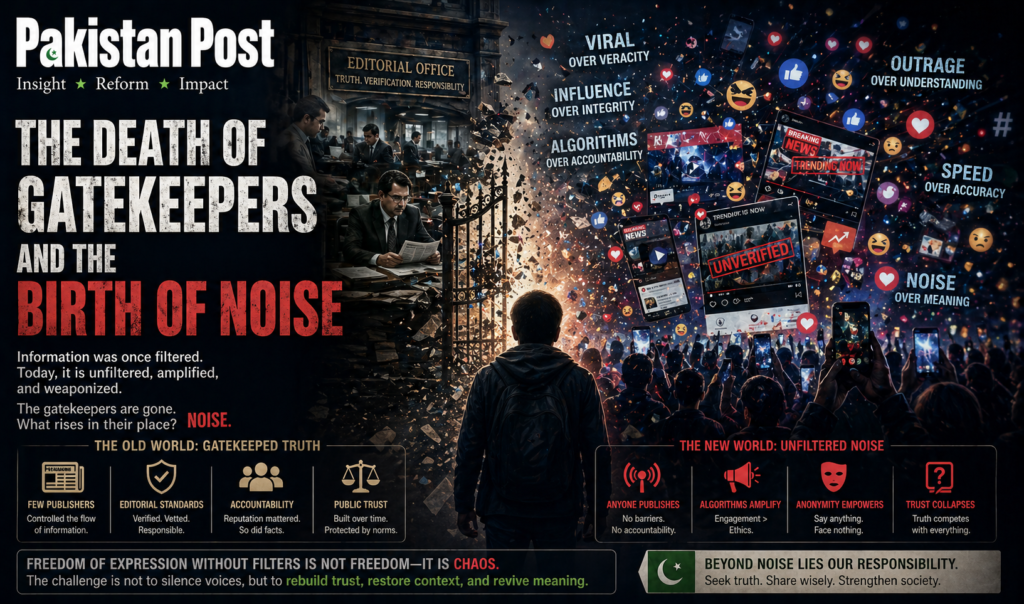
In Pakistan’s evolving media landscape, the making of public opinion no longer resembles a carefully curated editorial process; it increasingly resembles a contest of speed, emotion, and amplification. What was once filtered through the disciplined architecture of print editorials, televised debates, and institutional authority has now dissolved into a fluid, decentralized, and often chaotic ecosystem where narratives rise and fall not by merit alone, but by their capacity to travel, provoke, and sustain attention. The transformation is neither subtle nor temporary. It signals a structural reordering of how societies think, decide, and ultimately govern themselves.
For decades, public opinion in Pakistan was shaped by identifiable gatekeepers. Editors, columnists, and television anchors functioned as intermediaries between information and interpretation. Their authority derived not only from institutional affiliation but also from the implicit trust placed in professional norms such as verification, balance, and editorial accountability. While this system was never immune to bias or political pressure, it maintained a certain rhythm of deliberation. Ideas competed within constrained spaces. Arguments unfolded with a degree of continuity. The public sphere, though imperfect, retained a sense of coherence.
That coherence is now fragmenting. The rise of social media platforms has dismantled the traditional hierarchy of opinion formation, replacing it with a decentralized network of voices that operate beyond conventional institutional boundaries. Influencers, digital activists, and citizen journalists have emerged as new opinion leaders, often commanding audiences that rival or exceed those of legacy media. Their authority is not institutional but performative, not derived from editorial oversight but from metrics of engagement such as likes, shares, and views. In this new order, visibility is credibility, and virality is validation.
This shift has profound implications for how opinions are formed and circulated. In the traditional model, the process of opinion formation was relatively linear. Information was gathered, verified, contextualized, and then presented to the public, which engaged with it through letters, discussions, and eventually electoral choices. Today, the process is recursive and instantaneous. Information, interpretation, and reaction collapse into a single moment. A viral video or tweet does not merely report an event; it frames it, interprets it, and invites immediate judgment. The audience is no longer a passive recipient but an active participant in the construction of meaning.
The consequences of this transformation are evident in the nature of public discourse. Emotionally charged content travels faster and further than measured analysis. Outrage, fear, and indignation have become the currency of attention in an economy that rewards engagement above all else. This is not an accidental byproduct of digital platforms but a structural feature of their design. Algorithms prioritize content that keeps users engaged, and engagement is most reliably generated by content that triggers strong emotional responses. As a result, narratives that are simplistic, polarizing, and sensational often outperform those that are nuanced, complex, and analytical.
The decline of traditional gatekeeping has also altered the dynamics of agenda setting. In the past, media institutions played a central role in determining which issues entered the public consciousness. Today, agenda setting is increasingly driven by viral trends, hashtags, and influencer campaigns. This has democratized the process in certain respects, allowing previously marginalized voices to bring attention to issues that might have been ignored by mainstream media. Grassroots movements, regional concerns, and minority perspectives can now gain visibility without institutional mediation.
Yet this democratization comes with significant costs. The absence of effective gatekeeping mechanisms has made the information ecosystem more vulnerable to misinformation and disinformation. False narratives can spread rapidly, often outpacing efforts to correct them. The speed of dissemination, combined with the cognitive biases of audiences, means that initial impressions are difficult to dislodge. In such an environment, the distinction between fact and opinion becomes blurred, and the authority of evidence is undermined by the immediacy of belief.
The role of influencers in this ecosystem further complicates the picture. Influencers operate at the intersection of entertainment, personal branding, and political communication. Their appeal lies in their relatability and perceived authenticity. Unlike traditional journalists, they are not bound by professional codes of conduct or editorial standards. This allows them to engage with audiences in ways that are more direct and emotionally resonant, but it also raises questions about accountability and responsibility. When influencers shape public opinion on political or social issues, they do so without the institutional safeguards that traditionally governed such influence.
At the same time, legacy media institutions have not disappeared; they have adapted. Many have established a presence on digital platforms, integrating social media strategies into their operations. Journalists now engage with audiences in real time, often blurring the line between reporting and commentary. Television debates are clipped and circulated online, where they reach wider audiences than the original broadcasts. In this sense, the structures of opinion leadership are not collapsing entirely but reconfiguring into hybrid forms that combine elements of traditional authority with digital legitimacy.
This hybridization, however, is not without tension. The economic pressures facing traditional media have intensified in the digital age. Advertising revenues have shifted to global technology platforms, leaving local media organizations with shrinking resources. This financial strain can compromise editorial independence, as outlets become more susceptible to political or commercial influence. At the same time, the need to compete for attention in a crowded digital space can push even established institutions toward more sensationalist and click-driven content.
The result is a convergence of practices across different types of media actors. Traditional journalists adopt the immediacy and performative style of social media, while influencers increasingly engage in forms of commentary that resemble journalism. This convergence blurs the boundaries between information and opinion, reporting and advocacy. It creates a media environment in which it is often difficult for audiences to distinguish between credible analysis and partisan messaging.
The implications for deliberative reasoning are significant. In a fragmented and fast-moving information ecosystem, the conditions necessary for thoughtful public debate are weakened. Deliberation requires time, context, and a shared foundation of facts. It depends on the ability to engage with opposing viewpoints and to consider evidence critically. These conditions are difficult to sustain in an environment dominated by short-form content, rapid cycles of attention, and algorithmically curated feeds that reinforce existing preferences.
Selective exposure, driven by both user behavior and platform design, further exacerbates this problem. Individuals are more likely to encounter content that aligns with their existing beliefs, creating echo chambers in which alternative perspectives are minimized or excluded. This does not necessarily mean that people are completely isolated from opposing views, but it does mean that such views are often encountered in distorted or antagonistic forms. The result is not just disagreement but polarization, where differences in opinion are reinforced and intensified over time.
The impact of misinformation in this context cannot be overstated. False or misleading information can shape public perceptions, influence political attitudes, and even affect electoral outcomes. In Pakistan, as in many other countries, misinformation has been used as a tool in political competition, with actors seeking to manipulate narratives for strategic advantage. The decentralized nature of the digital ecosystem makes it difficult to trace the origins of such campaigns or to hold perpetrators accountable.
Attention economy dynamics also play a critical role in shaping public opinion. In a system where attention is scarce and valuable, content producers are incentivized to capture and retain it by any means necessary. This often leads to the prioritization of spectacle over substance, speed over accuracy, and emotion over reason. The constant competition for attention creates a sense of urgency that discourages reflection and encourages impulsive reactions. Public opinion becomes more volatile, shifting rapidly in response to the latest viral narrative.
Despite these challenges, it would be overly simplistic to view the transformation of public opinion formation in Pakistan as entirely negative. The decentralization of media has created new opportunities for participation and engagement. Citizens are no longer limited to consuming information; they can produce it, share it, and respond to it in real time. This has the potential to enhance democratic participation by making the public sphere more inclusive and dynamic.
Digital platforms have also enabled the emergence of alternative narratives that challenge dominant discourses. Issues such as social justice, regional inequality, and minority rights have gained visibility through online activism. In some cases, digital mobilization has translated into tangible political outcomes, demonstrating the capacity of decentralized communication networks to influence real-world events.
The challenge lies in balancing these opportunities with the risks associated with a fragmented and unregulated information environment. The question is not whether the traditional model of gatekeeping can or should be restored, but how new forms of accountability and credibility can be established in a decentralized system. This requires a multi-dimensional approach that involves media institutions, technology platforms, policymakers, and citizens.
For media institutions, the task is to reaffirm the value of professional journalism in a way that resonates with contemporary audiences. This means not only maintaining standards of accuracy and integrity but also adapting to the realities of digital consumption. It involves finding ways to present complex information in accessible formats without sacrificing depth or nuance. It also requires greater transparency in editorial processes to rebuild trust.
Technology platforms, for their part, must grapple with the consequences of their design choices. While algorithms are central to the functioning of these platforms, they are not neutral. Decisions about what content to promote or demote have significant implications for public discourse. Greater accountability and transparency in algorithmic systems are essential, as is the development of mechanisms to mitigate the spread of misinformation without undermining freedom of expression.
Policymakers face the difficult task of regulating a rapidly evolving media environment without stifling innovation or infringing on fundamental rights. This involves creating legal frameworks that address issues such as data privacy, platform accountability, and the protection of journalistic freedom. It also requires investment in media literacy initiatives to equip citizens with the skills needed to navigate a complex information landscape.
Ultimately, the resilience of democratic systems depends on the ability of citizens to engage with information critically and constructively. In Pakistan, as elsewhere, the transformation of public opinion formation presents both a challenge and an opportunity. The decline of traditional gatekeepers has disrupted established structures of authority, but it has also opened up new spaces for participation and expression. Whether these spaces contribute to a more informed and inclusive public sphere or to greater fragmentation and polarization will depend on how the various actors within the media ecosystem respond to the changing dynamics.
The future of public opinion in Pakistan will not be determined by a single institution or technology. It will be shaped by the interaction of multiple forces, including economic incentives, technological innovations, cultural norms, and political strategies. In this complex and evolving landscape, the need for credible, responsible, and reflective communication has never been greater. The challenge is to ensure that the noise of the digital age does not drown out the possibility of meaningful dialogue, and that the democratization of voice does not come at the expense of truth.
A Public Service Message