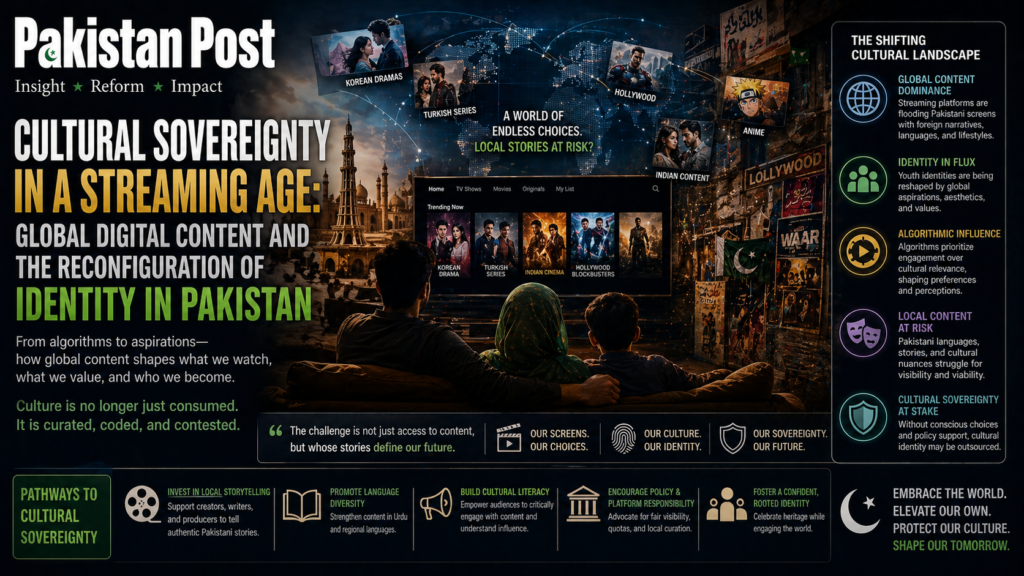
CULTURAL SOVEREIGNTY IN A STREAMING AGE: GLOBAL DIGITAL CONTENT AND THE RECONFIGURATION OF IDENTITY IN PAKISTAN

Pakistan’s cultural landscape is undergoing a profound reordering under the influence of transnational digital media flows, where streaming platforms, short-form video ecosystems, and algorithmically curated entertainment have become primary vehicles of cultural consumption. This shift is not merely technological; it is structural, altering the very conditions under which culture is produced, circulated, and internalized. In this emerging environment, cultural sovereignty is no longer a matter of territorial boundaries or state broadcasting authority, but a contested space shaped by platform capitalism, global content supply chains, and individualized consumption patterns.
The rise of global streaming services and social media entertainment platforms has significantly expanded access to international cultural products in Pakistan. Hollywood films, Turkish dramas, Korean series, Indian digital content, and global influencer media now circulate seamlessly across mobile devices, often bypassing traditional gatekeepers such as national broadcasters, cinema distribution networks, and cultural regulatory institutions. This expansion has created a new cultural ecology characterized by immediacy, abundance, and algorithmic personalization.
At one level, this globalization of content has been interpreted as a form of cultural dilution. Critics argue that the increasing dominance of global narratives risks marginalizing local storytelling traditions, weakening linguistic diversity, and eroding indigenous aesthetic frameworks. Urdu poetry traditions, regional folk narratives, and locally rooted television drama formats face competitive pressure from globally standardized formats optimized for binge consumption and cross-border appeal. The concern is not simply replacement, but gradual displacement, where local cultural production becomes structurally disadvantaged within attention economies dominated by multinational platforms.
However, such a linear narrative of cultural loss does not fully capture the complexity of Pakistan’s digital cultural transformation. Cultural consumption in the digital age is not passive absorption but active recombination. Audiences do not simply adopt global content; they reinterpret, remix, and localize it within their own social and linguistic contexts. This process produces hybrid cultural forms in which global aesthetics are embedded within local sensibilities, generating new modes of expression that blur the boundary between foreign and indigenous cultural production.
This hybridization is particularly visible in the rise of digital creators and influencer economies in Pakistan. Content creators operating on platforms such as YouTube, TikTok, and Instagram are increasingly blending global formats with local narratives, producing content that reflects both transnational trends and domestic cultural realities. Comedy, lifestyle vlogging, beauty content, and political satire are all being reshaped through this hybrid logic, where cultural authenticity is no longer defined by origin alone but by relatability and engagement within specific digital communities.
Platform capitalism plays a decisive role in shaping these dynamics. Recommendation algorithms do not merely distribute content; they actively structure cultural visibility. Content that aligns with global engagement patterns is more likely to be amplified, while locally specific but lower-engagement content risks marginalization. Yet the same algorithms also enable niche cultural communities to form, allowing regional languages, subcultural identities, and alternative narratives to find audiences that were previously inaccessible through traditional media systems.
The question of cultural sovereignty, therefore, must be reframed. It is no longer solely about protecting national culture from external influence, but about understanding how cultural authority is redistributed within global digital infrastructures. Sovereignty in this context becomes relational rather than absolute, negotiated through platform policies, content monetization systems, and the capacity of local creators to compete within global attention markets.
An important dimension of this transformation is generational divergence. Younger, digitally native populations in Pakistan engage with culture through fundamentally different logics than older generations. For them, cultural identity is increasingly plural, algorithmically shaped, and transnational in orientation. Exposure to global content is not perceived as cultural substitution but as cultural expansion. Identity is constructed through layered affiliations that include local belonging, global aspiration, and digital community membership.
Older generations, however, often interpret this shift as cultural discontinuity. The rapid pace of digital cultural change creates a perception of loss, particularly in relation to language use, family-centered entertainment, and traditional moral frameworks embedded in earlier media systems. This generational gap contributes to broader debates about cultural authenticity, modernity, and social cohesion in Pakistan’s evolving media environment.
State cultural policy has struggled to keep pace with these transformations. Traditional regulatory approaches, often focused on broadcasting standards, censorship frameworks, and national content quotas, are increasingly misaligned with platform-based content ecosystems that operate across jurisdictions and outside conventional regulatory boundaries. The challenge is not simply one of enforcement, but of conceptual adaptation. Cultural policy must now account for algorithmic distribution systems, cross-border content licensing, and the decentralized nature of digital production.
At the same time, there are emerging efforts to strengthen local digital content ecosystems through funding initiatives, creator support programs, and partnerships with global platforms. These initiatives reflect an implicit recognition that cultural sovereignty in the digital age cannot be achieved through restriction alone, but requires competitive participation in global content markets. The ability of local creators to produce high-quality, globally legible content while maintaining cultural specificity is becoming a key determinant of cultural influence.
Yet this competitive framing also raises concerns about cultural commodification. As cultural production becomes increasingly tied to monetization metrics such as views, likes, and engagement rates, there is a risk that cultural value becomes conflated with market performance. Content that performs well algorithmically may not necessarily reflect deeper cultural significance, while culturally important narratives may struggle to achieve visibility within attention-driven systems.
This tension between cultural meaning and platform visibility is central to understanding the contemporary cultural condition in Pakistan. Cultural production is no longer primarily mediated by state institutions or traditional elites, but by distributed networks of creators and algorithms. Authority over cultural interpretation is fragmented, and cultural legitimacy is increasingly derived from audience engagement rather than institutional endorsement.
Despite concerns about erosion, it is also possible to interpret these developments as a form of cultural reconfiguration rather than decline. Pakistan’s cultural identity has historically been shaped by external influences, regional exchanges, and internal diversity. The current digital transformation may therefore represent an extension of this historical pattern under new technological conditions, rather than a rupture from it.
What distinguishes the present moment is the speed, scale, and algorithmic mediation of cultural exchange. Cultural flows that once took years to diffuse now circulate in real time. This acceleration compresses the distance between production and reception, creating a continuous feedback loop between creators and audiences. Cultural identity becomes more dynamic, but also more unstable, subject to rapid shifts in trends, aesthetics, and narratives.
Ultimately, the question of whether cultural sovereignty is being diluted or reinterpreted may be less a binary than a spectrum. On one end lies the risk of homogenization under global platform dominance; on the other lies the possibility of hybrid cultural innovation that expands expressive possibilities. Pakistan’s cultural future will likely be shaped by the tension between these poles, negotiated through everyday practices of consumption, creation, and digital participation.
In this evolving landscape, cultural sovereignty is not disappearing, but being redefined. It is no longer anchored solely in institutions or borders, but in the capacity of societies to generate meaning within global systems of circulation. The outcome will depend not only on policy interventions, but on the creative agency of individuals and communities navigating a world where culture is simultaneously local and global, rooted and algorithmically mobile.