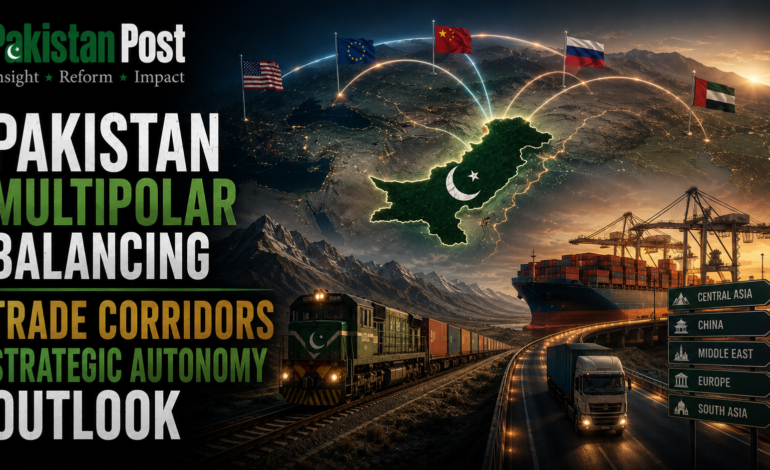
Pakistan Multipolar Balancing Trade Corridors Strategic Autonomy Outlook


The global system is undergoing a structural transition that is neither linear nor orderly, but fragmented, contested, and increasingly transactional. In this emerging environment, the notion of fixed alliances is giving way to fluid alignments, where states engage simultaneously with competing power centres across economic, technological, and security domains. For Pakistan, this transformation presents both an opportunity for strategic reinvention and a persistent risk of structural overexposure. The central question is no longer where Pakistan stands in global politics, but how effectively it can navigate between converging and diverging centres of power without becoming structurally dependent on any single axis.
Pakistan’s geographic position has historically endowed it with strategic relevance. However, geography alone no longer guarantees leverage in a system where connectivity, supply chain integration, digital infrastructure, and financial networks define influence. The contemporary geopolitical landscape is increasingly shaped by corridors rather than blocs, logistics rather than ideology, and economic interdependence rather than military alignment. In this context, Pakistan’s potential role as a transit and connectivity hub linking South Asia, Central Asia, the Middle East, and western China remains significant, yet under-realised.
The China Pakistan Economic Corridor represents the most visible articulation of this connectivity logic. It has transformed the discourse of infrastructure development into one of strategic economic geography. Yet its broader significance extends beyond bilateral cooperation. It situates Pakistan within a larger contest over Eurasian connectivity, where competing visions of trade routes, energy pipelines, and digital corridors intersect. At the same time, engagement with Gulf economies, particularly in energy investment, remittances, and emerging technological partnerships, has introduced a parallel axis of economic dependence and opportunity. Meanwhile, relations with Western institutions and markets continue to shape Pakistan’s financial stabilisation mechanisms and regulatory frameworks.
The hidden strategic risk in this multipolar engagement lies in asymmetry. Engagement across multiple poles does not automatically translate into strategic autonomy. On the contrary, without institutional coherence, it can result in fragmented dependencies, where different sectors of the economy become tied to different external actors under divergent conditionalities. This produces a condition of partial alignment without systemic integration, leaving national policy exposed to external shocks transmitted through multiple channels simultaneously.
In the current global environment, strategic autonomy is no longer defined as isolation or neutrality. It is defined as the capacity to maintain decision-making flexibility under conditions of simultaneous external engagement. This requires not only diplomatic balancing but also internal economic resilience. States that are overly reliant on external financing for fiscal stability, external technology for digital infrastructure, or external markets for export absorption, inevitably face constraints on policy independence regardless of formal diplomatic positioning.
Pakistan’s economic structure reflects this tension. On one hand, external partnerships are essential for investment inflows, infrastructure development, and balance of payments support. On the other hand, these same partnerships often come with implicit or explicit expectations regarding regulatory alignment, fiscal adjustment, and policy prioritisation. The result is a narrowing of domestic policy space that is not imposed through coercion but through dependency architecture.
The evolving competition between major global powers further intensifies this dynamic. The United States and China are engaged in a complex interaction that blends strategic rivalry with selective cooperation. Rather than a binary confrontation, the system is characterised by issue-based competition across technology, finance, trade, and security domains. Middle powers such as the Gulf states, Türkiye, and several Southeast Asian economies are simultaneously expanding their strategic footprints, creating additional nodes of influence that complicate traditional alignment patterns.
Within this environment, Pakistan’s strategic calculus must account for the increasing overlap between economic and security considerations. Infrastructure financing is no longer purely developmental; it is embedded within geopolitical positioning. Technology transfer is no longer purely commercial; it is embedded within data sovereignty concerns. Energy investment is no longer purely economic; it is embedded within long-term strategic dependency structures.
The most significant transformation, however, lies in the rise of geoeconomics as the primary instrument of influence. Trade corridors, port access, digital platforms, and supply chain integration have become tools of strategic competition. States capable of controlling or facilitating these flows gain disproportionate leverage. Pakistan’s ports, particularly Gwadar and Karachi, its road and rail connectivity potential, and its proximity to energy-rich Central Asia position it as a potentially critical node in this emerging system. Yet this potential remains constrained by governance inefficiencies, regulatory uncertainty, and infrastructural bottlenecks.
The strategic risk is not simply underutilisation of geography but overextension of commitments without corresponding institutional capacity. Multipolar engagement requires high levels of policy coordination, regulatory predictability, and economic diversification. Without these, external engagements may produce short-term inflows but long-term structural vulnerabilities.
Another underexplored dimension is the impact of global financial architecture on strategic autonomy. Multilateral institutions, sovereign bond markets, and credit rating agencies increasingly function as indirect arbiters of domestic policy space. Fiscal decisions are shaped not only by internal priorities but also by external perceptions of creditworthiness and macroeconomic discipline. This introduces a layer of structural constraint that operates independently of bilateral diplomacy.
At the same time, technological fragmentation is reshaping economic sovereignty. Competing digital ecosystems, data governance regimes, and cybersecurity standards are creating parallel technological spheres. Countries that fail to develop indigenous digital capacity risk becoming dependent not only economically but also informationally. For Pakistan, this raises questions about digital infrastructure sovereignty, cybersecurity resilience, and data governance frameworks within a multipolar technological environment.
The interplay between these dimensions produces what can be described as layered dependency. Economic dependency on financial institutions, technological dependency on external platforms, and infrastructural dependency on foreign investment converge to create a complex web of interdependence that is difficult to disentangle. In such a system, strategic autonomy becomes less about complete independence and more about managed interdependence.
The policy challenge, therefore, is not to reject external engagement but to structure it in a way that preserves internal coherence. This requires prioritisation of sectors that generate endogenous growth capacity, diversification of export markets, and strengthening of domestic institutional frameworks. It also requires a diplomatic strategy that emphasises flexibility, issue-based cooperation, and avoidance of rigid alignment commitments.
A further hidden risk lies in the temporal mismatch between geopolitical cycles and domestic development cycles. External powers often operate on strategic horizons measured in years or decades, while domestic political systems operate on shorter electoral or administrative cycles. This misalignment can result in policy discontinuity, under-implementation of long-term projects, and strategic inconsistency.
The internal governance dimension is equally critical. Multipolar engagement demands high-quality coordination between economic ministries, foreign policy institutions, security establishments, and regulatory bodies. Fragmented decision-making structures can undermine the coherence required to navigate complex external environments. Institutional silos, competing policy narratives, and inconsistent implementation frameworks weaken the state’s ability to extract maximum value from external partnerships.
In strategic terms, Pakistan is not lacking in external engagement but in internal synchronisation. The absence of a unified geoeconomic doctrine limits the country’s ability to convert geographic potential into sustained strategic advantage. Without such a doctrine, engagement risks becoming reactive rather than strategic, fragmented rather than integrated.
The global trend toward regionalisation of trade and finance further reinforces the importance of strategic positioning. As supply chains are reorganised around resilience rather than efficiency, countries that can offer stability, connectivity, and predictability will gain strategic importance. Pakistan’s ability to integrate into these emerging supply chain architectures will depend on its capacity to improve governance standards, regulatory frameworks, and infrastructural reliability.
Ultimately, the future of Pakistan’s strategic relevance will be determined not by its ability to align with any single global power, but by its ability to remain structurally indispensable across multiple networks of influence. This requires a shift from reactive diplomacy to proactive geoeconomic strategy, from fragmented engagement to integrated policy design, and from dependency management to autonomy maximisation.
In a multipolar world defined by uncertainty and overlap, strategic success will belong to those states that can convert complexity into opportunity without becoming trapped by it. For Pakistan, the challenge is not merely to navigate the global system, but to architect a position within it that preserves agency while embracing interconnection.
A Public Service Message