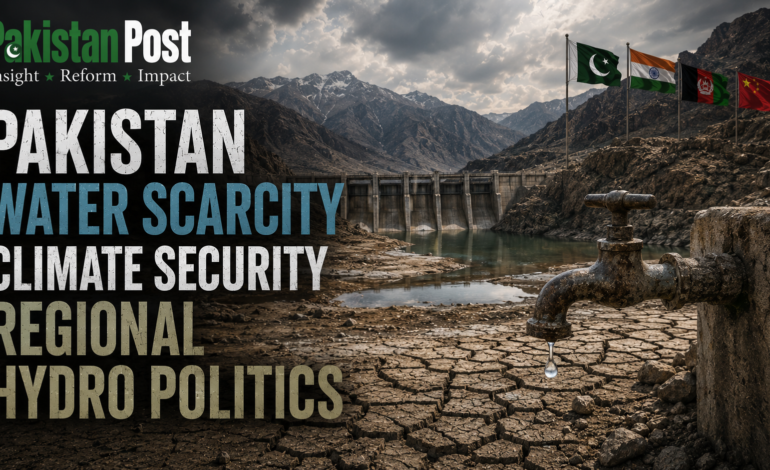
Pakistan Water Scarcity Climate Security Regional Hydro Politics


Climate change has ceased to be an environmental concern confined to scientific discourse; it has become a structural determinant of state stability, economic viability, and geopolitical tension. In South Asia, where population density, agricultural dependence, and transboundary river systems intersect, climate stress is increasingly translating into hydro political sensitivity. For Pakistan, this transformation is not theoretical. It is unfolding in real time through shifting precipitation patterns, accelerated glacial melt, rising temperatures, and increasing variability in river flows that underpin national food and energy systems.
Water, once treated as a technical resource governed by engineering and administrative frameworks, is now emerging as a strategic commodity embedded within national security calculations. The Indus Basin system, upon which Pakistan’s agrarian economy depends, is increasingly exposed to climatic volatility that cannot be managed through conventional irrigation governance alone. Glacial retreat in the Himalayas and Hindu Kush ranges is altering long term water availability trajectories, while erratic monsoon behavior introduces uncertainty into seasonal planning cycles. The result is not simply scarcity but unpredictability, which is strategically more destabilizing than shortage itself.
At the national level, the implications extend across multiple domains. Agriculture, which remains the largest absorber of labor and a critical contributor to GDP, is directly exposed to hydrological instability. Variability in water supply disrupts cropping cycles, reduces yield predictability, and increases vulnerability to food inflation. Energy production, particularly hydroelectric generation, is similarly affected by fluctuating river flows. Urban centers, already under demographic pressure, face compounding stress from groundwater depletion and inefficient distribution systems. These interconnected pressures create a systemic risk profile that cannot be addressed through isolated sectoral interventions.
The hidden strategic risk lies in the gradual securitization of water discourse. As scarcity intensifies, perceptions of inequity in distribution and upstream downstream dynamics may acquire political salience. In South Asia, where major river systems are shared across national boundaries, hydrological changes inevitably intersect with historical sensitivities and strategic mistrust. Even when disputes remain technical in nature, they are often interpreted through strategic lenses, amplifying their geopolitical resonance.
Climate stress also introduces a less visible but equally significant internal security dimension. Resource scarcity can exacerbate rural distress, accelerate migration toward urban centers, and intensify competition over already strained infrastructure. These dynamics do not manifest as immediate crises but as cumulative pressures that gradually reshape governance capacity. In regions where state presence is already uneven, environmental stress can further weaken institutional legitimacy and create governance vacuums that are difficult to manage through conventional administrative tools.
Another emerging dimension is the relationship between climate stress and social cohesion. As water availability becomes increasingly variable, perceptions of distributional fairness gain political importance. Disparities between regions, provinces, and agricultural zones may be interpreted through political rather than environmental frameworks. This perceptional shift carries strategic implications, as resource allocation disputes can evolve into broader questions of governance legitimacy.
At the regional level, climate change introduces a new layer of strategic complexity into already fragile interstate relations. The Indus Waters Treaty has historically provided a legal framework for water sharing between Pakistan and India, but climate induced variability places unprecedented stress on its operational assumptions. While the treaty itself remains a stabilizing mechanism, its effectiveness depends on hydrological predictability that is increasingly being undermined by climate dynamics. This creates a scenario where legal frameworks remain intact while environmental realities evolve beyond their original design parameters.
In addition, China’s upstream position in certain Himalayan river systems introduces another layer of hydrological interdependence that is not fully institutionalized through binding water sharing agreements. Similarly, Afghanistan’s evolving water infrastructure development projects on western tributaries contribute to a broader regional hydro political landscape characterized by fragmented governance and limited coordination. The absence of integrated basin level management across the region increases the likelihood that climate variability will translate into strategic friction.
The global narrative surrounding climate governance further complicates Pakistan’s position. International climate finance mechanisms, adaptation funding frameworks, and carbon mitigation initiatives are increasingly shaping domestic policy choices. While these instruments provide critical resources for climate adaptation, they also introduce conditionalities that influence energy policy, agricultural modernization, and infrastructure development. The intersection of climate finance and sovereign policy space is becoming an emerging domain of strategic negotiation.
A critical hidden risk lies in the temporal gap between climate impact and policy response. Climate change operates on long time horizons, while political and administrative systems often function on short cycles. This mismatch results in delayed adaptation, fragmented planning, and reactive rather than anticipatory governance. As a consequence, the costs of adjustment increase over time, while resilience-building opportunities diminish.
Urbanization further intensifies climate vulnerability. Rapid expansion of cities without corresponding upgrades in water infrastructure leads to inefficient consumption, leakage losses, and inequitable distribution. Informal settlements are particularly exposed to water insecurity, creating localized zones of vulnerability that may expand under conditions of prolonged heat stress and reduced supply reliability.
The energy-water nexus represents another critical dimension of systemic risk. Hydropower generation is directly dependent on river flows, while thermal power generation relies heavily on water for cooling processes. Climate induced water scarcity therefore has cascading effects on energy security, which in turn affects industrial productivity and economic stability. This interdependence creates a feedback loop where water scarcity amplifies energy insecurity, which then exacerbates economic vulnerability.
Agricultural adaptation strategies, while necessary, face structural constraints. Crop diversification, irrigation efficiency improvements, and drought resistant seed varieties offer partial mitigation but require sustained institutional capacity and investment. Without coherent policy implementation, adaptation measures risk remaining fragmented and insufficient relative to the scale of climatic transformation.
At the strategic level, climate change is redefining the meaning of national security. Security is no longer confined to military preparedness or territorial integrity; it now encompasses resource stability, ecological resilience, and socio economic adaptability. States that fail to integrate climate considerations into their security planning risk confronting compounding crises that span multiple domains simultaneously.
The emerging challenge for Pakistan is therefore not simply to manage water scarcity but to anticipate a future in which water becomes a central axis of national vulnerability and strategic negotiation. This requires a shift from reactive water management toward anticipatory hydro political strategy, integrating climate science, security analysis, economic planning, and diplomatic engagement into a unified framework.
Institutionally, this demands the creation of mechanisms capable of long term climate risk assessment and cross sectoral coordination. Water governance cannot remain fragmented across ministries and provinces. It must be elevated to a strategic planning function embedded within national security architecture. This includes integrating climate data analytics into policy design, strengthening inter provincial coordination mechanisms, and enhancing transboundary water diplomacy capacity.
The broader geopolitical implication is that climate change will increasingly function as a multiplier of existing tensions rather than an independent source of conflict. In regions with pre existing disputes, resource stress will amplify sensitivities. In regions with cooperative frameworks, it may test institutional resilience. In both cases, the strategic significance of water will continue to grow.
Ultimately, the transformation of water from a natural resource into a strategic variable reflects a deeper shift in global politics. Environmental systems are no longer external to geopolitical calculation; they are embedded within it. For Pakistan, navigating this transition will require not only technical adaptation but also strategic foresight capable of integrating environmental realities into national security doctrine.
A Public Service Message