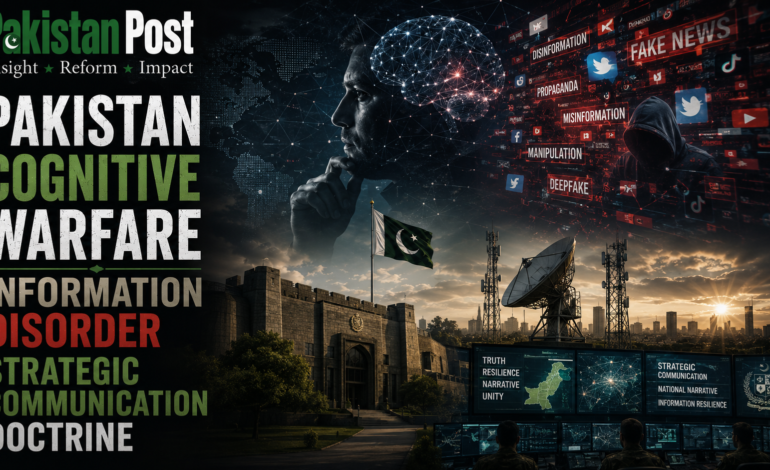
Pakistan Cognitive Warfare Information Disorder Strategic Communication Doctrine

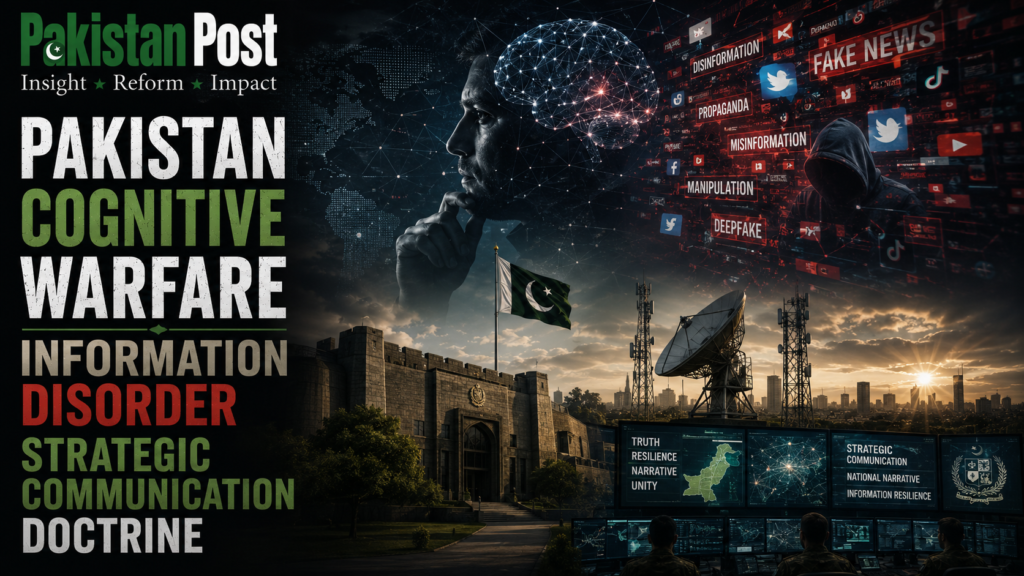
Modern conflict no longer begins with troop movements or diplomatic breakdowns; it begins in the cognitive domain where perception is shaped, credibility is contested, and reality itself becomes a site of strategic manipulation. In this evolving theatre, information is not merely a medium of communication but a weaponized instrument of influence, deployed to shape decision making environments long before kinetic confrontation emerges. For Pakistan, this transformation presents an under-recognized but increasingly decisive strategic challenge: the management of cognitive warfare in an era of accelerated information velocity and institutional vulnerability.
The informational ecosystem has undergone structural compression. Digital platforms, algorithmic amplification, and artificial intelligence driven content generation have collapsed the time gap between event and interpretation. Narratives now precede verification, and perception often stabilizes before factual correction can occur. This temporal inversion creates a strategic asymmetry in which influence operations achieve impact not through depth of argument but through speed of dissemination and emotional resonance.
Within this environment, hybrid warfare has evolved beyond conventional definitions. It is no longer confined to coordinated propaganda campaigns or sporadic misinformation incidents. It now operates as a continuous process of narrative conditioning, where multiple actors state, non state, and proxy simultaneously shape fragmented perceptions across digital and traditional media ecosystems. The objective is not necessarily to impose a single narrative but to induce interpretive confusion, institutional mistrust, and cognitive fatigue within target societies.
Pakistan’s informational landscape is particularly exposed to such dynamics due to a combination of high digital penetration, rapid social media consumption patterns, linguistic diversity, and politically charged media environments. These conditions create fertile ground for narrative amplification, selective framing, and viral misinformation cycles. In such ecosystems, strategic messaging does not require centralized orchestration to achieve systemic impact; decentralized propagation is sufficient to generate national level perceptual effects.
The hidden strategic risk lies in the erosion of epistemic coherence. When societies lose the ability to converge on shared factual baselines, policy discourse becomes increasingly fragmented and reactive. Decision making processes are then shaped not by stable information inputs but by fluctuating perception waves generated through digital ecosystems. Over time, this undermines institutional credibility and reduces the state’s capacity to maintain narrative authority even in areas of technical governance.
At the international level, cognitive warfare has become an embedded component of geopolitical competition. Major powers increasingly integrate information operations into broader strategic doctrines, recognizing that influence over perception can yield strategic outcomes without direct confrontation. In contested regions, narrative shaping is often deployed alongside diplomatic signaling, economic leverage, and security posturing, creating multi layered pressure environments.
For Pakistan, this implies that external strategic pressure is no longer confined to border regions or diplomatic forums; it extends into domestic information spaces. Sensitive policy areas such as security operations, economic reforms, energy pricing, and foreign alignments become subject to rapid narrative contestation. In such cases, policy decisions are immediately interpreted, reframed, and redistributed through digital channels, often before official communication frameworks can respond effectively.
The institutional challenge is compounded by structural communication gaps. Fragmented messaging, delayed responses, and inconsistent inter agency communication create informational vacuums. In the absence of authoritative narratives, these vacuums are rapidly filled by speculative or adversarial interpretations. The result is not merely misinformation but structural ambiguity, where multiple competing versions of reality coexist without resolution.
Another emerging dimension is the role of artificial intelligence in scaling cognitive influence. Generative models can now produce highly convincing synthetic text, audio, and visual content at minimal cost and high volume. Deepfake technologies and automated content farms reduce the barrier to entry for influence operations, enabling both state and non state actors to conduct sustained narrative campaigns with limited resources. This democratization of influence capability increases the frequency and complexity of information threats.
The socio political implications are significant. Sustained exposure to conflicting narratives can lead to cognitive overload, where individuals disengage from verified information sources and rely instead on emotionally aligned content streams. This phenomenon contributes to polarization, institutional distrust, and the weakening of shared civic frameworks. In such conditions, governance becomes more difficult not because of policy failure but because of perception fragmentation.
Within Pakistan’s context, this dynamic intersects with existing political polarization and institutional contestation. Competing domestic narratives often overlap with external influence vectors, creating layered complexity in information interpretation. Distinguishing between organic political discourse and externally amplified narrative manipulation becomes increasingly challenging, particularly in real time scenarios.
The strategic response to cognitive warfare cannot be limited to reactive fact checking or ad hoc communication. It requires a systemic reconfiguration of how information is produced, verified, and disseminated at the state level. Strategic communication must evolve from a peripheral function into a core component of national security architecture.
This necessitates the development of integrated information monitoring systems capable of real time narrative tracking across digital platforms, traditional media, and transnational information flows. Such systems must be paired with analytical frameworks that distinguish between organic discourse, coordinated influence operations, and algorithmically amplified misinformation patterns.
Equally important is the institutionalization of rapid response communication protocols. In high velocity information environments, delay is strategically equivalent to silence. The first narrative to stabilize often becomes the dominant interpretive framework, regardless of subsequent corrections. Therefore, state communication mechanisms must prioritize speed, clarity, and consistency without sacrificing credibility.
Another critical dimension is public resilience. Cognitive security cannot be achieved solely through state level interventions; it requires societal capacity to critically evaluate information. Digital literacy, media education, and awareness of manipulation techniques must be integrated into educational frameworks to build long term informational resilience.
At the strategic level, Pakistan must also engage in proactive narrative construction. Defensive communication alone is insufficient in environments where adversarial narratives are continuously generated. States must articulate coherent long term narratives that explain policy choices, contextualize challenges, and project strategic intent in accessible formats. Narrative absence is often more damaging than narrative contestation.
The hidden risk in failing to address cognitive warfare lies in gradual institutional erosion rather than abrupt collapse. Over time, persistent narrative fragmentation can weaken trust in governance systems, reduce compliance with public policy, and increase susceptibility to external influence. This creates a condition of strategic vulnerability that is difficult to reverse once entrenched.
In the broader geopolitical environment, information dominance is increasingly recognized as a component of comprehensive national power. States that can effectively manage cognitive ecosystems gain advantages in diplomacy, economic negotiation, and strategic positioning. Conversely, states that remain reactive in information domains risk becoming subjects rather than authors of strategic narratives.
For Pakistan, the imperative is therefore clear. Cognitive security must be elevated to the same level of importance as territorial security and economic stability. This requires institutional integration, technological investment, and doctrinal clarity. Information is no longer a secondary domain of governance; it is a primary arena of strategic competition.
Ultimately, the future of national resilience will depend not only on the ability to defend borders or stabilize economies but on the capacity to maintain coherence in perception under conditions of sustained informational pressure. In the emerging global order, sovereignty is not only territorial or economic; it is increasingly cognitive.
A Public Service Message