
Leveraging Artificial Intelligence for Organizational Transformation in Pakistan

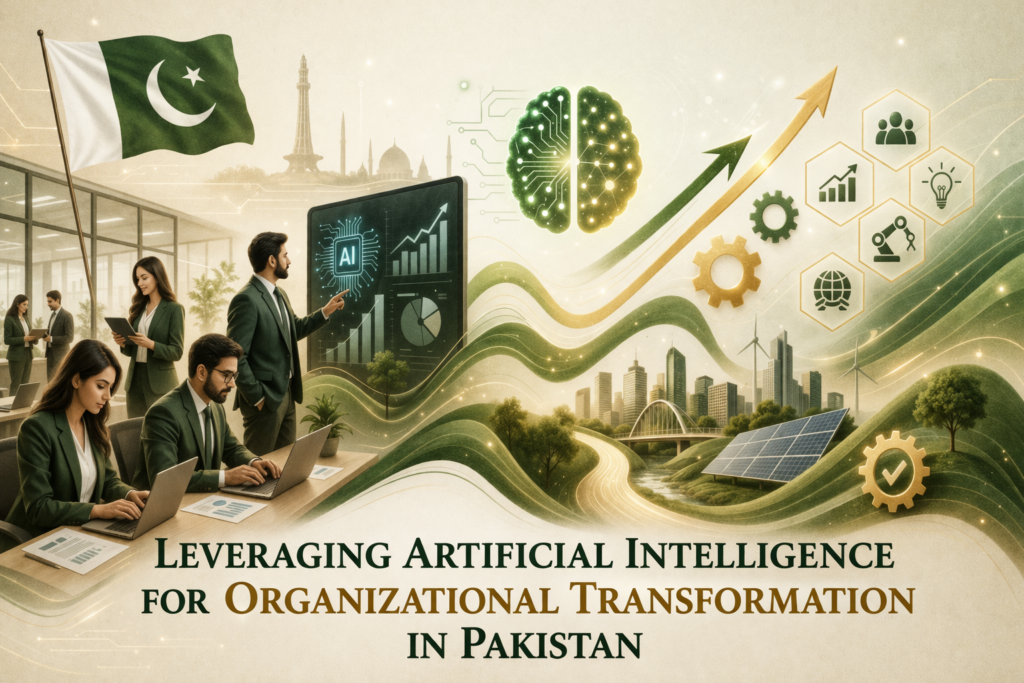
Artificial Intelligence is rapidly reshaping the landscape of organizational management, strategy, and innovation across the world. In Pakistan, institutions are beginning to recognize that AI is not merely a tool for automation but a transformative partner capable of driving organizational excellence, operational efficiency, and strategic foresight. The true potential of AI emerges when organizations engage with it thoughtfully, integrating it into decision-making ecosystems, scenario planning processes, and iterative improvement frameworks. Across healthcare, education, public administration, and the private sector, AI offers the ability to enhance judgment, anticipate risks, optimize resources, and unlock insights that were previously inaccessible. Its value lies not only in processing data but in acting as a collaborator in reasoning, enabling institutions to make informed, forward-looking decisions that align with long-term strategic goals.
In healthcare, for example, AI is transforming the way hospitals approach operational and clinical decision-making. Emergency departments in Pakistan often face unpredictable patient volumes, limited resources, and complex operational constraints. Traditional approaches relying on intuition or historical trends are insufficient for managing these dynamic environments. AI, when applied strategically, can model patient inflow patterns, predict staffing needs, and suggest optimal allocation of resources. It can simulate multiple scenarios, allowing hospital administrators to anticipate bottlenecks, minimize wait times, and deliver high-quality care consistently. By engaging AI as a strategic partner, hospitals gain insights into trade-offs between operational efficiency and patient outcomes, and they can evaluate decisions from multiple perspectives including cost, safety, scalability, and regulatory compliance. AI becomes not just a tool but a framework through which hospitals can make evidence-based decisions and continuously improve operational practices.
The educational sector in Pakistan presents another domain where AI is reshaping organizational processes. Universities and colleges face increasing pressure to implement digital transformation, optimize student services, and enhance the quality of education while operating under resource constraints. AI can assist in these challenges by creating structured evaluation systems that guide decision-making. For example, when selecting learning management systems or digital education platforms, AI can generate scoring frameworks that consider usability, integration with existing infrastructure, security compliance, cost efficiency, and adaptability to future technological needs. This structured evaluation transforms subjective decision-making into a transparent, data-driven process that improves accuracy and institutional confidence. Iterative engagement with AI further allows organizations to refine criteria, evaluate alternative options, and continuously optimize outcomes over time.
Organizational transformation requires more than process optimization. It requires a shift in mindset toward collaborative intelligence, where AI acts as an advisor capable of reasoning, critiquing, and simulating consequences. In scenarios involving major initiatives, AI can model best case, worst case, and most likely outcomes, identifying potential pitfalls that human planners may overlook. It can also evaluate reversible and permanent actions, enabling leaders to develop strategies that are resilient, flexible, and adaptive. For Pakistani institutions operating in complex and rapidly changing environments, this capacity for foresight is invaluable. Organizations that embrace AI-driven scenario planning gain a distinct advantage in navigating uncertainty, anticipating challenges, and implementing solutions that balance efficiency, sustainability, and strategic impact.
The value of AI also extends to iterative learning and continuous improvement. Organizations can engage AI to review decisions, critique outcomes, and propose refinements. This iterative process not only strengthens the quality of decisions but also fosters institutional learning, building adaptive intelligence that evolves with experience. Over time, human expertise and AI insight converge to create a culture of evidence-based reasoning, where decisions are continuously informed by data, analysis, and foresight. For example, an educational institution refining its curriculum delivery can use AI to analyze student engagement metrics, identify gaps, and implement incremental improvements while simultaneously projecting the long-term impact of these changes. This transforms organizational operations from reactive adjustments into strategic, forward-looking initiatives.
The private sector in Pakistan stands to benefit immensely from AI-driven organizational transformation. Businesses can leverage AI to optimize supply chain management, improve customer engagement, enhance financial planning, and streamline operational workflows. By creating structured evaluation frameworks for recurring decisions, such as vendor selection, resource allocation, or product development, organizations reduce uncertainty and achieve consistency in outcomes. AI can provide scenario simulations that anticipate market trends, competitor actions, and regulatory shifts, allowing businesses to respond proactively rather than reactively. This integration of AI into strategic planning strengthens resilience, fosters innovation, and positions organizations to compete effectively in regional and global markets.
Public administration and governance in Pakistan are equally poised to gain from AI adoption. Policy formulation, program evaluation, and service delivery can all be enhanced through data-driven insights and scenario-based planning. AI can help governments simulate the impact of policy decisions, anticipate resource requirements, and evaluate trade-offs across competing priorities. It can also support predictive analysis for national programs, optimizing implementation timelines and outcomes. By integrating AI into governance frameworks, policymakers can improve transparency, accountability, and responsiveness to citizen needs, ensuring that public resources are utilized effectively and outcomes are maximized.
To achieve these benefits, organizations must engage with AI strategically rather than tactically. Specificity in interaction, clarity of objectives, and defined roles for AI are critical to maximizing its impact. AI should be prompted to provide reasoning, step-by-step analysis, and multiple perspectives, rather than simplistic recommendations. Iterative engagement is essential, allowing organizations to refine processes, evaluate alternative strategies, and continuously improve decision quality. Over time, these practices create a culture of collaborative intelligence, where human judgment is enhanced by AI-driven insights and organizational resilience is strengthened.
Ethical and regulatory considerations also play a central role in the adoption of AI in Pakistan. Data privacy, security, and algorithmic transparency are essential to maintaining trust and ensuring responsible use of technology. Organizations must implement robust governance frameworks that monitor AI deployment, ensure compliance with legal and ethical standards, and address biases or unintended consequences in decision-making. By combining strategic engagement with ethical oversight, Pakistani institutions can fully leverage AI while maintaining accountability, fairness, and social responsibility.
The societal impact of AI-driven organizational transformation is substantial. In healthcare, it enables hospitals to deliver timely, high-quality patient care, optimize resource use, and reduce operational inefficiencies. In education, it provides equitable access to technology, enhances learning outcomes, and strengthens institutional decision-making. In business, it fosters innovation, improves competitiveness, and enhances financial and operational resilience. In governance, AI enables evidence-based policy-making, proactive service delivery, and long-term strategic planning. Collectively, these transformations contribute to Pakistan’s economic growth, social development, and global competitiveness.
Pakistan is at a strategic inflection point in the global AI revolution. Institutions that integrate AI thoughtfully into organizational strategy are positioned to achieve superior outcomes, anticipate challenges, and navigate uncertainty with agility. Those that fail to embrace AI risk being left behind as global competitors accelerate technological adoption and innovation. The imperative for Pakistani organizations is clear: treat AI not as a passive tool but as a strategic partner in reasoning, planning, and execution. By fostering iterative learning, multi-perspective analysis, and scenario-driven decision-making, institutions can unlock the full potential of AI to drive sustainable transformation.
The integration of AI into organizational strategy also encourages a shift toward adaptive intelligence. Leaders and teams learn to interpret AI-generated insights critically, question assumptions, and refine strategies continuously. This collaborative approach strengthens both individual and institutional capabilities, transforming decision-making from a reactive exercise into a forward-looking, evidence-based discipline. In Pakistan, where organizations often operate under complex regulatory, social, and economic pressures, this ability to anticipate change, weigh trade-offs, and optimize outcomes is particularly valuable.
Ultimately, the journey toward AI-driven organizational transformation is as much about culture and mindset as it is about technology. Success depends on fostering a culture of curiosity, experimentation, and informed judgment. It requires investing in capacity building, data infrastructure, and governance frameworks that support responsible AI adoption. It demands leaders who recognize the strategic potential of AI and can integrate it into decision-making systems effectively. When these elements align, AI becomes not merely a technological innovation but a transformative partner that empowers institutions to work smarter, think strategically, and achieve outcomes that would otherwise be unattainable.
The opportunity for Pakistan is immense. By leveraging AI as a collaborative partner in organizational transformation, institutions can enhance operational efficiency, foster innovation, and strengthen strategic foresight across sectors. Healthcare, education, public administration, and private enterprises all stand to benefit from AI-driven insights, scenario simulations, and structured decision-making frameworks. The potential impact extends beyond individual organizations to society at large, contributing to economic growth, social progress, and national competitiveness. The challenge is not the availability of AI technology but the vision, strategy, and institutional commitment to deploy it thoughtfully and effectively.
Pakistan has the opportunity to redefine its organizational and operational landscape through AI. By adopting a structured, strategic, and collaborative approach, institutions can harness AI to anticipate challenges, optimize decisions, and achieve long-term sustainability. The transformative potential of AI lies not only in the solutions it provides but also in the enhancement of human reasoning, strategic insight, and institutional intelligence. In a rapidly evolving technological and global environment, the integration of AI into organizational strategy is not optional but essential. Those who embrace this transformation will gain a decisive advantage, positioning Pakistan as a leader in innovation, operational excellence, and evidence-based decision-making.
Artificial Intelligence, when treated as a partner rather than a tool, can catalyze a new era of organizational performance, strategic foresight, and sustainable development in Pakistan. By integrating AI into decision-making systems, fostering iterative learning, and embracing multi-dimensional scenario analysis, organizations can enhance resilience, improve outcomes, and shape the future of their sectors with confidence and foresight. The potential of AI to drive organizational transformation in Pakistan is enormous, and the time to act is now, ensuring that institutions are equipped to meet the demands of an increasingly complex, competitive, and technologically driven world.
A Public Service Message