
Geo-Economics over Geopolitics: Pakistan’s Strategic Play in a Fragmenting Post–War Global Order

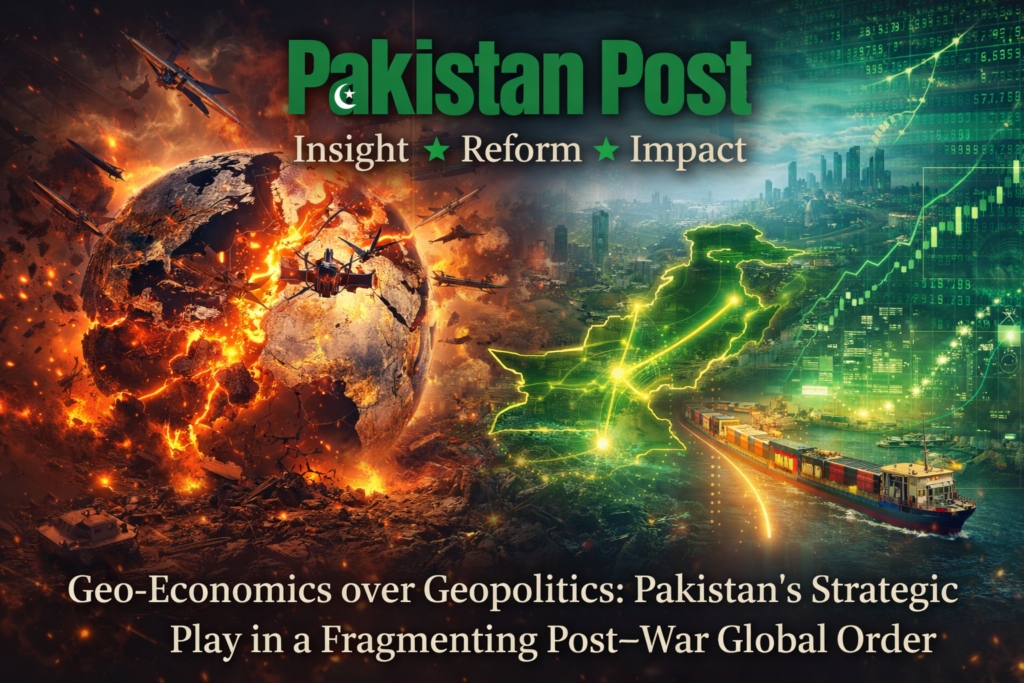
The conclusion of a major war does not restore order; it redistributes power within it. The confrontation involving the United States, Israel, and Iran has accelerated a transformation that was already underway in the global system but had not yet fully revealed itself. What distinguishes the present moment is not merely the scale of disruption, but the speed with which economic realities are overtaking political constructs. The war has exposed the fragility of a global order that long relied on the assumption that economic interdependence could coexist with strategic rivalry without consequence. That assumption no longer holds. In its place, a more fragmented, contested, and economically driven system is emerging—one in which states are forced to reassess their positions not in terms of alliances alone, but in terms of access, connectivity, and resilience.
The immediate economic impact of the conflict has been unmistakable. Energy markets, already under pressure from previous disruptions, have experienced renewed volatility as supply routes in the Middle East have been threatened or interrupted. Oil prices have surged, gas markets have tightened, and the ripple effects have been felt across industrial production, transportation, and consumer markets worldwide. Inflation, which had shown signs of moderation in several economies, has reasserted itself, complicating monetary policy and eroding purchasing power. Financial markets, while initially resilient, have displayed increasing sensitivity to geopolitical developments, reflecting deeper uncertainties about the sustainability of growth in an environment defined by recurring shocks.
Yet the significance of these developments extends beyond immediate economic indicators. The war has underscored the extent to which global systems remain dependent on a relatively narrow set of critical nodes—energy chokepoints, financial centers, and supply chain hubs. When these nodes are disrupted, the effects propagate rapidly and unpredictably. This realization is prompting a shift in strategic thinking across capitals, as states seek to diversify their dependencies, secure alternative routes, and build buffers against future disruptions. The result is a gradual but decisive move away from a singular, integrated system toward a more distributed and resilient network of economic relationships.
For the United States, this shift presents both challenges and opportunities. Its dominance in global finance, anchored in the centrality of the dollar and the reach of its regulatory frameworks, remains a powerful source of influence. Through sanctions, access controls, and market signals, Washington continues to shape the behavior of states and institutions worldwide. However, the conflict has highlighted the limits of this influence when it intersects with fundamental economic needs. The exclusion of a major energy producer from global markets does not occur in isolation; it alters supply dynamics, drives price volatility, and imposes costs that are ultimately shared by allies and adversaries alike.
This dynamic creates a tension at the heart of U.S. strategy. On the one hand, maintaining pressure on adversarial states is a core objective. On the other, the economic consequences of that pressure can undermine broader stability, including within the United States itself. The post-war environment is therefore likely to push Washington toward a recalibration—one that preserves strategic leverage while reducing systemic risk. This recalibration is unlikely to take the form of full normalization, but rather a series of incremental adjustments that allow for limited economic engagement, particularly in sectors where global stability is at stake.
In this context, the potential reintegration of Iran into global energy markets assumes particular importance. Iran’s reserves of oil and natural gas are among the largest in the world, yet their contribution to global supply has been constrained by sanctions and limited infrastructure. The war has not diminished the value of these resources; if anything, it has enhanced their significance by highlighting the fragility of existing supply chains. As global demand continues to grow, the economic logic of bringing Iranian energy back into circulation becomes increasingly compelling. This does not imply a wholesale reversal of policy, but rather a pragmatic recognition that stability requires participation.
For Iran, the post-war landscape presents a dual imperative. The economic damage inflicted by conflict, combined with the cumulative effects of sanctions, has created a pressing need for recovery. At the same time, the global demand for energy provides an opportunity to leverage resources in pursuit of reintegration. The easing of restrictions—whether partial, conditional, or sector-specific—would serve as both a form of economic compensation and a mechanism for restoring balance to global markets. The challenge for Iran lies in navigating this process in a manner that preserves strategic autonomy while enabling economic growth.
It is at this intersection of necessity and opportunity that Pakistan’s strategic position becomes particularly significant. Unlike the principal actors in the conflict, Pakistan is not bound by the same constraints of direct confrontation or ideological opposition. Its geographic location places it at the confluence of key regions—the Middle East, South Asia, Central Asia, and China—while its diplomatic relationships span multiple and often competing systems. This combination of proximity and flexibility allows Pakistan to operate in a space that is both accessible and valuable to a range of actors.
The concept of Pakistan as a connector state is not new, but the post-war environment gives it renewed urgency. In a world where economic systems are becoming more fragmented, the ability to bridge divides becomes a source of strategic advantage. Pakistan’s border with Iran provides immediate access to energy resources, while its existing infrastructure and regional linkages offer pathways for integration. At the same time, its engagement with global financial systems ensures that it remains connected to broader economic networks.
The most immediate and tangible opportunity lies in energy integration. Pakistan’s longstanding energy challenges—characterized by supply shortages, high costs, and reliance on imports—have constrained economic growth and industrial development. The volatility induced by the recent conflict has only intensified these challenges, highlighting the risks of dependence on distant and unstable supply chains. In contrast, Iran offers a proximate and potentially stable source of energy that aligns with Pakistan’s needs.
The revival of the Iran–Pakistan gas pipeline must therefore be viewed not as a singular project, but as a cornerstone of a broader strategic shift. The pipeline represents a direct link between supply and demand, one that bypasses many of the vulnerabilities associated with global markets. For Pakistan, it offers the prospect of affordable and reliable energy, reducing pressure on foreign exchange reserves and supporting industrial expansion. For Iran, it provides a route to market and a means of participating in regional economic systems. For the global economy, it contributes to the diversification of supply routes, enhancing resilience in the face of future disruptions.
However, the realization of this opportunity requires careful navigation of financial and political constraints. Even in a post-war environment, sanctions are unlikely to disappear entirely. This necessitates the development of alternative mechanisms that can facilitate transactions while minimizing exposure to residual restrictions. Currency swaps, localized settlement systems, and barter arrangements offer potential pathways, particularly in the early stages of reintegration. These mechanisms, while less efficient than fully liberalized systems, provide a practical means of initiating economic engagement.
China’s role in this process is both significant and multifaceted. Its investments in infrastructure, its interest in securing diversified energy supplies, and its capacity to operate within alternative financial frameworks position it as a key enabler of regional integration. The alignment of Chinese capital, Iranian resources, and Pakistani geography creates the foundation for a new economic corridor—one that extends beyond traditional boundaries and reflects the realities of a multipolar world. This corridor is not merely a physical construct, but a network of relationships that encompasses trade, finance, and energy.
For Pakistan, the challenge is to align domestic policy with this emerging framework. This requires a shift from short-term crisis management to long-term strategic planning, with a focus on building the infrastructure and institutions necessary to support increased economic activity. Energy integration must be accompanied by investments in transmission networks, industrial zones, and logistics systems that can translate supply into productivity. Regulatory frameworks must be streamlined to attract investment and reduce uncertainty, while governance structures must be strengthened to ensure transparency and efficiency.
Diplomatically, Pakistan must navigate a complex landscape of competing interests. Its relationships with Gulf states, particularly Saudi Arabia and the United Arab Emirates, remain central to its economic and political stability. At the same time, its engagement with the United States continues to shape access to global financial systems and development support. Expanding ties with Iran must therefore be managed in a manner that avoids unnecessary friction, emphasizing economic pragmatism and mutual benefit. The objective is not to align with any single bloc, but to operate effectively within a networked system.
The broader implications of this strategy extend beyond immediate economic gains. By positioning itself as a facilitator of connectivity, Pakistan can enhance its relevance within the regional and global system. Energy corridors linking Iran to South Asia, trade routes connecting Central Asia to global markets, and financial mechanisms bridging diverse systems all contribute to a new pattern of interdependence. This interdependence, in turn, has the potential to moderate conflict dynamics by increasing the economic costs of instability.
At the same time, the risks associated with this transition must be acknowledged and managed. The post-war environment is inherently uncertain, with potential fluctuations in sanctions policy, regional security conditions, and global economic trends. Pakistan must therefore adopt a phased approach, prioritizing initiatives that offer clear economic benefits while minimizing exposure to volatility. Early successes in energy integration and trade facilitation can build confidence and create momentum for broader engagement.
The global economy that emerges from this conflict is unlikely to be characterized by rapid growth or stability. Instead, it will be defined by slower expansion, higher volatility, and a greater emphasis on resilience. In such an environment, access to reliable energy and efficient trade networks becomes a critical determinant of economic performance. Pakistan’s ability to secure these advantages will depend on its capacity to act decisively and strategically in the immediate aftermath of war.
More fundamentally, the transformation underway reflects a shift in the nature of global power. In an interconnected world, influence is increasingly derived from the ability to facilitate flows rather than to control them. States that can connect regions, systems, and markets become central to the functioning of the global economy. Pakistan’s geographic position provides a foundation for such a role, but its realization depends on strategic intent, institutional capacity, and policy coherence.
The post-war moment is therefore one of both challenge and opportunity. It demands a rethinking of national priorities, a recalibration of relationships, and a commitment to long-term planning. For Pakistan, the path forward lies in embracing geo-economics as the central organizing principle of its strategy. This involves leveraging its position, strengthening its capabilities, and engaging with multiple partners in a manner that enhances its autonomy.
In the final analysis, the fragmentation of the global order does not signal its collapse, but its transformation. The emerging system is more complex, more interconnected, and more dependent on the ability of states to navigate overlapping networks. For Pakistan, this complexity offers a pathway to relevance. By positioning itself as a bridge between systems—facilitating integration where others see division—it can transform the disruptions of war into the foundations of long-term strategic advantage. The opportunity is not without risk, but it is defined by the choices made in the critical period that follows the end of conflict, and by the willingness to act with clarity in a world that is being reshaped by economic necessity rather than political design.
A Public Service Message