Fractured Mandates Reshape Pakistan Institutional Stability Amid Expanding Strategic Pressures

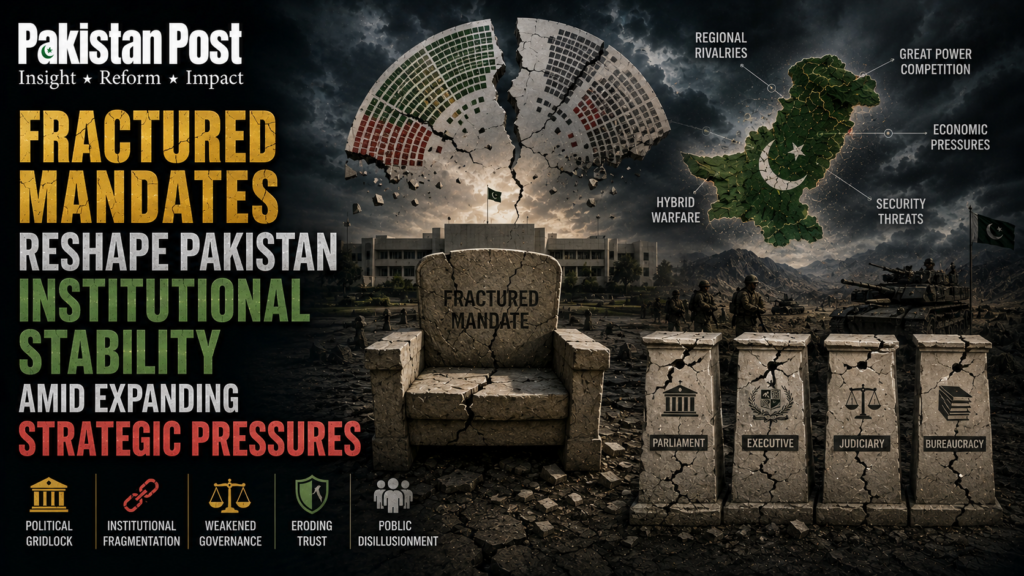
Pakistan is entering a historically delicate phase where the traditional equilibrium between civilian authority and strategic institutions is being recalibrated under the simultaneous pressure of economic fragility, governance exhaustion, regional insecurity, technological disruption, and intensifying geopolitical competition. The resulting transformation is neither a conventional democratic transition nor a recognizable authoritarian consolidation. Instead, the state is gradually evolving into a hybridized governance architecture where constitutional structures coexist uneasily alongside expanding security centric administrative management.
This transition is unfolding quietly yet decisively. Beneath the visible turbulence of electoral politics, cabinet instability, judicial confrontation, and partisan polarization lies a more consequential institutional question confronting Pakistan’s power structure. The central issue is no longer whether civilian supremacy or strategic oversight should dominate governance. The deeper concern is whether the Pakistani state can maintain administrative continuity, economic survivability, and national cohesion without expanding institutional overlaps that gradually erode constitutional clarity.
The modern Pakistani state increasingly functions under conditions of permanent crisis management. Fiscal instability, external debt dependence, inflationary shocks, insurgent resurgence, regional border volatility, water insecurity, cyber vulnerabilities, urban unrest, and collapsing public trust collectively generate a governance environment where traditional bureaucratic systems struggle to sustain operational effectiveness. Under such circumstances, the gravitational pull toward centralized command structures becomes structurally inevitable.
For strategic planners within Pakistan’s establishment, the fear is not merely political instability but systemic paralysis. Weak governance continuity under severe economic stress creates national security vulnerabilities extending beyond domestic politics. Delayed policymaking, fragmented civilian authority, bureaucratic inertia, and elite conflict reduce state responsiveness precisely when geopolitical pressures are intensifying across the region.
The consequences of this environment are already visible. Security institutions increasingly operate beyond their traditional domains, participating directly or indirectly in economic coordination, diplomatic stabilization, infrastructure management, cyber oversight, internal security planning, and crisis response frameworks. Simultaneously, civilian institutions continue to retain constitutional legitimacy yet often lack administrative capacity, public confidence, or policy coherence necessary for independent strategic management.
This institutional convergence is producing a new governance reality within Pakistan. It is not accurately described through simplistic binaries of democracy versus military influence. Instead, it represents the emergence of a securitized technocratic state where legitimacy is increasingly derived from operational stability rather than purely electoral mandate.
Such transitions are not unique to Pakistan. Throughout history, states confronting prolonged instability frequently witness expansion of strategic institutional influence over governance mechanisms. However, Pakistan’s case carries unique risks because institutional overlap is unfolding within an environment already characterized by polarized politics, economic vulnerability, media fragmentation, and declining public trust.
The most immediate danger lies in the gradual normalization of ambiguity. Constitutional democracies require clarity regarding authority, accountability, and jurisdictional boundaries. Once overlapping centers of influence become institutionalized, governance coherence weakens. Policy responsibility becomes diffuse. Civilian actors defer difficult decisions upward while strategic institutions increasingly inherit reputational burdens traditionally associated with political leadership.
This dynamic creates long term structural complications for both civilian and military domains. Civilian leadership risks administrative dependency while strategic institutions face expanded exposure to political dissatisfaction, economic grievances, and governance failures. The distinction between stabilization and overextension becomes increasingly blurred.
Economic fragility remains the central accelerant driving this recalibration. Pakistan’s recurring balance of payments crises, IMF dependency cycles, industrial stagnation, declining investor confidence, and elite rent seeking structures have weakened public confidence in traditional political governance models. In periods of severe economic anxiety, populations often prioritize order, predictability, and administrative efficiency over ideological constitutionalism. This sociopolitical shift gradually strengthens arguments favoring centralized decision making.
The establishment recognizes that uncontrolled economic deterioration carries existential implications for state stability. Rising inflation, energy shortages, unemployment, currency volatility, and declining middle class resilience collectively generate social frustration vulnerable to political mobilization. Under such circumstances, the state increasingly adopts security oriented governance frameworks to preserve continuity.
Yet this approach carries hidden strategic risks rarely discussed openly within policy circles. Excessive securitization of governance may achieve short term stabilization while gradually weakening democratic institutional development. Political actors deprived of meaningful administrative ownership often resort toward populist confrontation rather than responsible governance participation. This deepens cycles of polarization rather than resolving them.
The media environment intensifies these tensions significantly. Pakistan’s information ecosystem has fragmented into competing ideological realities where institutions themselves become central political symbols. Strategic institutions are alternately portrayed as guardians of stability or obstacles to democratic evolution depending upon narrative orientation. Civilian leadership is simultaneously framed either as incompetent and corrupt or as victims of structural imbalance.
Digital platforms have accelerated this polarization dramatically. Algorithmic outrage economies reward confrontation, conspiracy, emotional absolutism, and anti institutional rhetoric. Nuanced constitutional discourse struggles to survive within ecosystems designed to maximize engagement through anger and grievance amplification.
Foreign adversaries understand these fractures with increasing sophistication. Hybrid warfare strategies targeting Pakistan increasingly exploit civil military sensitivities through disinformation campaigns, selective leaks, synthetic narratives, and reputational manipulation. External actors recognize that institutional distrust weakens national coherence more effectively than direct confrontation.
India’s strategic community closely monitors Pakistan’s internal equilibrium through both traditional intelligence channels and digital perception analysis. Narratives portraying Pakistan as politically unstable, economically exhausted, or institutionally fragmented serve broader regional strategic objectives by undermining international investor confidence and diplomatic credibility.
Simultaneously, Western policy circles increasingly interpret Pakistan through a security management framework rather than democratic transition lens. International financial institutions prioritize predictability, debt stabilization, and governance continuity over ideological constitutional debates. Gulf investors similarly assess Pakistan primarily through investment security calculations rather than political theory.
China’s position adds another layer of complexity. Beijing values centralized coordination and long term policy continuity for strategic projects including the China Pakistan Economic Corridor. Political volatility, bureaucratic inconsistency, and judicial unpredictability generate concern within Chinese strategic calculations regarding infrastructure security and investment reliability.
Consequently, Pakistan’s governance structure is being shaped not only by internal institutional dynamics but also by external geopolitical expectations. International stakeholders increasingly reward stability regardless of whether that stability emerges through ideal democratic consolidation or hybridized strategic management.
This creates a profound dilemma for policymakers. Pakistan requires institutional coordination strong enough to manage severe economic and security pressures, yet excessive concentration of authority risks undermining democratic legitimacy and public trust. Achieving equilibrium between stability and constitutionalism has become the defining strategic challenge of the state.
The judiciary occupies a particularly volatile position within this evolving landscape. Courts increasingly function as arenas for political contestation rather than neutral constitutional arbitration alone. Judicial interventions, selective accountability perceptions, delayed verdicts, and politicized interpretations deepen institutional uncertainty. Public trust in legal neutrality declines whenever judicial outcomes appear synchronized with political turbulence.
This judicial politicization creates cascading governance effects. Bureaucratic decision makers become excessively risk averse. Policy implementation slows. Administrative paralysis expands because officials fear future legal or political repercussions. Governance fatigue gradually becomes systemic rather than episodic.
Pakistan’s bureaucracy meanwhile suffers from structural exhaustion. Frequent political transitions, inconsistent policy direction, politicized appointments, and institutional insecurity have weakened administrative professionalism. Civil service institutions increasingly struggle to provide long term policy continuity independent of political turbulence.
As civilian governance mechanisms weaken, strategic institutions inevitably fill operational vacuums. Disaster management, infrastructure protection, counterterrorism coordination, border stabilization, and even economic logistics increasingly depend upon security oriented administrative frameworks. While operationally effective in certain contexts, this trend gradually transforms the nature of the state itself.
Another underexamined risk involves generational perception shifts. Younger Pakistanis raised during prolonged instability increasingly view governance through performance metrics rather than constitutional theory. Administrative delivery, economic opportunity, digital connectivity, and personal security matter more than abstract institutional arrangements. This sociological evolution may strengthen acceptance of technocratic centralized governance models if democratic systems continue appearing dysfunctional.
However, stability without legitimacy remains strategically fragile. Public compliance generated through exhaustion differs fundamentally from sustainable national consensus. If citizens perceive governance structures as permanently exclusionary, resentment gradually accumulates beneath apparent stability.
The international media environment further complicates matters. Western narratives often reduce Pakistan’s institutional complexities into simplistic tropes of military dominance versus democratic struggle. Such framings ignore the deeper structural reality that many civilian institutions themselves remain weak, fragmented, patronage driven, and administratively inconsistent. Yet external perception matters because diplomatic credibility and investment confidence increasingly depend upon international narratives.
For the establishment, reputational management has therefore become inseparable from national security. Global investors, strategic partners, multilateral lenders, and foreign governments assess not only macroeconomic indicators but also institutional predictability and governance coherence. Perceived instability increases borrowing costs, discourages foreign direct investment, and weakens diplomatic leverage.
Regional security conditions intensify these pressures further. Afghanistan remains unstable despite shifting international attention. Cross border militancy continues threatening internal security. Balochistan’s insurgency environment persists. Sectarian networks remain operational. Cyber vulnerabilities expand continuously. Water insecurity and climate pressures threaten future social instability.
Under such circumstances, the strategic establishment argues that governance fragmentation constitutes a direct national security risk. From this perspective, centralized coordination appears not merely preferable but necessary for state survival.
Yet the hidden danger lies in institutional overdependence. Sustainable states require resilient civilian governance structures capable of absorbing political shocks independently. If civilian institutions remain perpetually subordinate, underdeveloped, or politically delegitimized, long term governance sustainability weakens irrespective of short term stabilization success.
Pakistan therefore requires comprehensive institutional recalibration rather than reactive power balancing. Parliamentary structures must regain policy relevance beyond symbolic legislation. Civilian bureaucracies require professional modernization insulated from partisan patronage cycles. Judicial reforms must restore procedural credibility and constitutional consistency. Strategic institutions need clearly defined coordination frameworks preserving operational effectiveness without encouraging indefinite administrative expansion.
Media reform is equally essential. Pakistan requires strategic communication systems capable of countering disinformation without suppressing legitimate dissent. Narrative management through coercive methods alone ultimately damages credibility. Public trust emerges through transparency, consistency, and institutional restraint.
Economic restructuring remains central to any sustainable solution. Chronic fiscal dependency weakens civilian governance because crisis management continuously shifts toward centralized emergency structures. Export modernization, industrial reform, taxation rationalization, energy stabilization, and technological investment are therefore not merely economic priorities but national security imperatives.
Educational transformation is equally critical. Pakistan’s political culture increasingly rewards emotional populism over informed citizenship. Media literacy, constitutional education, institutional awareness, and civic reasoning must become national priorities if democratic resilience is to survive within digitally polarized environments.
The establishment also faces an important strategic communication challenge internally. National stability cannot depend indefinitely upon informal understandings, behind the scenes coordination, or personality based arrangements. Institutional predictability requires transparent constitutional mechanisms capable of surviving leadership transitions and political crises.
Pakistan stands at a decisive inflection point. The country’s future trajectory will depend upon whether institutional recalibration evolves toward balanced constitutional modernization or drifts into permanent ambiguity. Neither uncontrolled populism nor indefinite securitized governance can sustainably resolve Pakistan’s structural crises.
The strategic imperative for policymakers is therefore unmistakable. Pakistan requires a governance model combining constitutional legitimacy, administrative competence, economic realism, and strategic continuity simultaneously. Failure to achieve this equilibrium risks producing a permanently unstable hybrid order vulnerable to internal fragmentation and external manipulation alike.
The hidden threat confronting Pakistan is not immediate institutional collapse. It is gradual normalization of structural imbalance where governance survives tactically while constitutional confidence deteriorates strategically. Once societies lose faith in institutional fairness and political inclusion, stability becomes increasingly transactional rather than organic.
For senior decision makers, the lesson is severe yet clear. The preservation of Pakistan’s national cohesion will ultimately depend not upon the dominance of any singular institution but upon the state’s ability to restore functional equilibrium between authority, legitimacy, and governance capacity within an unforgiving geopolitical environment.
A Public Service Message