

Invisible Frontiers Shape Pakistan Electoral Sovereignty Under Hybrid Warfare Pressures

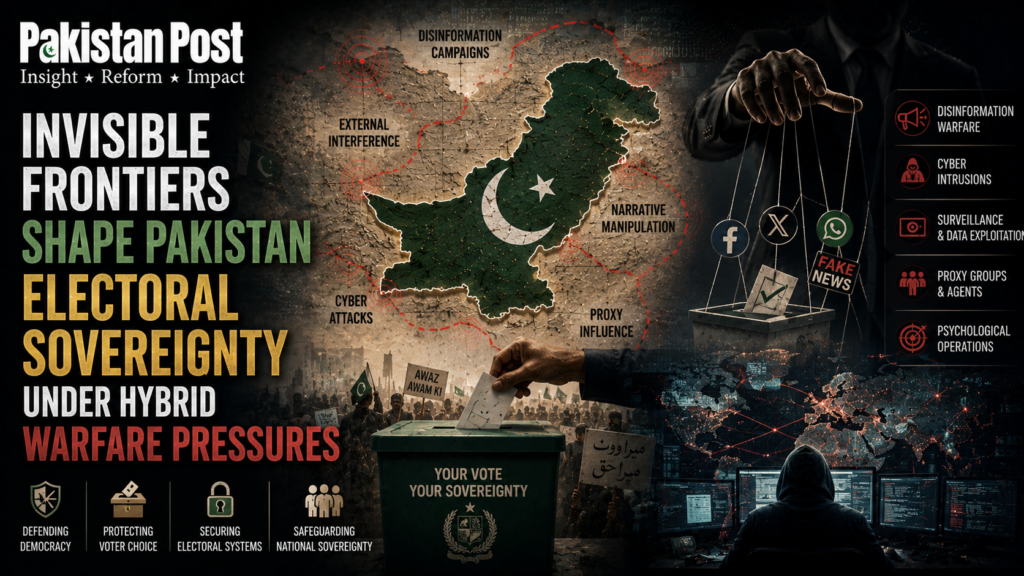
Pakistan’s democratic architecture is no longer operating within the conventional boundaries of electoral competition. It is functioning inside a contested cognitive battlespace where information, perception, and institutional legitimacy are being weaponized simultaneously by domestic political actors, transnational ideological ecosystems, hostile digital networks, commercially incentivized outrage industries, and foreign influence operations seeking strategic disruption without kinetic engagement. The modern Pakistani electoral environment increasingly resembles a fragmented theatre of hybrid warfare where the objective is not merely regime alteration but systemic exhaustion of institutional coherence itself.
The most consequential transformation in Pakistan’s political environment is not visible through ballot counts or parliamentary arithmetic. It is visible through the collapse of epistemic authority. Competing political camps no longer disagree merely on policy. They inhabit entirely separate informational universes reinforced by algorithmic echo chambers, emotionally manipulative narratives, and digitally accelerated grievance ecosystems. This fragmentation has generated a dangerous condition where electoral legitimacy itself becomes permanently contestable irrespective of procedural outcomes.
For strategic planners within Pakistan’s national security establishment, the emerging threat matrix extends far beyond traditional espionage or covert destabilization. The contemporary battlefield has shifted toward cognitive warfare. Electoral distrust, institutional suspicion, judicial delegitimization, and social polarization now function as force multipliers capable of degrading national cohesion without a single conventional military engagement. The most dangerous adversary is no longer necessarily a visible state actor but an invisible architecture of synchronized disinformation, perception management, financial panic amplification, sectarian manipulation, and digitally engineered psychological fatigue.
The strategic environment surrounding Pakistan’s electoral system has evolved dramatically after the acceleration of artificial intelligence assisted propaganda systems, decentralized political media ecosystems, and encrypted digital mobilization structures. Sophisticated influence operations no longer require centralized command hierarchies. Distributed networks of ideological activists, cyber operatives, diaspora influencers, anonymous amplification accounts, commercial political consultants, and opportunistic digital propagandists collectively manufacture narrative pressure capable of influencing public behavior at scale.
Pakistan’s social media environment has become uniquely vulnerable because political discourse increasingly operates through emotional virality rather than institutional verification. TikTok, X, YouTube, WhatsApp, Telegram, and short form algorithmic ecosystems reward outrage, victimhood, conspiracy, humiliation, and absolutist rhetoric. Nuance has become strategically uncompetitive. Complex policy discourse is algorithmically disadvantaged against emotionally charged slogans engineered for maximum digital circulation.
This transformation has profound implications for state stability. Public trust in institutions traditionally depended upon a shared minimum reality. Once that collapses, every institution becomes vulnerable to perpetual delegitimization campaigns. Electoral commissions become compromised in perception before voting even begins. Judicial verdicts are framed as engineered outcomes. Economic turbulence is interpreted as conspiracy. Security operations are recast as political engineering. Administrative decisions become evidence for competing ideological narratives.
Foreign adversaries understand this vulnerability with increasing sophistication. Contemporary influence operations targeting Pakistan do not necessarily seek immediate regime change. Their strategic objective is prolonged institutional paralysis. Sustained polarization weakens governance continuity, reduces foreign investor confidence, complicates counterterrorism coordination, fragments elite consensus, and exhausts state capacity through continuous internal turbulence.
Within regional strategic calculations, Pakistan occupies a uniquely exposed position. Its geopolitical importance, nuclear capability, economic fragility, polarized political landscape, and expanding digital penetration collectively create fertile terrain for hybrid warfare experimentation. Competing external powers increasingly perceive informational destabilization as a cost effective alternative to direct confrontation.
India’s strategic doctrine has evolved considerably toward information dominance and perception shaping. Indian digital ecosystems possess significant scale advantages, narrative amplification capacity, diaspora reach, and international media penetration. During periods of bilateral tension, anti Pakistan narratives circulate globally with extraordinary speed, often framing Pakistan simultaneously as politically unstable, economically fragile, and strategically irresponsible. Such narratives gradually shape diplomatic perceptions, investment calculations, and geopolitical trust frameworks.
Simultaneously, transnational ideological ecosystems exploit Pakistan’s internal divisions for their own strategic objectives. Sectarian organizations, religious populist movements, hyper nationalist factions, and external ideological patrons increasingly use digital infrastructures to influence public behavior. The result is a persistent erosion of national narrative coherence.
The danger for Pakistani policymakers lies in underestimating the cumulative psychological effects of these fragmented operations. Hybrid warfare succeeds not through singular catastrophic events but through prolonged erosion of confidence. Citizens gradually lose faith in electoral systems, constitutional procedures, media credibility, economic institutions, and national consensus. Once societal trust thresholds collapse, governance becomes structurally reactive rather than strategically proactive.
The economic dimension of hybrid destabilization is particularly alarming. Pakistan’s fragile macroeconomic environment remains acutely vulnerable to perception shocks. Coordinated disinformation regarding currency collapse, sovereign default, banking instability, or political upheaval can trigger real financial consequences irrespective of underlying fundamentals. Digital panic spreads faster than official clarification mechanisms. Markets increasingly respond not only to economic indicators but also to viral narratives.
Artificial intelligence is intensifying these risks dramatically. AI generated deepfakes, synthetic voice replication, fabricated documents, manipulated video evidence, and algorithmically optimized propaganda will fundamentally alter future political competition. Pakistan currently lacks sufficient institutional preparedness for this emerging threat environment. The next electoral crisis may not revolve around physical polling irregularities but around digitally manufactured realities capable of triggering unrest before verification becomes possible.
The strategic implications for civil military relations are equally significant. In periods of institutional distrust, the security establishment inevitably becomes central within competing political narratives. Political factions alternately seek institutional endorsement or accuse institutions of interference depending upon immediate tactical advantage. This creates long term reputational vulnerabilities for state structures responsible for national continuity.
For establishment planners, the critical concern is not merely political turbulence but institutional overstretch. When security institutions become permanent arbiters within polarized civilian environments, they risk simultaneous politicization and reputational attrition. External adversaries recognize this dynamic and increasingly exploit it through targeted narrative campaigns designed to deepen civil institutional friction.
Media ecosystems further complicate the situation. Pakistan’s traditional media model has fragmented irreversibly. Television no longer monopolizes narrative construction. Influencers with minimal accountability increasingly shape public perception more effectively than formal institutions. Anonymous digital accounts often outperform state communication structures in narrative velocity. Information authority has decentralized beyond conventional regulatory capacity.
This decentralization produces both democratic openness and national vulnerability. In the absence of strategic communication coherence, hostile narratives penetrate domestic discourse rapidly. Conspiracy theories flourish because institutional communication frequently remains delayed, fragmented, overly bureaucratic, or strategically inconsistent.
The state’s response to these developments has often remained excessively reactive. Regulatory crackdowns without institutional transparency risk intensifying public suspicion rather than restoring confidence. Heavy handed digital restrictions may generate short term tactical control while deepening long term legitimacy deficits. Contemporary information warfare cannot be resolved solely through censorship mechanisms. Cognitive resilience requires credibility rather than coercion alone.
Pakistan therefore requires a comprehensive national cognitive security doctrine integrating cyber defense, strategic communications, electoral resilience, media literacy, institutional transparency, and AI disinformation preparedness. Fragmented bureaucratic responses are insufficient against networked hybrid warfare architectures.
Electoral resilience must become a national security priority rather than merely an administrative function. Future elections should incorporate advanced cyber defense systems, AI enabled disinformation monitoring cells, rapid fact verification mechanisms, encrypted result transmission protocols, and coordinated strategic communication units capable of responding to narrative manipulation in real time.
Simultaneously, the Election Commission requires enhanced technological sovereignty. Dependence upon foreign digital infrastructures, externally hosted platforms, and vulnerable communication systems creates unacceptable exposure. Pakistan’s electoral data architecture must be secured through domestically supervised cyber frameworks integrated with national security oversight.
The role of intelligence agencies will also require recalibration. Traditional intelligence paradigms focused primarily upon physical threats, militant organizations, and external espionage must now expand toward cognitive warfare analysis. Narrative mapping, algorithmic manipulation tracking, digital influence attribution, and transnational propaganda monitoring should become institutional priorities within the broader national security apparatus.
However, strategic caution is essential. Expanding cognitive security operations without transparent legal safeguards risks intensifying accusations of political engineering. The challenge for policymakers is achieving equilibrium between national stability and democratic legitimacy. Excessive securitization of political discourse may generate the very alienation external adversaries seek to exploit.
Institutional transparency therefore becomes strategically indispensable. Public trust cannot be manufactured solely through information management. It requires procedural credibility, constitutional continuity, accountable governance, and visible institutional restraint. Where trust deficits persist, hostile narratives gain fertile ground.
Pakistan’s judiciary also occupies a critical position within this evolving battlespace. Judicial polarization magnifies systemic instability because courts increasingly function not only as legal institutions but as symbolic arenas for political legitimacy contests. Selective interpretations, delayed verdicts, contradictory legal messaging, and politicized perceptions weaken constitutional coherence. Judicial communication strategies therefore require modernization to preserve institutional neutrality within increasingly hostile digital environments.
Educational reform represents another underappreciated security imperative. Pakistan’s population remains highly vulnerable to digital misinformation due to weak media literacy, low institutional trust, emotional political mobilization, and limited critical verification culture. Long term national resilience requires educational frameworks emphasizing digital literacy, cognitive verification skills, and constitutional awareness.
The international dimension remains equally important. Pakistan must recognize that narrative battles increasingly shape diplomatic outcomes. Global investors, foreign governments, multilateral institutions, and strategic partners assess states not solely through objective indicators but through dominant international perceptions. Persistent portrayals of chaos, instability, and institutional dysfunction gradually influence geopolitical positioning.
Strategic communication therefore cannot remain fragmented across ministries, political actors, and institutional silos. Pakistan requires a centralized yet professionally autonomous national strategic communications framework capable of coordinating external messaging without descending into crude propaganda. Credibility, consistency, and sophistication are essential.
The military dimension of hybrid warfare should not be underestimated either. Conventional deterrence remains relevant, but adversaries increasingly pursue below threshold destabilization precisely because direct military confrontation carries unacceptable escalation risks. Information warfare offers plausible deniability, low operational cost, and strategic disruption without kinetic retaliation.
This creates a dangerous asymmetry. Pakistan possesses credible nuclear deterrence against traditional aggression but remains comparatively exposed within the information domain. Cognitive vulnerabilities cannot be deterred through conventional military doctrine alone.
Economic restructuring must therefore be understood partly through a security lens. Financial fragility amplifies susceptibility to narrative destabilization. States experiencing persistent inflation, unemployment, currency volatility, and elite fragmentation become easier targets for psychological operations because public anxiety already exists structurally within society.
Policy makers should also recognize the emerging convergence between organized digital manipulation and criminal economic networks. Cryptocurrency laundering, anonymous funding channels, covert digital advertising systems, foreign sponsored influence operations, and politically connected media ecosystems increasingly intersect. Hybrid warfare has become financially industrialized.
Within Pakistan’s urban centers, political radicalization is increasingly mediated through digital identity formation rather than traditional ideological institutions. Younger populations consume politics through emotionally optimized content ecosystems prioritizing outrage and performative confrontation. This produces volatile mobilization patterns difficult for conventional state structures to anticipate or control.
The establishment’s principal challenge therefore lies not merely in preserving order but in preserving legitimacy under conditions of permanent informational warfare. Tactical stability without public trust becomes strategically unsustainable over time. National resilience requires institutional credibility capable of surviving hostile narrative environments.
Pakistan stands at a decisive historical intersection. The country’s future political stability will depend less upon traditional electoral arithmetic and more upon whether state institutions can adapt to an era where perception itself has become a battlefield. Hybrid warfare is no longer a theoretical doctrine discussed within military academies. It is an operational reality shaping electoral legitimacy, economic confidence, social cohesion, and geopolitical positioning simultaneously.
The hidden risk confronting Pakistan is not immediate state collapse but gradual democratic exhaustion. A permanently contested political environment eventually weakens governance capacity, discourages investment, accelerates elite fragmentation, and normalizes instability. External adversaries do not necessarily need to defeat Pakistan militarily if internal distrust continuously weakens institutional functionality from within.
For policymakers, the strategic lesson is unmistakable. Electoral integrity can no longer be treated merely as a constitutional procedure. It has become a central pillar of national security. Cognitive sovereignty, digital resilience, institutional transparency, and narrative coherence now constitute the frontline defenses of modern states confronting twenty first century hybrid warfare realities.
A Public Service Message