Silent Deterrence Masks South Asian Escalation Dangers Beneath Strategic Rivalries

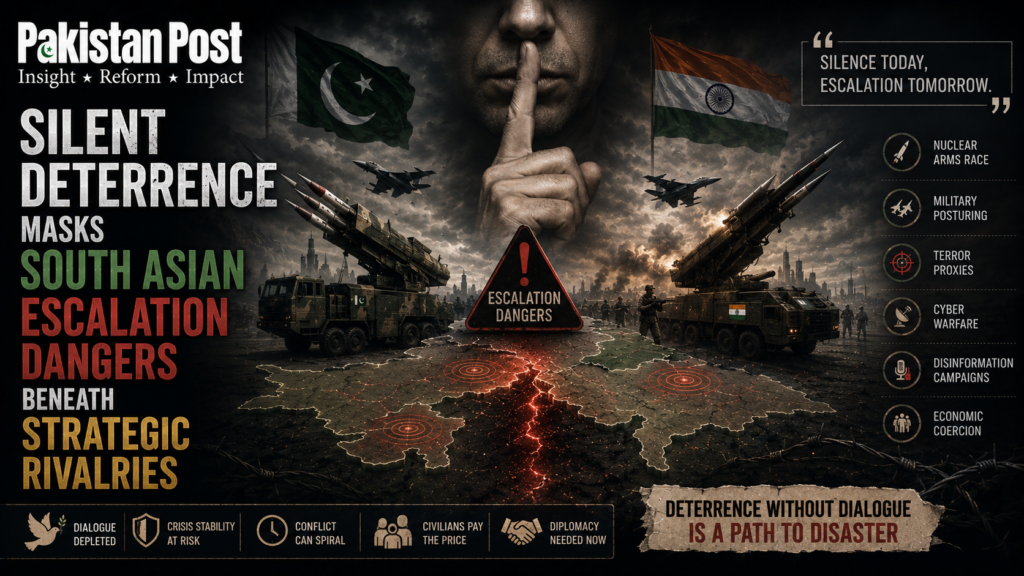
South Asia is entering a prolonged era of frozen hostility where nuclear deterrence preserves temporary stability while simultaneously concealing accelerating risks of conventional escalation, psychological confrontation, cyber disruption, water insecurity, and strategic miscalculation. The Pakistan India relationship no longer resembles a traditional bilateral rivalry governed by sustained diplomacy or structured conflict management. It increasingly operates as a volatile security equation defined by mutual distrust, fragmented communication, hyper nationalist political ecosystems, and militarized perception warfare capable of transforming localized incidents into regional crises with alarming speed.
The most dangerous dimension of contemporary South Asian instability is not visible through troop mobilizations or nuclear signaling alone. It lies within the gradual disappearance of strategic trust mechanisms that historically prevented tactical tensions from evolving into uncontrollable escalation cycles. Pakistan and India remain nuclear armed adversaries possessing substantial retaliatory capabilities, yet the diplomatic architecture necessary to manage crises between them continues deteriorating steadily.
Both states publicly maintain the language of deterrence stability while privately preparing for limited confrontation scenarios below the nuclear threshold. This contradiction defines the emerging regional security environment. Nuclear weapons prevent total war but simultaneously encourage experimentation with calibrated coercion, information warfare, covert operations, cyber intrusion, drone surveillance, and rapid military signaling designed to avoid full escalation while maximizing strategic pressure.
For policymakers within Pakistan’s security establishment, the principal concern is no longer the probability of immediate large scale war. The deeper anxiety involves cumulative escalation resulting from compressed decision making timelines, media driven nationalist pressure, and technological acceleration outpacing diplomatic coordination mechanisms. The risk environment has become increasingly nonlinear. A localized border incident, cyber disruption, militant attack, or politically amplified misinformation campaign can rapidly generate strategic instability before traditional crisis management channels fully activate.
India’s strategic doctrine has undergone substantial transformation over the past decade. New Delhi increasingly perceives itself not merely as a regional power but as an emerging global actor aligned with broader Western strategic objectives within the Indo Pacific framework. This geopolitical confidence has strengthened India’s willingness to adopt assertive military posturing, diplomatic isolation strategies, intelligence operations, and economic pressure mechanisms directed toward Pakistan.
Simultaneously, India’s internal political landscape has become deeply intertwined with hyper nationalist security narratives. Electoral politics increasingly reward muscular rhetoric regarding Pakistan, particularly during periods of domestic political contestation. The strategic danger arises when domestic political incentives reduce flexibility during moments of bilateral tension. Leadership structures operating under nationalist pressure often possess limited room for de escalation without appearing politically weak.
Pakistan faces parallel dynamics. Economic fragility, political polarization, institutional distrust, and external diplomatic pressures collectively intensify sensitivity toward Indian strategic signaling. Perceptions of encirclement, strategic isolation, or coercive pressure reinforce defensive postures within Pakistan’s security calculus. Consequently, both states increasingly interpret each other’s actions through worst case assumptions.
This environment creates extraordinary escalation vulnerability because deterrence stability itself may generate strategic complacency. Nuclear capability reduces the likelihood of total war yet increases the probability of repeated lower threshold confrontations under the assumption that escalation can always be controlled. History demonstrates such assumptions are inherently dangerous.
The Line of Control remains among the world’s most militarized and psychologically volatile frontiers. Although ceasefire arrangements periodically reduce immediate tensions, underlying hostility persists structurally. Drone intrusions, surveillance operations, sniper incidents, infiltration allegations, and intelligence activities continuously maintain a climate of suspicion. Tactical commanders on both sides operate under immense pressure within politically sensitive environments where local incidents can rapidly acquire national significance.
Technological evolution is intensifying these dangers substantially. Surveillance drones, satellite imaging, cyber reconnaissance, AI assisted intelligence analysis, and precision targeting systems compress reaction timelines dramatically. Decision makers increasingly operate within information saturated environments where incomplete or manipulated data may shape escalation choices during moments of crisis.
Media ecosystems further destabilize the regional environment. Pakistan and India now possess highly polarized digital landscapes where nationalist outrage circulates faster than diplomatic clarification. Television debates, social media amplification, anonymous influence accounts, and algorithmically optimized political content transform security incidents into emotional mass mobilization events within hours.
The Pulwama Balakot episode demonstrated how rapidly contemporary crises can evolve under media militarization. Information warfare now operates alongside conventional signaling as an integral component of escalation management. Public perception itself has become a strategic battlespace. Governments increasingly seek domestic narrative dominance simultaneously with military positioning.
This creates profound risks for rational crisis management. Leadership structures facing digitally amplified nationalist pressure may prioritize symbolic retaliation over strategic restraint. Once public expectations harden around retaliatory action, diplomatic maneuverability narrows significantly.
Foreign actors observe these dynamics closely. The United States views India as an increasingly important strategic partner within broader competition against China. Washington therefore maintains strong incentives to preserve India’s regional stability and military capacity. However, American strategic support for India simultaneously generates concern within Pakistani security circles regarding regional power asymmetry.
China’s role further complicates the equation. Beijing remains Pakistan’s principal strategic partner while simultaneously competing with India across multiple theaters including border disputes, maritime influence, technological rivalry, and regional infrastructure competition. Consequently, South Asia increasingly risks functioning as a secondary arena within larger global power contests.
The hidden danger for Pakistan lies in strategic overextension. Economic weakness constrains military modernization capacity at precisely the moment regional competition is accelerating technologically. India’s expanding defense budget, indigenous military production, intelligence integration, and cyber capabilities gradually alter conventional balances. Pakistan therefore continues relying heavily upon credible deterrence and asymmetric strategic calculations to preserve equilibrium.
Water insecurity may emerge as the most underestimated escalation catalyst of the coming decade. Climate change, glacier depletion, erratic monsoon patterns, agricultural stress, and expanding populations are transforming hydrological stability into a strategic concern. The Indus Waters framework historically functioned as one of the few durable institutional mechanisms surviving broader hostility. Yet environmental pressure increasingly politicizes water discourse on both sides.
Within Pakistan, growing fears exist regarding upstream infrastructure development, river flow manipulation, and long term agricultural vulnerability. In India, strategic circles increasingly debate maximizing treaty leverage amid broader geopolitical competition. Water therefore risks evolving from a technical management issue into a symbolically charged national security narrative.
Climate stress intensifies this vulnerability considerably. Reduced water availability combined with food insecurity, urban expansion, and economic instability could gradually transform environmental pressures into interstate political confrontation. Future South Asian crises may involve resource anxiety as much as traditional territorial disputes.
Cyber warfare constitutes another expanding frontier. Both Pakistan and India increasingly invest in offensive and defensive cyber capabilities targeting communications infrastructure, financial systems, surveillance networks, and strategic institutions. During crises, cyber operations may be deployed below traditional military thresholds while still producing severe economic and psychological disruption.
The challenge lies in attribution ambiguity. Cyber incidents often lack immediately verifiable responsibility, increasing risks of miscalculation or retaliatory escalation based upon incomplete intelligence. Artificial intelligence will further complicate this environment through synthetic media manipulation, automated propaganda generation, and AI enhanced disinformation campaigns capable of triggering public panic during sensitive moments.
Militant violence remains an enduring destabilizing factor despite changing regional dynamics. Any major terrorist incident risks immediate escalation because political leadership in both states operates within highly charged nationalist environments. Diplomatic space for restraint following mass casualty attacks has narrowed significantly over time.
For Pakistan’s establishment, a critical concern involves the possibility of non state actors deliberately attempting to provoke bilateral confrontation for ideological or strategic purposes. Escalation manipulation through asymmetric violence remains among the most dangerous scenarios confronting South Asian stability.
Another underexamined risk involves diplomatic exhaustion. Pakistan and India increasingly lack sustained structured dialogue mechanisms capable of managing accumulated grievances systematically. Backchannel communication continues intermittently, yet formal diplomatic engagement remains limited and politically constrained.
This diplomatic vacuum produces strategic rigidity. Without regular engagement, assumptions harden into doctrine. Intelligence interpretations replace political dialogue. Military signaling substitutes for negotiation. Over time, adversaries begin perceiving confrontation itself as the normal state of affairs.
The economic costs are immense yet frequently overlooked within nationalist discourse. Regional trade remains severely underdeveloped despite geographical proximity and complementary economic potential. South Asia continues functioning below its collective economic capacity because security competition dominates political imagination.
Yet political incentives favor confrontation narratives. Nationalist media ecosystems profit from hostility. Political actors mobilize electoral support through security rhetoric. Defense establishments maintain institutional influence within adversarial environments. Consequently, incentives for sustained reconciliation remain structurally weak.
International actors meanwhile increasingly prioritize crisis containment rather than conflict resolution. Major powers seek to prevent catastrophic escalation without fundamentally addressing underlying disputes. This approach preserves temporary stability while allowing long term hostility to deepen gradually.
The establishment in Pakistan therefore faces a multidimensional strategic challenge. The country must preserve credible deterrence, avoid diplomatic isolation, manage economic constraints, counter information warfare, and prevent uncontrolled escalation simultaneously. Conventional military readiness alone cannot address these overlapping pressures.
Strategic communication has become critically important. Pakistan must strengthen international narrative credibility while avoiding reactive rhetorical escalation. Global perceptions increasingly influence diplomatic leverage, financial confidence, and geopolitical partnerships. States perceived as unstable or escalation prone encounter growing strategic disadvantages internationally.
Institutional modernization is equally essential. Crisis management systems require technological upgrading, interagency coordination, AI assisted threat analysis, and secure communication infrastructures capable of functioning under cyber stress. Military hotlines alone are insufficient within contemporary hybrid conflict environments.
Pakistan should pursue discreet but consistent escalation management mechanisms with India irrespective of broader political hostility. Structured military communication protocols, cyber incident coordination frameworks, water dialogue mechanisms, and third party facilitated backchannels remain strategically necessary even during periods of diplomatic freeze.
Simultaneously, Pakistan must avoid strategic fatalism. Regional hostility should not become an excuse for economic stagnation or governance paralysis. Long term national resilience ultimately depends upon economic modernization, institutional credibility, technological advancement, and internal stability as much as military deterrence.
The hidden danger confronting South Asia is not immediate nuclear exchange. The more plausible threat is gradual normalization of perpetual low intensity confrontation where repeated crises steadily increase probabilities of catastrophic miscalculation over time. Each unresolved incident leaves behind psychological residue deepening future mistrust.
Nuclear deterrence provides stability only when combined with rational communication, political restraint, and functioning diplomatic channels. Without those mechanisms, deterrence itself may produce dangerous overconfidence regarding escalation control.
Pakistan and India now stand trapped within a paradoxical strategic environment. Both possess sufficient destructive capability to prevent total war yet insufficient political trust to prevent recurring crises. This unstable equilibrium may persist for years, but its sustainability cannot be assumed indefinitely.
For Pakistani policymakers and strategic institutions, the central lesson is stark. The future security environment will increasingly be shaped not only by military preparedness but by crisis anticipation, technological adaptation, narrative management, and diplomatic resilience. Strategic patience, institutional discipline, and calibrated deterrence will remain essential for navigating an increasingly volatile South Asian order where one miscalculation could alter regional history irreversibly.
A Public Service Message