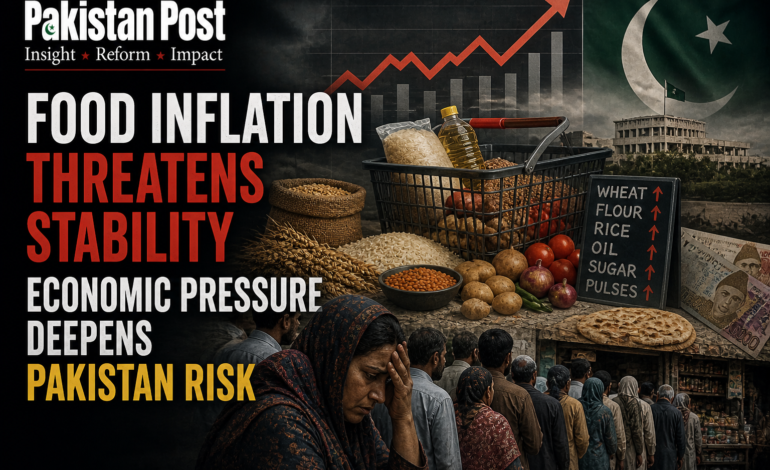
Food Inflation Threatens Stability Economic Pressure Deepens Pakistan Risk

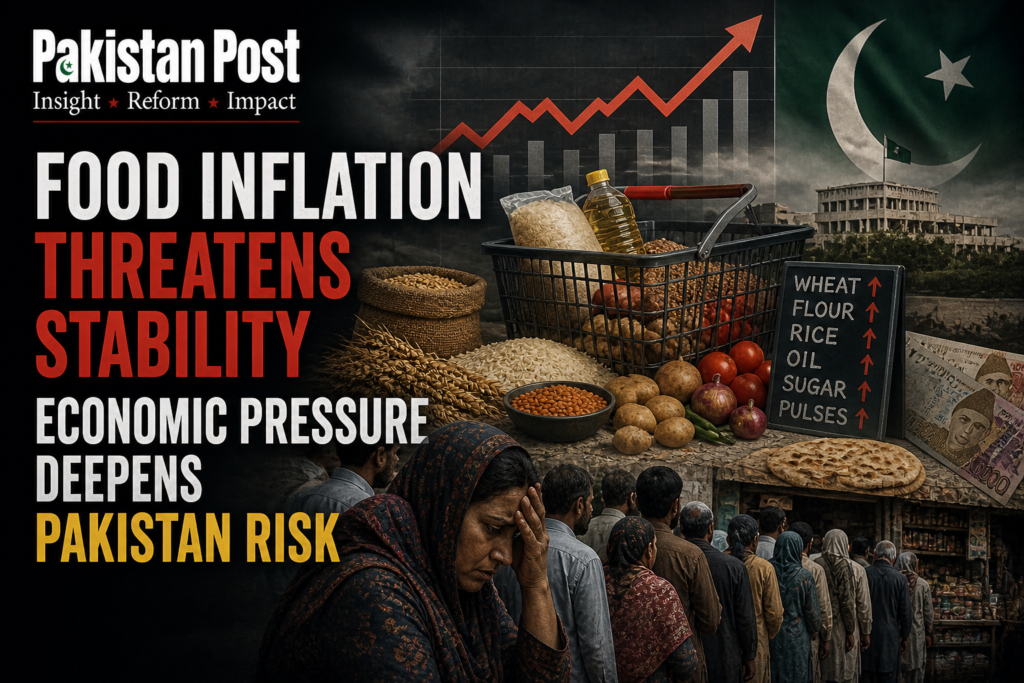
Food inflation has increasingly moved from the margins of economic reporting to the centre of political stability analysis in developing states, where the price of basic consumption goods is no longer treated as a routine macroeconomic indicator but as a barometer of governance credibility and social resilience. In Pakistan, this shift is particularly pronounced. The rising cost of wheat, sugar, edible oil, pulses, and vegetables is not only reshaping household consumption patterns but also redefining the relationship between citizens and the state under conditions of sustained economic stress.
In contemporary global policy discourse, food inflation is no longer interpreted solely through supply and demand mechanics. It is increasingly framed as a political economy phenomenon, where inflationary pressures interact with institutional capacity, fiscal constraints, currency instability, and global commodity cycles. For developing economies with limited policy buffers, food inflation becomes a transmission channel through which external shocks are internalised into domestic political systems.
Pakistan represents a critical case in this evolving analytical framework. The country’s food inflation trajectory has been shaped by a convergence of structural and cyclical factors. On the structural side, agricultural productivity constraints, water stress, inefficient supply chains, and limited storage infrastructure have long constrained the resilience of the food system. On the cyclical side, currency depreciation, global commodity price volatility, and energy cost increases have amplified domestic price pressures. The result is a persistent inflationary environment in which food prices remain highly sensitive to both internal inefficiencies and external shocks.
The political implications of this dynamic are increasingly visible. Food inflation directly affects the purchasing power of lower and middle income households, where food expenditure constitutes a large proportion of total income. As prices rise, consumption patterns shift toward cheaper, lower quality substitutes, while nutritional security deteriorates. This creates a silent but cumulative social stress that does not always manifest immediately in political mobilisation but gradually erodes trust in governance systems.
In policy narratives, particularly within international financial institutions and development agencies, food inflation is increasingly being linked to political stability indicators. The underlying logic is that when basic consumption goods become unaffordable, the legitimacy of the state is indirectly questioned. This does not imply automatic unrest, but it does indicate rising vulnerability to political dissatisfaction, particularly in urban centres where cost of living pressures are most visible.
In Pakistan, this vulnerability is compounded by macroeconomic constraints. The economy has repeatedly faced balance of payments pressures, leading to import restrictions, currency depreciation, and inflationary pass through effects. Food items that depend on imported inputs or global price benchmarks become particularly sensitive to external volatility. Edible oil, for instance, is heavily import dependent, making domestic prices vulnerable to international commodity cycles and exchange rate fluctuations.
At the same time, domestic agricultural inefficiencies reinforce these pressures. The structure of crop cultivation remains heavily concentrated in water intensive staples, while productivity growth has lagged behind population growth. Post harvest losses, weak cold storage systems, and fragmented supply chains further increase the gap between farm gate prices and retail prices. This structural inefficiency ensures that even when production levels are stable, market prices remain volatile.
Climate variability adds another layer of complexity. Floods, heatwaves, and erratic rainfall patterns have disrupted agricultural output cycles, reducing yield predictability and increasing risk premiums across the supply chain. The 2022 floods, which devastated large parts of agricultural land, highlighted the fragility of food production systems under climate stress. Even in subsequent recovery periods, production volatility has remained high, indicating that climate shocks have long term effects on price stability.
Within urban governance contexts, food inflation translates into immediate political pressure. Urban households are more exposed to market based food systems and have less capacity for self provisioning compared to rural populations. As a result, price increases are felt more acutely and more rapidly. This creates a feedback loop where urban dissatisfaction becomes more visible in political discourse, media narratives, and public debate.
The media framing of food inflation in Pakistan has increasingly shifted from economic reporting to political interpretation. Rising prices are often linked to governance performance, administrative inefficiency, and policy inconsistency. This narrative construction is significant because it shapes public perception of economic hardship not as an abstract macroeconomic phenomenon but as a direct outcome of state action or inaction.
Internationally, food inflation is increasingly being discussed as part of a broader “cost of living crisis” narrative, particularly in emerging economies. This framing connects food prices to energy costs, transport expenses, and housing affordability, creating a composite index of economic stress. In Pakistan’s case, food inflation sits at the centre of this composite pressure, amplifying other vulnerabilities in the economic system.
Policy responses have largely focused on short term stabilization measures, including price controls, subsidies, import facilitation, and administrative interventions in supply chains. While these measures can provide temporary relief, they do not address underlying structural inefficiencies. In some cases, they may even distort market incentives, leading to supply shortages or fiscal pressure.
A more structural response would require reforming agricultural productivity systems, improving irrigation efficiency, investing in storage and logistics infrastructure, and reducing post harvest losses. However, these reforms require long term planning and fiscal space, both of which are constrained in Pakistan’s current economic environment. As a result, policy remains reactive rather than transformative.
Another critical dimension is the role of currency depreciation in transmitting inflation into food markets. As the Pakistani rupee weakens against major currencies, the cost of imported food items and agricultural inputs rises. Fertilizers, fuel, and machinery components become more expensive, increasing production costs and ultimately retail prices. This exchange rate pass through effect is a key driver of sustained food inflation in import dependent economies.
Debt servicing obligations further constrain policy flexibility. With a significant portion of fiscal resources allocated to external debt repayment, limited space remains for targeted food subsidies or large scale agricultural investment. This fiscal constraint reinforces a cycle in which inflation is managed through short term administrative tools rather than long term structural adjustment.
The social consequences of this environment are significant but often gradual. Food insecurity does not always manifest as visible hunger but as nutritional decline, dietary simplification, and reduced consumption diversity. Over time, this affects public health outcomes, productivity levels, and human capital development. These effects are less visible in political cycles but more persistent in developmental trajectories.
In political economy terms, food inflation operates as a distributive pressure mechanism. It reshapes income allocation between producers, traders, and consumers. In many cases, rural producers may benefit from higher prices, while urban consumers bear the burden. However, this benefit is uneven and often offset by rising input costs, making the net effect complex and context dependent.
The governance challenge lies in managing these competing pressures while maintaining macroeconomic stability. In Pakistan’s case, this requires coordination between agricultural policy, trade policy, monetary policy, and social protection systems. However, institutional fragmentation often limits such coordination, leading to policy incoherence.
Social protection mechanisms, such as cash transfer programs, play an important role in cushioning vulnerable populations from inflationary shocks. However, their effectiveness depends on coverage, targeting accuracy, and inflation indexing. In high inflation environments, static transfer amounts lose real value rapidly, reducing their protective capacity unless adjusted frequently.
The international policy discourse increasingly suggests that food inflation should be treated as a security relevant variable, particularly in fragile and emerging economies. The rationale is that sustained price increases in essential goods can contribute to political dissatisfaction, reduce institutional trust, and increase the risk of social unrest under certain conditions. However, this relationship is not linear and is mediated by governance quality, political systems, and social resilience.
In Pakistan, the key question is not whether food inflation exists, but whether institutional systems can adapt to sustained price volatility without systemic destabilisation. This requires moving beyond crisis management toward structural resilience building. It also requires integrating food security into broader macroeconomic planning rather than treating it as a sectoral issue.
Ultimately, food inflation in Pakistan is not merely an economic challenge but a governance stress test. It reveals the limitations of supply chains, the constraints of fiscal policy, the vulnerabilities of agricultural systems, and the pressures of external dependency. More importantly, it reflects the broader condition of a developing economy navigating overlapping crises of climate, currency, and capacity.
The emerging narrative in international analysis is clear. Food inflation is no longer a temporary distortion in developing states; it is becoming a structural feature of global economic fragmentation. For Pakistan, the policy imperative is not only to stabilize prices but to reconfigure the underlying systems that produce vulnerability in the first place.
A Public Service Message