Digital Finance, Informal Economies, and the Struggle for Economic Visibility in Pakistan’s Transition to a Data-Driven Financial Order

The global economy is entering a phase where value is no longer measured solely through physical output, but increasingly through data, traceability, and digital financial footprints. In this emerging order, digital finance is not simply a technological upgrade to existing banking systems; it is a structural transformation of how economies are recorded, regulated, and integrated into formal fiscal systems. For countries like Pakistan, where the informal economy has historically absorbed a significant share of labor, production, and consumption, this transition carries profound implications. It raises a central question: whether digitalization can convert economic invisibility into measurable, taxable, and investable activity, or whether structural fragmentation will persist beneath a technologically modern surface.
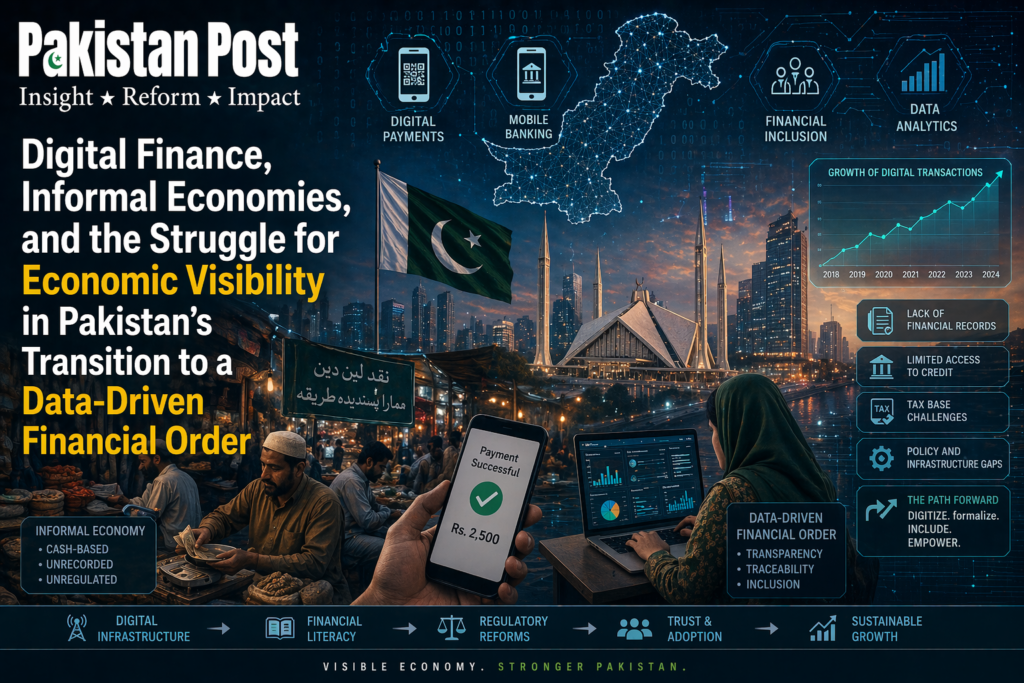
Pakistan’s informal economy is not marginal. It is foundational. It spans retail trade, transport, agriculture services, small-scale manufacturing, freelance labor, and household-based production systems. For decades, this segment has operated outside formal taxation frameworks, not necessarily due to illegality, but due to structural barriers, administrative complexity, and limited financial inclusion. The result has been a dual economy where formal and informal systems coexist but do not fully interact. This duality has constrained fiscal capacity, limited credit expansion, and reduced the state’s ability to accurately measure economic activity.
The rise of digital finance, mobile banking, fintech platforms, and real-time payment systems is beginning to disrupt this structural separation. Pakistan has witnessed rapid growth in digital payment adoption, particularly through mobile wallets, branchless banking systems, and e-commerce platforms. These developments are not merely convenience tools; they represent the creation of digital trails that convert previously invisible transactions into recorded data. In theory, this shift allows economic activity to be mapped, analyzed, and taxed with greater precision than traditional cash-based systems.
However, the transition from cash dominance to digital financial integration is neither linear nor uniform. Cash remains deeply embedded in Pakistan’s economic culture, particularly in rural and semi-urban areas where trust in formal banking institutions remains limited. In such environments, financial behavior is shaped not only by access but by perception, habit, and institutional confidence. Digital systems may exist, but their adoption depends on whether users perceive them as secure, efficient, and beneficial relative to established informal mechanisms.
At the same time, global trends in digital finance are reshaping the broader context in which Pakistan operates. The expansion of cross-border payment systems, fintech interoperability frameworks, and digital identity verification systems is creating new possibilities for integrating informal economies into formal financial ecosystems. Remittance flows, which constitute a significant portion of Pakistan’s external inflows, are increasingly being digitized, reducing transaction costs and improving transparency. This shift has implications not only for household income flows but also for macroeconomic stability and foreign exchange management.
Fintech platforms are also altering the structure of credit markets. Traditional banking systems in Pakistan have historically been limited in their reach, particularly in extending credit to small enterprises and informal workers due to lack of documented financial histories. Digital financial platforms, however, generate alternative credit scoring mechanisms based on transaction data, mobile usage patterns, and behavioral analytics. This creates the possibility of expanding credit access to previously excluded segments of the population. If scaled effectively, this could have a transformative impact on small business growth and entrepreneurial activity.
Yet, the expansion of digital finance also introduces new structural challenges. Data governance becomes a central issue in economies where financial digitization accelerates faster than regulatory capacity. The ownership, privacy, and security of financial data become critical questions in determining whether digitalization empowers individuals or centralizes control within a limited set of institutions. In the absence of strong regulatory frameworks, digital financial systems risk replicating existing inequalities in new forms, where access is widespread but control remains concentrated.
Another critical dimension is financial literacy. Digital finance systems assume a level of user understanding that is not uniformly distributed across the population. In Pakistan, disparities in education, digital access, and financial awareness create uneven patterns of adoption. Urban populations tend to integrate more quickly into digital systems, while rural populations often lag behind, not due to resistance, but due to infrastructural and informational gaps. This creates a risk of digital exclusion within an economy that is simultaneously attempting to formalize.
The state’s role in this transition is pivotal. Digital financial integration requires not only technological infrastructure but also institutional alignment. Tax authorities, banking regulators, telecom operators, and fintech companies must operate within a coordinated framework that ensures interoperability, transparency, and security. Without such coordination, digital finance may remain fragmented, limiting its potential to transform the informal economy into a structured fiscal base.
One of the most significant potential benefits of digital financial expansion is its impact on tax collection efficiency. Pakistan’s tax-to-GDP ratio has historically remained low compared to regional and global averages, largely due to the size of the informal economy and structural inefficiencies in tax administration. Digital transactions, by creating traceable economic activity, can expand the tax net without necessarily increasing tax rates. However, this requires careful policy calibration to avoid over-taxation of newly formalizing sectors, which could discourage digital adoption.
E-commerce platforms represent another frontier in this transformation. Online marketplaces are increasingly formalizing small-scale vendors, artisans, and service providers by integrating them into structured payment systems. This creates hybrid economic spaces where informal producers engage with formal financial systems without fully transitioning into traditional corporate structures. These hybrid models may represent the future of emerging market economies, where formalization is gradual rather than abrupt.
Cross-border digital payments add an additional layer of complexity. As global labor markets become increasingly digitalized, freelance work, remote services, and digital exports are becoming significant sources of income for emerging economies. Pakistan has a growing freelance workforce engaged in global digital platforms. However, the full integration of these earnings into formal financial systems remains uneven. Regulatory frameworks must adapt to ensure that digital export earnings are captured within national economic statistics and contribute effectively to foreign exchange stability.
Despite these opportunities, structural constraints remain significant. Infrastructure gaps in broadband access, electricity reliability, and digital security continue to limit the scalability of digital finance in certain regions. Additionally, trust deficits in formal institutions slow the pace of adoption. Economic transformation through digitalization is therefore not only a technological challenge but also an institutional and cultural one.
There is also an important macroeconomic dimension to this transition. As economies digitize, central banks gain access to more granular data on money flows, consumption patterns, and liquidity dynamics. This enhances monetary policy precision but also increases the scope of financial surveillance. The balance between efficiency and privacy becomes a critical policy consideration. In emerging economies, where institutional trust is still developing, this balance is particularly sensitive.
Ultimately, the question is not whether digital finance will expand in Pakistan, but whether it will successfully integrate the informal economy into a coherent, inclusive, and productive financial system. The potential exists for a structural shift in which previously invisible economic activity becomes part of formal growth channels, expanding the tax base, improving credit access, and enhancing macroeconomic stability. However, this outcome is not automatic. It depends on regulatory foresight, institutional coordination, and sustained investment in digital infrastructure and financial literacy.
In a global economy increasingly defined by data visibility and digital traceability, economic invisibility is becoming a form of structural disadvantage. For Pakistan, the transition to digital finance represents both an opportunity and a test. It is an opportunity to expand economic inclusion and fiscal capacity, but also a test of whether institutional frameworks can adapt quickly enough to harness the transformative potential of a rapidly digitizing economy.
A Public Service Message