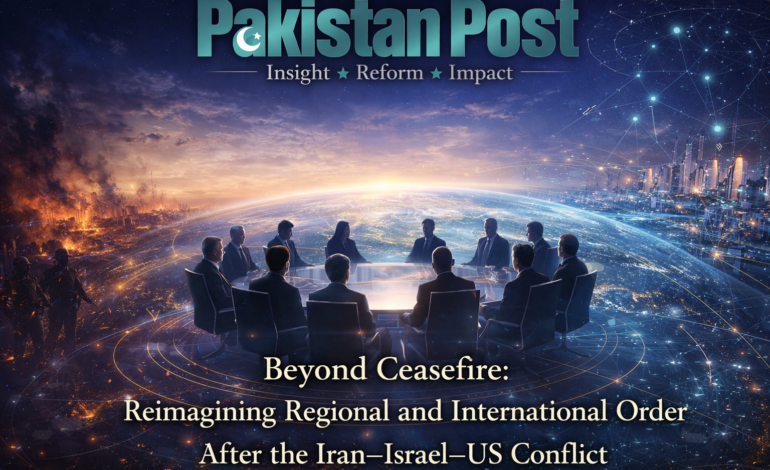
Beyond Ceasefire: Reimagining Regional and International Order After the Iran–Israel–US Conflict

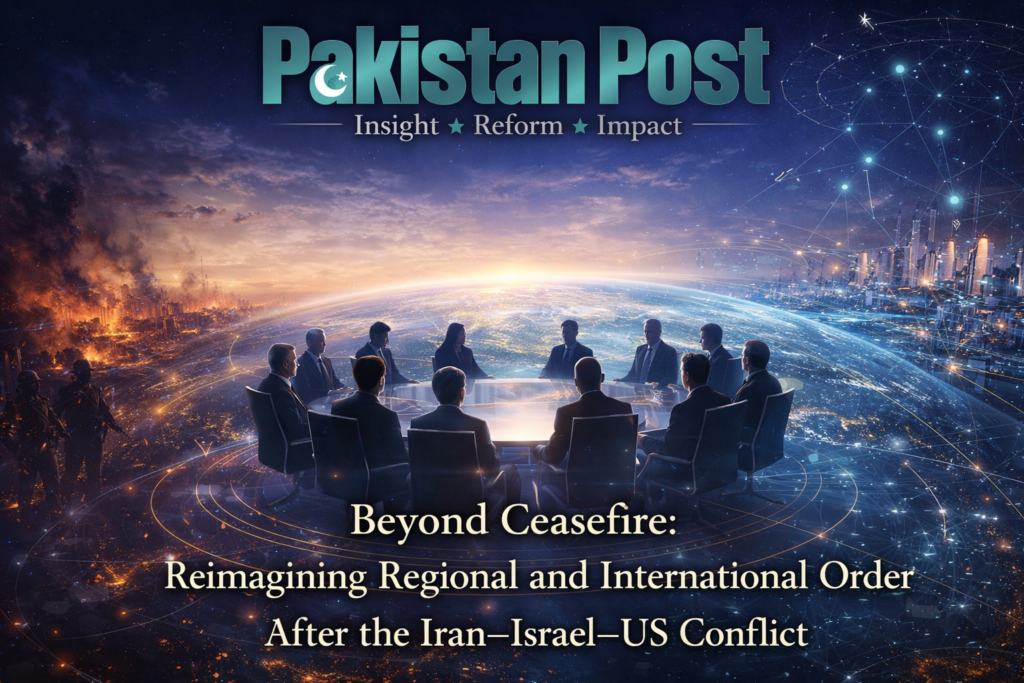
The end of war is rarely the end of history. It is, more often, the beginning of a new argument about order—who defines it, who enforces it, and who benefits from it. The recent confrontation involving the United States, Israel, and Iran has forced precisely such an argument into the open. It has exposed not only the fragility of regional security arrangements but also the deeper imbalance that has characterized international order since the collapse of the Soviet Union. For more than three decades, the global system has operated under a set of assumptions that are now increasingly difficult to sustain: that power can be centralized without resistance, that economic interdependence can insulate against strategic rivalry, and that regional stability can be managed through external intervention rather than internal equilibrium.
The war has challenged each of these assumptions. It has demonstrated that concentrated power, even when backed by technological and financial superiority, cannot easily impose stable outcomes in complex regional environments. It has shown that economic interdependence, far from eliminating conflict, can amplify its consequences by transmitting shocks across markets and borders. And it has revealed the limitations of external intervention as a substitute for regional order. In doing so, it has accelerated a shift that was already underway—the gradual movement from a unipolar system toward a more distributed and contested global landscape.
This shift is not occurring in a vacuum. It is shaped by the interaction of multiple forces: the rise of new economic centers, the diffusion of military capabilities, the fragmentation of supply chains, and the increasing importance of non-state actors and technologies. Together, these forces are creating conditions in which no single actor can dominate without incurring significant costs. The result is a system in which stability must be negotiated rather than imposed, and in which regional dynamics play a central role in shaping global outcomes.
In this emerging environment, the concept of regional orders gains renewed significance. Unlike the Cold War era, where global alignments were largely defined by ideological blocs, the current system is characterized by overlapping and sometimes competing regional frameworks. These frameworks are not necessarily formalized through treaties or institutions; they are often informal, flexible, and adaptive. They reflect the interests and capabilities of the actors involved, as well as the specific challenges they face.
The Middle East and its extended periphery are at the forefront of this transformation. The recent conflict has underscored the need for a more resilient and internally grounded order, one that can manage crises without relying exclusively on external intervention. The idea of a ceasefire, while necessary, is insufficient as a long-term solution. What is required is a reimagining of how security, diplomacy, and economic integration are structured—an approach that moves beyond reactive measures toward proactive frameworks.
One of the defining features of this new approach is the concept of layered networks. Rather than relying on singular alliances or rigid blocs, states are increasingly seeking to build multiple, overlapping connections that enhance resilience and flexibility. These networks can take various forms: economic corridors that link producers and consumers, security arrangements that provide mutual support without formal commitments, and diplomatic channels that facilitate dialogue across divides. The strength of such networks lies in their adaptability; they can evolve in response to changing conditions and accommodate diverse interests.
Deterrence, within this context, is also being redefined. Traditional models of deterrence, based on overwhelming force or binary opposition, are giving way to more nuanced approaches that incorporate multiple dimensions. These include not only military capabilities but also economic leverage, technological advantages, and diplomatic influence. The objective is not to eliminate conflict entirely, but to manage it in ways that prevent escalation and preserve stability.
Connectivity plays a central role in this framework. The ability to facilitate the movement of goods, energy, and information is increasingly seen as a source of strategic value. In a world where disruptions can have cascading effects, states that serve as connectors—linking regions, systems, and markets—gain influence and resilience. This is particularly relevant in the context of the Middle East and South Asia, where geography provides both opportunities and challenges.
It is within this evolving landscape that Pakistan’s role becomes particularly significant. Positioned at the intersection of South Asia, Central Asia, the Middle East, and China, Pakistan occupies a space that is both geographically and strategically pivotal. Its relationships with key actors across these regions provide a foundation for engagement that is broad and flexible. In a system defined by layered networks, such positioning is inherently valuable.
Pakistan’s contribution to a post-war order can be understood across several dimensions. In the realm of security, it can play a role in facilitating dialogue and coordination among regional actors. Its experience in managing complex relationships and its involvement in various international forums provide a basis for engagement. By supporting mechanisms for crisis communication and de-escalation, Pakistan can contribute to reducing the risk of conflict.
In the economic domain, Pakistan’s potential as a connector is particularly pronounced. Its ports and transport networks provide access to maritime routes that link the Middle East to South Asia and beyond. Its overland corridors connect Central Asia and China to the Arabian Sea. By enhancing these connections and integrating them into broader networks, Pakistan can facilitate trade and energy flows that contribute to stability and growth.
Energy, in particular, represents a critical area of opportunity. The recent conflict has highlighted the vulnerability of existing supply routes and the need for diversification. Pakistan’s proximity to energy-rich regions, including Iran, positions it as a potential hub for the distribution of resources. By developing infrastructure that connects supply with demand, Pakistan can contribute to the stabilization of energy markets while addressing its own needs.
Diplomatically, Pakistan’s ability to engage with multiple actors positions it as a bridge between different systems. Its relationships with China, the Gulf states, and other Muslim-majority countries provide a platform for dialogue that can complement formal mechanisms. By promoting initiatives that emphasize cooperation and mutual benefit, Pakistan can help to shape the contours of a new regional order.
The concept of civilizational legitimacy adds another layer to this role. In a region where identity, history, and culture play significant roles in shaping perceptions and policies, the ability to articulate and promote shared values can enhance cohesion. Pakistan, as a major Muslim-majority state with a history of engagement across regions, can contribute to this dimension by supporting narratives that emphasize unity, cooperation, and mutual respect.
At the same time, the realization of this potential is contingent on addressing internal and external challenges. Domestically, Pakistan must strengthen its institutional capacity, improve governance, and invest in infrastructure to support increased connectivity. Policy coherence is essential, ensuring that economic, diplomatic, and security objectives are aligned. Externally, it must navigate a complex landscape of competing interests, balancing relationships with major powers and regional actors.
The broader question is whether the current moment represents a transition toward a more stable and balanced system, or merely a temporary adjustment within an ongoing cycle of instability. The answer is likely to be nuanced. The emergence of regional orders and layered networks suggests a move toward greater distribution of power and responsibility. However, the persistence of underlying tensions and the potential for new conflicts mean that stability cannot be taken for granted.
What can be said with greater confidence is that the logic of the post-Cold War order is no longer sufficient to address contemporary challenges. The concentration of power, the reliance on external intervention, and the assumption of linear progress have been undermined by events. In their place, a more complex and adaptive framework is emerging—one that requires states to engage with multiple dimensions of power and to build relationships that are both resilient and flexible.
For Pakistan, this represents both an opportunity and a responsibility. By positioning itself as a connector, a facilitator of dialogue, and a participant in the construction of regional networks, it can contribute to shaping a more stable and inclusive order. This requires not only strategic vision but also practical implementation, translating concepts into policies and projects that deliver tangible results.
In the final analysis, the aftermath of the Iran–Israel–US conflict is not defined by the cessation of hostilities, but by the reconfiguration of relationships. The challenge is to move beyond ceasefire toward a framework that addresses the underlying causes of instability and creates conditions for sustainable peace. This is a task that extends beyond any single state or region, requiring cooperation, innovation, and a willingness to adapt.
The emerging order, if it takes shape, will not be perfect. It will reflect the complexities and contradictions of the world in which it exists. But it offers the possibility of a system that is more balanced, more resilient, and more reflective of the diverse interests and capabilities of its participants. For those willing to engage with its challenges, it also offers the opportunity to shape its outcomes.
A Public Service Message