Pakistan’s Climate Risk Is Becoming a Fiscal Risk

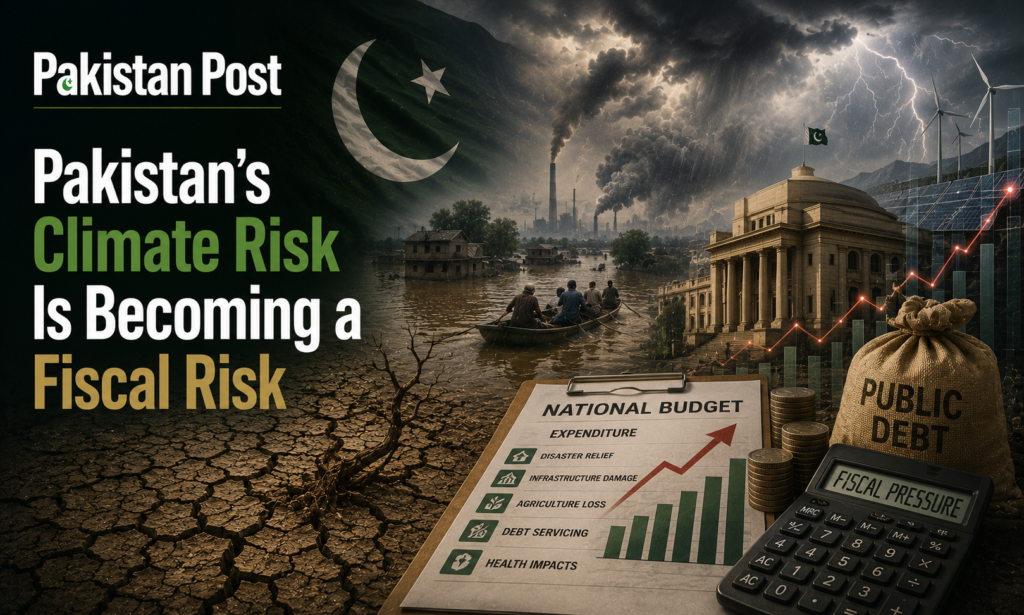
Pakistan’s climate problem is no longer adequately described as an environmental challenge. It is increasingly a question of sovereign solvency, budgetary resilience and national security. Floods, extreme heat, water scarcity, crop failures and urban climate shocks are becoming recurrent disturbances to an economy whose fiscal buffers are already narrow. The critical policy question is therefore changing. It is no longer simply how Pakistan will rebuild after the next disaster, but how it will finance the contingent liabilities that can be identified before the disaster occurs.
The distinction matters because Pakistan has repeatedly relied on exceptional mobilisation after exceptional events. Emergency appropriations, supplementary grants, donor appeals, concessional loans and reconstruction packages can provide relief, but they do not constitute a durable fiscal architecture. When a major climate shock arrives, the government is often compelled to redirect scarce development resources towards relief and rehabilitation, while provinces face simultaneous demands for health, agriculture, infrastructure and social protection. External financing requirements then rise precisely when economic activity, exports and domestic revenues may be weakening.
The 2025 floods demonstrated the macroeconomic transmission mechanism with unusual clarity. The International Monetary Fund reported that the floods affected nearly seven million people, caused more than 1,000 deaths and damaged housing, infrastructure and agricultural land, while weakening the growth outlook. The Fund also noted that flood related disruption had implications for food prices and the fiscal position. (IMF) The World Bank subsequently assessed that recurrent natural disasters were constraining Pakistan’s medium term growth prospects even as the government attempted to rebuild fiscal buffers. (World Bank)
For policymakers, the strategic implication is straightforward. Climate exposure should be incorporated into sovereign risk management with the same seriousness applied to external debt, energy imports, banking sector liabilities and contingent obligations of state owned enterprises.
A flood does not begin as a fiscal event. It becomes one through a chain of economic consequences. Agricultural losses reduce rural incomes and exportable surpluses. Damage to roads, bridges, irrigation systems, schools and health facilities creates immediate reconstruction requirements. Food shortages raise inflation and may require imports. Lower agricultural output can weaken the current account. Businesses suspend operations, tax receipts decline and demands for subsidies or social assistance increase. Provinces incur emergency expenditure while their own revenue capacity remains limited. The federal government is then expected to fill the financing gap.
This creates a dangerous procyclical pattern. The state spends more when revenues are under pressure, borrows when borrowing conditions may be less favourable and postpones productive expenditure to finance repairs. If the shock is sufficiently large, reconstruction itself can become dependent on external assistance. Climate vulnerability therefore feeds directly into debt dynamics.
The same mechanism operates through heat. Extreme temperatures can reduce labour productivity, increase electricity demand, damage transport infrastructure and impose additional pressure on public health systems. In an economy dependent upon agriculture, construction, manufacturing and informal employment, heat is not merely a meteorological inconvenience. It can become a productivity shock transmitted through household income, business costs and government expenditure.
Water scarcity represents an even more structural liability. Declining water availability, changing precipitation patterns, glacial instability and inefficient irrigation can reduce agricultural productivity while increasing competition among provinces, sectors and communities. The fiscal consequences are not confined to water ministries. They reach food security, rural employment, electricity generation, industrial production and regional stability. The IMF’s Resilience and Sustainability Facility has consequently placed greater emphasis on efficient water use, public investment processes and stronger coordination of disaster response and financing. (IMF)
Pakistan’s present institutional arrangements remain poorly suited to this risk profile. Disaster management has historically been organised around response capacity rather than financial preparedness. Federal and provincial institutions can mobilise after an emergency, but the financing architecture for predictable, rapid and prearranged disbursement remains comparatively underdeveloped. The distinction between disaster management and disaster finance is important. Rescue agencies can determine how to respond to a flood. Finance ministries must determine how the state will pay for it without destabilising the wider economy.
That question deserves to move closer to the centre of national economic planning.
The federal budget should contain an explicit sovereign disaster risk statement identifying the government’s exposure under different hazard scenarios. This should include expected annual losses, probable maximum losses, exposure of public infrastructure, agricultural vulnerabilities, provincial liabilities and potential effects on debt and external financing. Such an exercise would allow policymakers to distinguish between routine shocks that can be absorbed through annual appropriations and extreme events requiring insurance, contingent credit or capital market instruments.
Pakistan should establish a national disaster risk financing architecture under the joint policy authority of the Ministry of Finance, National Disaster Management Authority, provincial finance departments and relevant regulators. Its purpose should not be to create another administrative layer. It should consolidate risk information, financing instruments and predetermined expenditure triggers into a single sovereign framework.
The architecture should operate through layers of risk. Frequent, relatively moderate disasters should be financed through annual budgetary provisions and a professionally managed contingency reserve. Medium severity events should activate prearranged contingent credit facilities and insurance mechanisms. Catastrophic events should trigger sovereign insurance, catastrophe bonds and multilateral emergency financing. This would replace the present tendency to treat every disaster as an extraordinary fiscal improvisation.
The principle should be that the cheaper instruments finance frequent risks and the capital markets absorb the remote but potentially devastating tail risks.
Sovereign insurance deserves particular attention. Pakistan need not attempt to insure every possible loss. That would be financially inefficient and could produce unaffordable premiums. Instead, insurance could cover clearly measurable sovereign exposures, including defined categories of public infrastructure or rainfall and river flood thresholds. Parametric insurance could be particularly useful because payouts can be triggered by independently verifiable indicators such as rainfall intensity, river levels or seismic measurements rather than waiting for lengthy damage assessments.
The advantage is speed. The state would receive liquidity when it needs it most, rather than months after the bureaucratic valuation of damage. The disadvantage is basis risk, meaning the possibility that a qualifying event produces less or more actual damage than the predefined trigger suggests. This requires sophisticated modelling, transparent parameters and independent verification, not abandonment of the instrument.
Catastrophe bonds could provide another layer of protection. Under such arrangements, investors receive a return while the specified disaster does not occur. If an agreed catastrophic event is triggered, some or all of the principal becomes available to the affected sovereign or designated risk pool. The international market for catastrophe bonds has expanded substantially, demonstrating that institutional capital can be mobilised for disaster risk transfer. (Financial Times) Pakistan should examine whether a regional or multilateral structure could reduce transaction costs and improve pricing.
A Pakistani catastrophe bond should not become a prestige capital market exercise. Its credibility would depend on transparent hazard models, internationally recognised triggers, independent trusteeship and strict separation from discretionary political spending. The objective would be rapid liquidity, not cheap borrowing disguised as climate finance.
Contingent credit facilities should form the middle layer. Pakistan already operates within a financial environment in which multilateral institutions are central to macroeconomic stabilisation. The existing Resilience and Sustainability Facility provides a relevant institutional platform because its reform programme explicitly recognises natural disasters as macrocritical risks. (IMF) The next step should be to negotiate financing arrangements that are genuinely contingent, rapidly disbursable and protected from the delays that often accompany post disaster appeals.
The country also needs a climate resilience fund, but its design should differ from conventional development funds. It should finance investments that reduce future fiscal liabilities. Flood protection around economically critical urban areas, climate resilient roads, irrigation modernisation, drainage systems, heat resistant public facilities, water efficiency and resilient electricity infrastructure should be evaluated partly according to the losses they prevent. A project that costs more today but substantially reduces future emergency expenditure should be treated as a fiscal investment, not merely an environmental project.
This requires a major change in public investment appraisal. Every large infrastructure project should undergo a climate stress test. Roads, bridges, power facilities, irrigation networks, hospitals and government buildings should be assessed against plausible flood, heat, drought and water stress scenarios. The question should be not merely whether an asset is economically viable under normal conditions, but whether it remains functional under increasingly volatile climatic conditions.
Climate tagging of public expenditure can support this transition, but tagging should not become a cosmetic accounting exercise. Ministries and provinces should be required to identify whether expenditure reduces physical climate exposure, strengthens adaptive capacity, transfers risk or merely responds to damage already incurred. Independent audit should verify the classification. Otherwise, climate tagged spending could become another label attached to conventional expenditure without producing measurable resilience.
Provincial governments require particular attention. Much of the physical impact of climate disasters occurs at provincial and local levels, while fiscal capacity is unevenly distributed. A national framework should therefore establish predetermined fiscal transfer rules following verified disasters. Provinces should know before an emergency how much support can be accessed, under what conditions and through which financing channel.
This would reduce political bargaining during crises and improve administrative speed. It would also create incentives for prevention. Provinces receiving larger transfers because they have demonstrably improved early warning systems, land use regulation, drainage, building standards and resilient infrastructure could be rewarded through risk adjusted financing arrangements.
Such a system would have strategic significance beyond fiscal management. Disaster financing is increasingly connected to internal stability. When floods destroy livelihoods, food prices rise and reconstruction is delayed, public confidence can deteriorate. When urban heat overwhelms electricity and health systems, economic disruption can intensify social tensions. When water scarcity affects agriculture and provincial interests simultaneously, resource competition can acquire political and security dimensions.
For Pakistan’s strategic institutions, climate risk should consequently be incorporated into national security assessments. The relevant question is not whether climate change itself is a security threat in the conventional sense. It is whether repeated climate shocks can weaken fiscal capacity, increase dependence on external financing, disrupt food and energy security, intensify internal migration and reduce the state’s ability to respond to other strategic contingencies. The answer is increasingly evident.
There is also a diplomatic dimension. Pakistan’s climate vulnerability creates a legitimate case for international climate finance, but dependence on external appeals is not a substitute for domestic financial architecture. International partners are more likely to provide predictable support when Pakistan can demonstrate transparent risk assessment, credible public investment systems and mechanisms capable of absorbing financing efficiently. The IMF’s current climate related programme reforms already emphasise public investment, disaster response coordination and climate risk disclosure. (IMF eLibrary)
Pakistan should therefore negotiate climate finance around measurable fiscal resilience rather than broad environmental commitments. Multilateral partners could be asked to support premium payments for sovereign insurance, capitalisation of a resilience fund, technical development of catastrophe risk models and establishment costs for catastrophe bond structures. Such arrangements would convert international climate support into instruments capable of reducing future sovereign expenditure.
The insurance regulator and financial sector also have a role. Banks and insurers should gradually incorporate physical climate risk into underwriting, collateral valuation and capital planning. The IMF has already identified improved disclosure of climate related risks by banks and corporations as part of Pakistan’s resilience agenda. (IMF) This should be expanded into a national climate risk data infrastructure combining meteorological, hydrological, agricultural, property and fiscal information.
Without reliable data, risk cannot be priced. Without pricing, insurance remains expensive or unavailable. Without insurance, the sovereign becomes the insurer of last resort. And when the sovereign itself has limited fiscal space, that implicit guarantee becomes a major source of vulnerability.
The most important reform is therefore conceptual. Pakistan must stop treating disaster expenditure as an unpredictable exception to normal fiscal policy. Climate disasters are becoming sufficiently recurrent that their financial consequences should be incorporated into the normal machinery of sovereign risk management.
The next disaster will eventually arrive. Its precise location, intensity and economic cost cannot be known with certainty. Its financial architecture can nevertheless be designed in advance.
A credible Pakistani model would combine a protected contingency reserve, parametric sovereign insurance, contingent multilateral credit, catastrophe bonds, a climate resilience investment fund, risk based provincial transfers and mandatory climate stress testing of major public investments. These instruments should sit within a unified national framework governed by transparent triggers, independent verification and parliamentary accountability.
The strategic objective should not be to eliminate fiscal exposure. That is impossible. It should be to prevent a climate shock from becoming a sovereign financing crisis.
Pakistan has spent too much time asking who will pay after the water rises. The more consequential question for policymakers is who has already agreed to pay, through which instrument, at what trigger, and within how many days. That is the difference between disaster relief and disaster risk management. For a fiscally constrained state facing increasingly expensive climate volatility, it may also become the difference between temporary disruption and a national economic crisis.
A Public Service Message