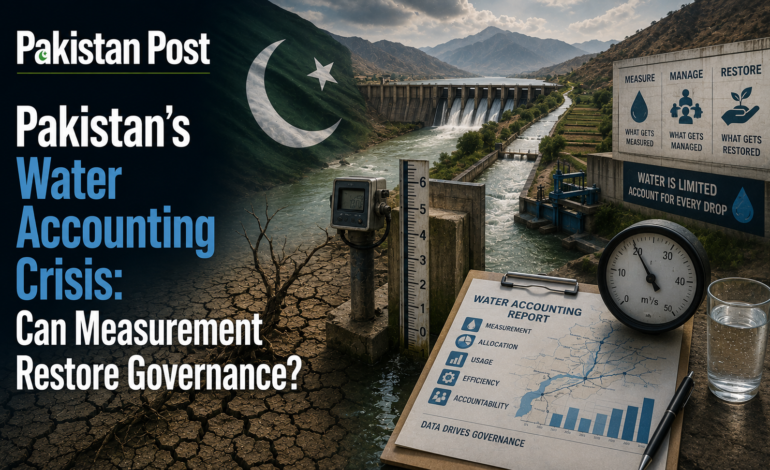
Pakistan’s Water Accounting Crisis: Can Measurement Restore Governance?

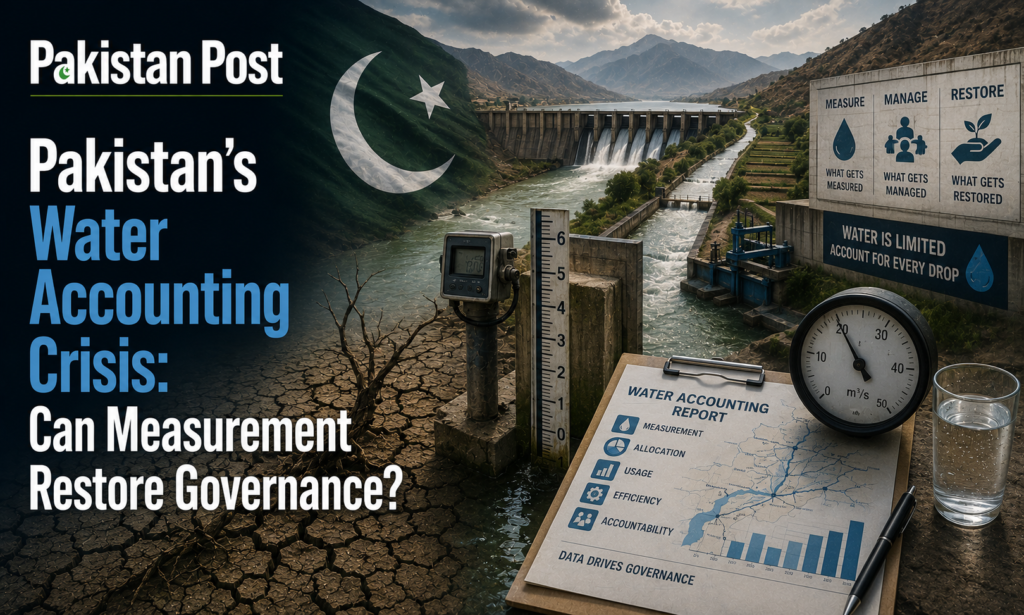
Pakistan’s water problem is increasingly described as scarcity, but scarcity is only part of the institutional story. A country cannot govern a resource reliably when it cannot establish, with sufficient precision, how much water enters its systems, where it moves, who withdraws it, how much is consumed, how much returns to rivers or aquifers, and where losses are genuinely physical rather than merely administrative. Pakistan has substantial hydrological infrastructure, sophisticated river regulation and an established interprovincial allocation architecture, yet its water economy remains characterised by incomplete measurement, fragmented information and weak conversion of data into enforceable decisions. The result is a paradox with serious strategic consequences: water is treated as a national security asset while much of its economic circulation remains only partially visible.
The institutional architecture already contains important components. The Ministry of Water Resources, WAPDA, IRSA, provincial irrigation departments, the Pakistan Council of Research in Water Resources, the Pakistan Meteorological Department and other agencies possess different segments of the national water picture. The National Water Policy established a broad framework for sustainable management and acknowledged the need for stronger governance. Yet the existence of institutions does not necessarily produce an integrated water intelligence capability. Official policy itself recognises the need to address surface water diversions, groundwater extraction, water productivity and monitoring at national and provincial scales. (Ministry of Water Resources)
The strategic weakness lies in the distance between measurement and authority. A canal discharge may be measured without establishing the quantity ultimately delivered to farms. A tubewell may operate continuously without its abstraction being incorporated into a comprehensive aquifer balance. An urban utility may report production while having limited knowledge of actual consumption and leakage. Agricultural statistics may record crop acreage without reliably connecting individual cropping patterns to volumes of irrigation water consumed. Satellite imagery can identify changes in vegetation and evapotranspiration, but such information is not yet systematically embedded in regulatory decisions. Pakistan therefore possesses many measurements without possessing a sufficiently integrated national accounting system.
This distinction matters because water accounting is not simply an engineering exercise. It determines the credibility of agricultural policy, the quality of provincial negotiations, the fiscal value of infrastructure, the resilience of cities and the credibility of climate adaptation plans. When the quantity of water used by competing sectors is uncertain, political bargaining inevitably fills the information gap. Provinces negotiate over allocations, farmers contest distribution, cities expand demand and governments announce conservation programmes, but the country lacks a universally accepted operational ledger capable of showing the complete water balance at basin, canal command, district, aquifer and major urban levels.
The problem becomes more consequential when groundwater is included. Pakistan’s groundwater system is not a peripheral reserve. It is deeply embedded in agriculture and domestic supply. The World Bank estimates that groundwater provides about 70 percent of domestic water nationally and more than half of agricultural water, while warning that over abstraction, waterlogging and contamination are undermining the resource. The Indus Basin irrigation system has also functioned as a massive groundwater recharge mechanism, making the conventional administrative separation between canal water and groundwater increasingly artificial. (World Bank)
Yet groundwater remains one of the least visible components of the national water balance. Thousands of private and public tubewells extract water at different depths and intensities. Electricity consumption can provide clues about pumping, satellite observations can indicate changes in land and crop conditions, and piezometric monitoring can reveal groundwater levels, but these datasets are rarely fused into an enforceable abstraction regime. The state consequently regulates what it can see most easily while a substantial portion of actual consumption occurs beyond direct administrative visibility.
This has implications for agricultural strategy. Pakistan has historically concentrated on increasing the supply of water through canals, reservoirs, lining projects and irrigation infrastructure. Such investments remain important, but infrastructure alone cannot resolve a productivity problem if the state does not know precisely how much water is being consumed to produce a tonne of wheat, rice, sugar, cotton or other crops. The relevant policy question is therefore shifting from how much water can be delivered to how much economic and nutritional value can be generated from each cubic metre.
The distinction is critical. The familiar assumption that all canal conveyance losses represent wasted water can be misleading. Some seepage and percolation contribute to groundwater recharge and may subsequently support agricultural production. World Bank analysis has noted that basin level irrigation efficiency can be substantially higher than conventional narratives suggest, with major concerns instead involving distributional inefficiencies, weak service delivery and low productivity per unit of water. (World Bank Blogs) This changes the policy equation. Governments should not simply reward projects that demonstrate reduced physical losses. They should measure whether interventions improve the total productivity and sustainability of the basin water balance.
That requires a national water accounting standard capable of distinguishing withdrawals, consumption, recoverable flows, non recoverable losses, recharge and environmental requirements. Without such distinctions, a canal lining project can appear successful because less water disappears from the canal, even if the intervention reduces recharge to an aquifer that downstream farmers depend upon. Conversely, a groundwater pumping regime can appear productive because it expands cropped area while silently drawing down an aquifer accumulated over decades.
Urban Pakistan presents an equally serious accounting challenge. Rapid expansion of metropolitan areas is increasing pressure on municipal systems while groundwater depletion, intermittent supply and leakage complicate the demand picture. Cities often measure what utilities produce rather than what consumers actually receive and consume. The difference is economically consequential. Non revenue water represents not merely a utility management problem but an invisible drain on energy, municipal finances and groundwater security.
A serious urban water strategy would therefore move towards district metering, pressure management, digital household meters, commercial metering and systematic leakage detection. The objective should not initially be punitive pricing. It should be visibility. A government cannot design credible conservation incentives without knowing the baseline from which consumption is changing. The experience of recent water service projects demonstrates that metered connections and management information systems are already feasible within Pakistan, although their coverage remains uneven. (World Bank)
The same principle should apply to agriculture, but with greater institutional sensitivity. Universal farm level volumetric metering across Pakistan’s vast irrigation landscape would be expensive, politically contentious and administratively difficult. A more credible approach would combine representative physical metering with satellite based estimation, remote sensing, telemetry and statistical modelling. Strategic points in canal networks could be equipped with digital flow measurement, while major groundwater abstraction zones could be progressively registered and monitored.
Satellite technology offers an especially important opportunity because it can reduce the dependence on physical measurement alone. Evapotranspiration, crop intensity, vegetation condition and land use can increasingly be estimated through earth observation. The World Bank’s water accounting work explicitly identifies remote sensing, irrigation scanning and integrated hydro informatics platforms as mechanisms for combining satellite and in situ information into actionable water intelligence. (World Bank) Pakistan should move from viewing satellite imagery primarily as an analytical resource to treating it as part of the national regulatory infrastructure.
This would require a national water intelligence system with a statutory mandate, rather than another project based dashboard. Its architecture should integrate river flows, reservoir levels, canal discharges, rainfall, snow and glacier observations, groundwater levels, pumping estimates, crop maps, evapotranspiration, urban consumption, wastewater flows, industrial withdrawals and ecological requirements. Data should be spatially referenced and updated according to operational importance. A strategic reservoir may require near real time reporting. An aquifer may require seasonal accounting. Agricultural water productivity may require monthly or crop cycle analysis.
Institutionally, the system should not become another bureaucratic silo. A central water intelligence authority or empowered interagency platform should establish common standards while allowing provinces to retain constitutional and operational responsibilities. The objective should be interoperability rather than centralisation. IRSA should retain its allocation responsibilities. Provincial irrigation departments should remain responsible for distribution. WAPDA should continue managing its infrastructure mandate. Meteorological and scientific institutions should maintain their technical functions. What is missing is an authoritative layer capable of reconciling their datasets into a common national water balance.
Such a system would also improve the quality of interprovincial politics. Water disputes frequently become politically charged because each side approaches the allocation question through its own operational information. A transparent national ledger could establish common reference points for river inflows, canal withdrawals, reservoir operations and return flows. It would not eliminate political disagreement, nor should it. But it could move disagreement from competing claims about basic facts towards legitimate differences over policy priorities and allocation rules.
For the security establishment, this distinction has increasing relevance. Water accounting should be treated as strategic infrastructure because unreliable information can create cascading vulnerabilities across food security, energy planning, internal stability and economic management. A severe drought, prolonged heatwave or disrupted monsoon can rapidly alter irrigation requirements, hydropower availability, food prices and provincial fiscal pressures. If the state lacks reliable information about where water is being consumed, emergency measures become reactive and politically exposed.
The same weakness affects climate adaptation. Pakistan cannot credibly prioritise adaptation investment solely by mapping areas exposed to floods, droughts or heat. It must understand how much water different landscapes actually consume and how efficiently that consumption generates economic value. Climate adaptation therefore requires a transition from hazard mapping to water balance management. Agricultural planning should incorporate basin specific water availability. Crop incentives should reflect water productivity. Urban expansion should be conditioned by sustainable water availability. Industrial investment should disclose water requirements and recycling plans. Public infrastructure should be assessed against future hydrological scenarios rather than historical averages alone.
The fiscal dimension is equally important. Every cubic metre of water that is poorly measured can generate a hidden fiscal liability. Governments may finance new storage because existing water appears insufficient, subsidise electricity for groundwater pumping while aquifers decline, repair irrigation infrastructure without resolving distribution inefficiencies, or expand urban supply systems while leakage continues. Better accounting can therefore become a form of expenditure control. It allows public investment to be directed towards the constraint that actually limits productivity.
The political economy will nevertheless be difficult. Metering creates losers as well as winners. Farmers accustomed to relatively weak oversight may resist abstraction limits. Provincial administrations may hesitate to expose discrepancies in distribution. Urban consumers may oppose volumetric billing. Industrial users may resist disclosure of water intensity. Political governments may prefer visible infrastructure projects to less glamorous investments in sensors, databases, calibration and institutional capacity. These obstacles mean that water accounting cannot be introduced merely through notification. It requires a phased compact linking measurement with incentives.
The state should begin with information before enforcement. A national groundwater registry should identify wells, approximate depth, purpose, location and abstraction category. High risk aquifers should receive priority monitoring. Digital meters should initially target major commercial, industrial and high capacity agricultural abstractions rather than imposing an indiscriminate burden on smallholders. Satellite estimates should be independently calibrated against field observations. Water productivity benchmarks should be published by crop, basin and season, with adjustments for climate and soil conditions. Over time, these benchmarks can inform licensing, subsidies, crop planning and investment decisions.
Pakistan also needs a national water data security protocol. Water information is increasingly strategic. Reservoir levels, critical infrastructure locations, groundwater conditions and agricultural production patterns should not be treated as unrestricted operational data. The national system should distinguish public transparency from sensitive infrastructure intelligence. Policymakers need reliable information without creating unnecessary vulnerabilities in critical infrastructure. A secure architecture with graded access, audit trails and institutional accountability would reconcile these requirements.
The ultimate objective should not be to create a technologically impressive database. It should be to make measurement consequential. If an aquifer falls below a defined sustainability threshold, abstraction policy should change. If a crop consistently generates low economic value per unit of water in a stressed basin, agricultural incentives should respond. If a city’s distribution losses exceed an established benchmark, investment and managerial intervention should follow. If a canal command repeatedly demonstrates abnormal discrepancies between delivery and estimated consumption, an audit should be triggered. Data becomes governance only when institutions are obliged to act upon it.
Pakistan has already recognised the seriousness of its water challenge through national policy and successive institutional initiatives. The Ministry of Water Resources continues to frame water development and management around shortage, resilience, infrastructure and coordination, while recent official discussions have again raised questions about whether existing surface and groundwater monitoring is adequate for national and provincial compliance. (Ministry of Water Resources) The strategic requirement now is to move beyond recognition.
The country does not necessarily need to know every litre with perfect precision. It needs a sufficiently reliable accounting system to distinguish genuine scarcity from administrative leakage, productive consumption from waste, temporary stress from structural depletion and physical loss from recoverable return flow. That is a more demanding task than constructing another reservoir, canal or treatment plant, but it is ultimately more consequential.
For Pakistan Post, the central policy proposition is therefore straightforward: water intelligence should be elevated to the status of national economic and strategic infrastructure. A national water accounting framework should establish common measurement protocols, integrate satellite and ground observations, create groundwater registries, digitise strategic irrigation flows, institutionalise urban metering, publish water productivity benchmarks and connect verified data with allocation, licensing, agricultural incentives and public investment.
The strategic test will not be whether Pakistan possesses more water data. It will be whether the state can make authoritative decisions because of that data. A country confronting climatic volatility, agricultural pressure, urban expansion and interprovincial sensitivity cannot afford to govern water through approximations indefinitely. Measurement is not the administrative precondition to water governance. It is becoming the substance of water governance itself.
A Public Service Message