Pakistan’s Afghanistan Policy Needs Separate Security and Trade Channels

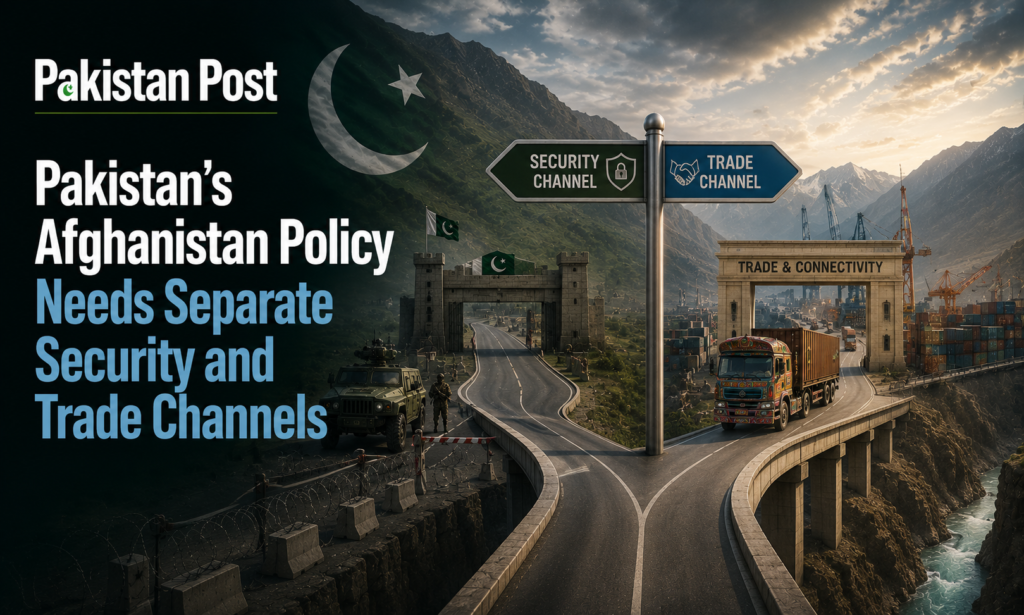
Pakistan’s Afghanistan policy has accumulated a structural problem that is increasingly difficult to disguise as a temporary dispute. Border security, transit trade, refugee management, diplomatic engagement and humanitarian movement have become so tightly interwoven that deterioration in one area routinely contaminates the others. A security incident can trigger restrictions on commerce. Commercial closures can deepen mistrust. Refugee pressures can become part of the diplomatic argument. Transit arrangements can be deployed as leverage during political confrontations. The resulting policy may appear coherent because every instrument serves the same immediate objective, but coherence is not the same as effectiveness.
For Pakistan, the central question is no longer whether security and economic interests should be considered together. They inevitably are. The more consequential question is whether they should continue to be administered through the same political mechanism. Islamabad has legitimate reasons to insist that Afghan territory must not be used for attacks against Pakistan, that border controls must be enforceable, and that the movement of people and goods must be documented. Yet these imperatives do not require every truck, trader, patient, student, refugee or humanitarian shipment to become an indirect instrument of security policy.
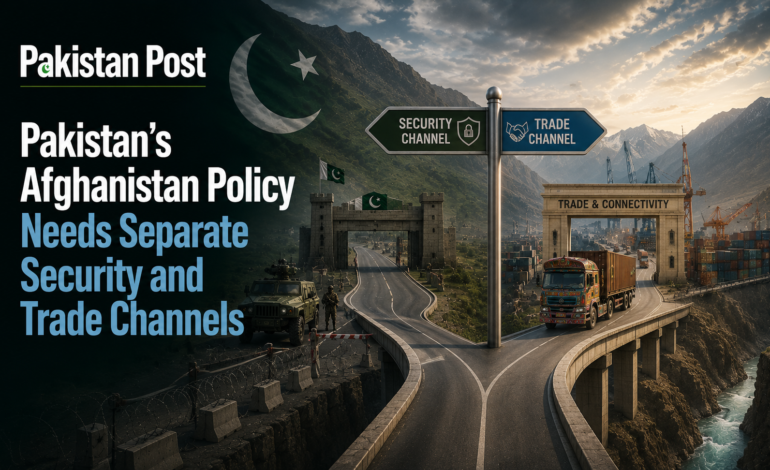
A more durable framework would preserve strategic conditionality while introducing administrative separation. Security verification should remain under clearly designated diplomatic, intelligence and law enforcement channels. Customs clearance, transit documentation, commercial payments, humanitarian access and regulated population movement should operate through technically governed systems with their own procedures, audit trails and escalation mechanisms. Such compartmentalisation would not represent strategic concession. It would provide Pakistan with greater leverage because it would make penalties more targeted, credible and reversible.
The Afghan relationship is unusually resistant to comprehensive political settlements because the two countries share geography, communities, informal economic networks and security vulnerabilities without possessing a stable institutional architecture for managing them. Pakistan cannot relocate its western frontier. Afghanistan cannot substitute another neighbour for access to Pakistani markets and maritime routes with ease. Millions of livelihoods have historically depended on movement across the frontier, while Pakistani security institutions remain concerned about militant infiltration, weapons trafficking, smuggling and the use of Afghan territory by hostile organisations.
That interdependence creates both leverage and exposure. A border closure may impose costs on Afghanistan, but it can also impose costs on Pakistani exporters, transporters, customs agents and border communities. A restriction on Afghan transit may reduce particular vulnerabilities, but prolonged commercial disruption can increase incentives for informal crossings and illicit brokerage. When legitimate trade becomes unpredictable, the informal economy does not necessarily disappear. It can become more sophisticated.
This is particularly relevant to the political economy of the frontier. Formal commerce depends on predictable rules, functioning customs posts, recognised documentation and confidence that cargo will not be stranded because of a dispute unrelated to the shipment itself. Informal commerce depends on precisely the opposite conditions. When traders cannot determine whether a border will remain open, whether a document will be accepted or whether a consignment will face sudden restrictions, the premium attached to informal facilitation rises.
For Pakistan, this creates an awkward strategic paradox. Policies designed to increase control can, if poorly calibrated, reduce visibility. A truck travelling through a documented customs corridor generates data. A transaction diverted into an informal network generates less. A registered trader can be audited. A smuggler can change routes, intermediaries and currencies. A legitimate banking transaction can be monitored. Cash settlement cannot be subjected to equivalent scrutiny.
The strategic objective should therefore be to maximise traceable movement rather than simply minimise movement.
This requires a distinction between controlled openness and unrestricted access. Pakistan need not choose between a completely open frontier and a commercially paralysed border. A middle architecture is available. Designated crossings can operate according to risk based protocols, with enhanced inspection for sensitive categories, electronic documentation for ordinary consignments, biometric and identity verification for authorised travellers, and predetermined procedures for temporary suspension when intelligence indicates an immediate threat.
The key is predictability. Security agencies should retain the authority to recommend restrictions, but the commercial system should know what conditions trigger them, which authority imposes them, how long they remain valid and what evidence is required for restoration. Ambiguity may create tactical leverage, but institutionalised ambiguity eventually becomes an economic cost.
This distinction is particularly important for Pakistan’s western trade strategy. Afghanistan is not merely a bilateral market. It forms part of Pakistan’s potential access to Central Asian economies, while Pakistani ports offer Afghanistan an alternative route to international maritime commerce. The strategic value of transit therefore extends beyond the volume of Afghan goods entering Pakistani territory. It concerns Pakistan’s position within a broader regional logistics system.
If transit arrangements become permanently hostage to bilateral political crises, Pakistan risks weakening its own claim to be a dependable commercial gateway. International traders price reliability into their routing decisions. A corridor that can be closed abruptly for political reasons may be useful during a crisis, but it becomes less attractive as a long term commercial platform.
This is where security policy and economic statecraft need to be recalibrated. Pakistan should retain the ability to suspend specific categories of movement where there is credible evidence of security exploitation. But restrictions should be proportionate to the identified risk. A security concern involving a particular cargo category should not automatically immobilise unrelated food, pharmaceutical, industrial or humanitarian consignments. A diplomatic dispute should not automatically translate into a generalised commercial penalty.
Such differentiation would also strengthen Pakistan’s position with international partners. A policy based on transparent procedures, documented security grounds and narrowly tailored restrictions is easier to defend diplomatically than one in which economic access appears to fluctuate according to political temperature. For policymakers dealing with international financial institutions, trading partners and humanitarian organisations, procedural credibility has become an element of strategic credibility.
Refugee management requires the same separation of functions. Pakistan has carried a substantial humanitarian and socioeconomic burden associated with Afghan displacement for decades. The state has legitimate interests in documentation, identity verification, border control and repatriation policy. But refugee administration should not become an improvised extension of bilateral retaliation.
The security establishment understandably requires reliable information about who enters the country, where individuals reside and whether particular persons or networks present a threat. That objective is better served by comprehensive registration, biometric verification, intelligence screening and interagency data integration than by administrative uncertainty affecting entire populations. Security screening becomes more effective when legitimate populations can be distinguished from high risk actors.
The same principle applies to humanitarian movement. Hospitals, educational institutions, relief organisations and families should not be forced to navigate an unpredictable system in which every cross border movement is interpreted primarily through the lens of bilateral political relations. Humanitarian channels can be tightly controlled without being politically indiscriminate.
The institutional question is therefore more important than the rhetoric surrounding bilateral relations. Pakistan needs an Afghanistan framework that distributes responsibilities across specialised mechanisms while preserving a central strategic command structure. The National Security Committee and relevant senior state institutions can define the strategic parameters, but implementation should not depend upon a single political channel.
A dedicated security mechanism could handle militant threats, border incidents, intelligence sharing, verification of security assurances and investigation of specific violations. A diplomatic mechanism could manage political communication, crisis de escalation and formal commitments. A commerce and customs mechanism could manage transit documentation, tariffs, inspections, cargo disputes and authorised trade. A humanitarian mechanism could address medical movement, relief supplies and vulnerable populations. Each mechanism should have designated interlocutors, response timelines and escalation procedures.
This would also enable Pakistan to impose graduated penalties. Instead of moving immediately from normal trade to comprehensive closure, the state could apply a calibrated sequence. Enhanced inspection could precede restricted clearance. Restricted clearance could be followed by suspension of specific routes or commodity categories. Individual companies or transporters could be sanctioned where evidence exists. Broader restrictions could remain available for extraordinary circumstances.
Such a system would increase rather than reduce deterrence. Punishment is most credible when it is specific, attributable and reversible. If every violation produces the same maximal response, the government eventually has fewer instruments left to deploy. Strategic coercion requires a ladder, not merely an on off switch.
The Afghan side would also face clearer obligations. Security commitments should be converted into measurable benchmarks rather than general assurances. Pakistan could seek documented procedures concerning the prevention of attacks from Afghan territory, information exchange on designated militant networks, notification of significant border incidents and mechanisms for investigating allegations. Compliance could be reviewed periodically, allowing commercial normalisation to respond to verifiable conduct rather than political declarations.
This approach would require a difficult adjustment in institutional culture. Security agencies often operate according to classified information, urgency and operational necessity, while customs and commerce depend upon predictability, documentation and procedural continuity. These institutional logics are different. The answer is not to subordinate one to the other, but to create a controlled interface between them.
A secure trade system can actually enhance national security. Digital customs records, advance cargo information, vehicle tracking, trader identification and financial transparency provide intelligence that blanket restrictions cannot generate. Pakistan should therefore treat trade facilitation technology as part of its western border security architecture rather than as a competing economic objective.
Risk based customs profiling deserves particular attention. Not every consignment has the same probability of concealment, misdeclaration or sanctions exposure. Data analytics can identify anomalies involving commodity descriptions, declared values, routes, traders, vehicles and transaction histories. High risk consignments can receive intensified scrutiny while low risk commerce moves faster. This reduces congestion and makes enforcement resources more concentrated.
The same principle can be applied to border crossings. Pakistan should move towards an integrated border management model in which customs, immigration, law enforcement and intelligence functions share authorised information without eliminating institutional accountability. The objective should be a single risk picture rather than multiple disconnected databases.
There is also a geopolitical dimension. Afghanistan policy cannot be designed solely through the bilateral lens. China’s security concerns in the region, Central Asian connectivity, Iran’s interests along the western frontier, Gulf investment, American counterterrorism priorities and international humanitarian considerations intersect with Pakistan’s Afghan policy. A system that separates technical commerce from political disputes would give Islamabad greater flexibility in explaining its policies to external stakeholders.
Pakistan should also recognise that prolonged economic pressure does not necessarily produce political compliance. Afghanistan’s economy is vulnerable, but its informal networks have considerable adaptive capacity. Traders can reroute commodities, substitute intermediaries and alter settlement arrangements. Border communities have developed commercial practices over generations. The state should not assume that every restriction creates proportionate negotiating leverage.
Indeed, excessive restrictions can create constituencies opposed to formalisation. Traders who lose confidence in official channels may invest in alternative networks. Transporters may cultivate informal routes. Consumers may turn to undocumented markets. Revenue collection falls. Security visibility deteriorates. The state then faces the paradox of having imposed controls that weaken the very monitoring capacity it seeks to strengthen.
Pakistan’s policy should therefore pursue a more sophisticated objective: preserve economic interdependence while denying hostile actors the ability to exploit it.
That requires political discipline. Security crises will continue to occur. There will be incidents that demand immediate action. A compartmentalised system does not mean that Pakistan must keep trade open regardless of circumstances. In a grave emergency, temporary comprehensive restrictions may remain justified. But exceptional measures should be explicitly treated as exceptional. Their legal basis, security rationale, review mechanism and conditions for reversal should be identifiable within the state apparatus.
The larger strategic gain would be institutional resilience. Pakistan would no longer have to choose between appearing weak on security and appearing unreliable on commerce. It could demonstrate that security concerns are serious precisely because they are managed through defined instruments rather than improvised pressure.
For the Pakistani establishment, this is ultimately a question of state capacity. A powerful state is not one that closes every channel whenever relations deteriorate. It is one capable of keeping useful channels open while isolating the channels through which adversaries can cause harm. Strategic maturity lies in distinguishing a security threat from a commercial transaction, a militant network from a refugee family, and diplomatic disagreement from a consignment moving under valid customs documentation.
Pakistan should consequently move towards an Afghanistan policy based on functional separation, integrated intelligence and graduated enforcement. Security assurances should be measurable. Border restrictions should be risk based. Transit trade should have predictable procedures. Refugee management should rely on documentation and screening rather than collective uncertainty. Humanitarian movement should remain technically regulated. Customs systems should become more digital and intelligence driven. Diplomatic engagement should provide an escalation channel capable of resolving disputes before they contaminate every other domain.
The purpose would not be to depoliticise the Afghanistan relationship. That is unrealistic. Nor would it diminish Pakistan’s security imperatives. It would make them more enforceable. The central strategic proposition is straightforward. Pakistan does not need less security policy on its western frontier. It needs better separation between security policy and the economic, humanitarian and administrative systems that security policy is currently capable of paralysing. If Islamabad can preserve legitimate trade while maintaining credible penalties for verified security violations, it will gain something more valuable than temporary leverage: a policy architecture capable of absorbing crises without repeatedly damaging Pakistan’s own strategic interests.
A Public Service Message