Frontier Stability Beyond Border Militarisation Today

The Pakistan Afghanistan frontier has moved beyond the classical definition of a border problem. What was once framed as a territorial management issue between two sovereign states has evolved into a layered governance challenge that sits at the intersection of security doctrine, demographic pressure, informal economies, refugee politics, and contested legitimacy along the western periphery of the Pakistani state. The persistence of cross border militancy, especially the operational resilience of the Tehrik e Taliban Pakistan, combined with periodic border closures, deportation cycles, intelligence distrust, and fluctuating engagement with the Afghan authorities, has revealed a deeper structural question. The question is no longer where the border lies but whether the Pakistani state can secure and integrate its frontier regions without turning them into permanent militarised exception zones that reproduce instability over time.
At the core of this dilemma is the tension between securitisation and governance inclusion. Pakistan’s western frontier has historically been managed through a security dominant lens, where the assumption has been that stability can be imposed through force projection, border fencing, kinetic operations, and intelligence containment. This model has produced tactical gains but strategic stagnation. The fencing of the Pakistan Afghanistan border, while reducing certain forms of mobility, has not eliminated militant permeability or ideological diffusion. Instead, it has shifted the burden inward toward internal policing stress, intelligence saturation, and reactive military deployments. The result is a system that controls movement but does not necessarily generate legitimacy or long term stability in frontier communities.
The deeper issue is that frontier spaces in Khyber Pakhtunkhwa and adjacent tribal districts are not merely geographic peripheries. They are socio political ecosystems with their own informal governance structures, economic dependencies, and cross border cultural continuities. Any doctrine that treats them purely as security buffer zones risks reproducing alienation. The legacy of administrative fragmentation, particularly the long historical separation between tribal areas and the mainstream legal framework, has left behind a governance gap that cannot be filled by security instruments alone. Even after formal integration reforms, the institutional penetration of civilian governance remains uneven, and this unevenness creates vacuums that non state actors exploit.
The persistence of TTP related militancy is not only a function of external sanctuaries or ideological persistence but also of local governance deficits. Recruitment networks draw strength from unemployment, weak dispute resolution mechanisms, inconsistent policing presence, and fragmented service delivery. When state presence is episodic or overwhelmingly militarised, it becomes associated with coercion rather than protection. This perception gap is strategically significant because it affects intelligence quality, community cooperation, and early warning systems. Counter insurgency theory consistently demonstrates that intelligence driven success depends on political inclusion and administrative normalisation rather than force intensity alone.
The deportation and refugee management dimension adds another layer of complexity. Pakistan hosts and has historically hosted large Afghan refugee populations whose legal status, mobility patterns, and economic integration remain partially formalised. Periodic deportation drives, while politically framed as sovereignty enforcement, often generate humanitarian pressure and diplomatic friction without resolving underlying structural drivers of migration. Moreover, abrupt population movements can destabilise border markets, informal trade networks, and local economies in border districts, creating secondary stress points that feed insecurity rather than reduce it.
Trade regulation along the frontier also remains inconsistent. Informal cross border trade has historically functioned as both an economic lifeline and a regulatory challenge. Sudden closures of crossings such as Torkham or Chaman create immediate disruption in supply chains, commodity prices, and local livelihoods. These disruptions can quickly translate into political grievances that undermine broader stabilisation efforts. A purely restrictive trade posture ignores the reality that regulated economic interdependence can serve as a stabilising mechanism by embedding incentives for cross border predictability and reducing the economic appeal of illicit networks.
Intelligence distrust between Pakistan and Afghanistan compounds these challenges. The absence of sustained institutional trust mechanisms results in episodic cooperation followed by rapid breakdowns. In such an environment, intelligence sharing becomes tactical and transactional rather than strategic and continuous. This prevents the development of joint threat mapping, coordinated border management protocols, and synchronized counter infiltration strategies. Without institutionalised mechanisms, each crisis resets cooperation back to a minimal baseline.
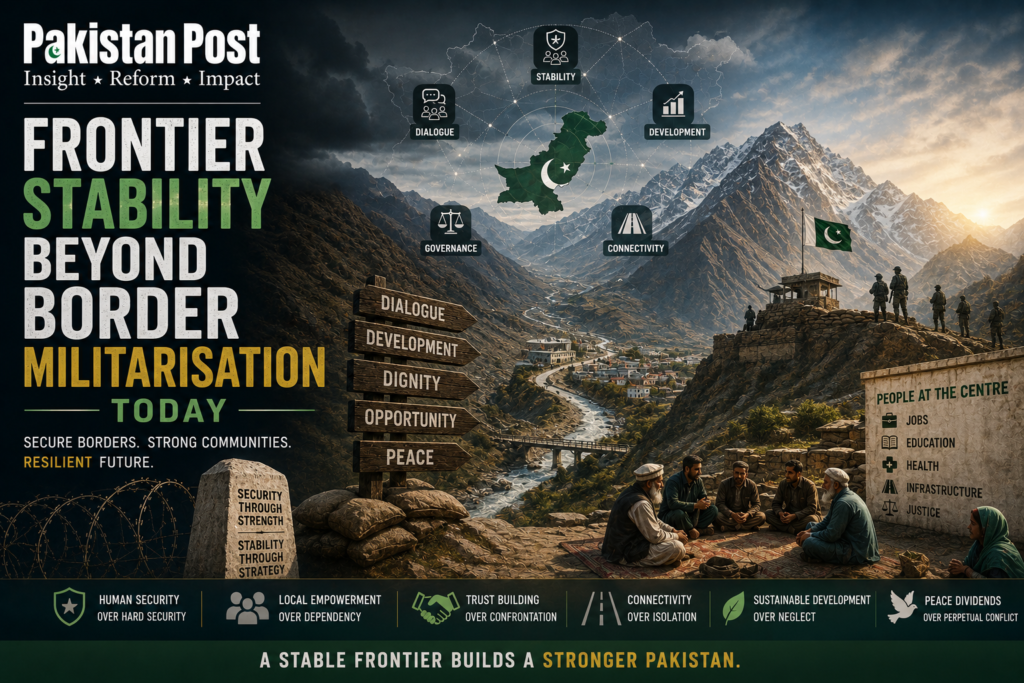
The emergence of a frontier resilience doctrine becomes necessary precisely because the existing framework oscillates between over securitisation and reactive disengagement. Frontier resilience implies a shift from treating border regions as containment zones to treating them as integrated governance spaces requiring layered policy instruments. This includes counterterrorism operations where necessary, but embedded within a broader architecture of political inclusion, economic stabilization, administrative normalisation, and regional diplomacy.
At the governance level, frontier resilience requires full consolidation of civilian administrative authority in formerly semi autonomous regions, not only in legal terms but in operational capacity. This means strengthening district level policing systems, judicial access, land dispute resolution mechanisms, and service delivery infrastructure. Without credible civilian institutions, military presence becomes the default governance substitute, which is not sustainable as a long term model.
Policing reform is particularly critical. Frontier policing must evolve from reactive checkpoint based models to intelligence led community policing systems. This requires recruitment from local populations, specialized training in counter insurgency environments, and integration with national intelligence databases. The objective is not militarisation of policing but professionalisation of local security institutions that can operate with legitimacy in sensitive environments.
Economic stabilization is another pillar of frontier resilience. Border districts require targeted development frameworks that prioritize employment generation, cross border legal trade facilitation, and infrastructure connectivity. Industrial zones linked to trade corridors can transform border regions from conflict peripheries into economic interfaces. However, such development must be protected from elite capture and must be aligned with local labor absorption capacities to avoid creating enclaves of exclusion.
Diplomacy with Kabul remains a necessary but structurally unstable variable. Engagement with Afghan authorities must move beyond crisis driven interaction toward structured dialogue on border management, refugee regulation, and counterterrorism coordination. At the same time, Pakistan’s diplomacy must increasingly factor in the role of external stakeholders such as Beijing, which has strategic interest in regional stability due to connectivity and economic corridor considerations. A trilateral or multilateral framework involving economic incentives may offer more durability than bilateral security focused exchanges alone.
The most difficult tension in this entire architecture remains the balance between force and inclusion. Pakistan cannot abandon counterterrorism operations where credible threats exist, nor can it rely solely on dialogue in the presence of active militant networks. However, overreliance on kinetic approaches risks reinforcing the very cycles of alienation that sustain militancy. The strategic challenge is therefore not elimination of force but its calibration within a wider governance ecosystem.
The critical question is whether the Pakistani state can escape the historical pattern in which frontier regions are treated as perpetual exceptions. Exceptionalism produces policy shortcuts, and policy shortcuts produce structural fragility. A resilient frontier is one where normal governance processes function even under security pressure, where civilian institutions are primary rather than auxiliary, and where economic and social integration reduces the appeal of insurgent alternatives.
Ultimately, the Pakistan Afghanistan frontier will be defined not by the thickness of its fences or the frequency of its military operations, but by whether it becomes a space of governed stability or persistent managed crisis. If the current trajectory continues without doctrinal adjustment, the frontier will remain a zone of recurring disruption that drains strategic bandwidth and domestic cohesion. If a resilience based framework is adopted, the same space could evolve into a stabilised interface between South and Central Asia, reducing security burdens while enhancing economic and diplomatic leverage.
The decisive factor is not geography but governance imagination.
A Public Service Message