When Everything Becomes Leverage: Pakistan in the Age of Transactional Geopolitics

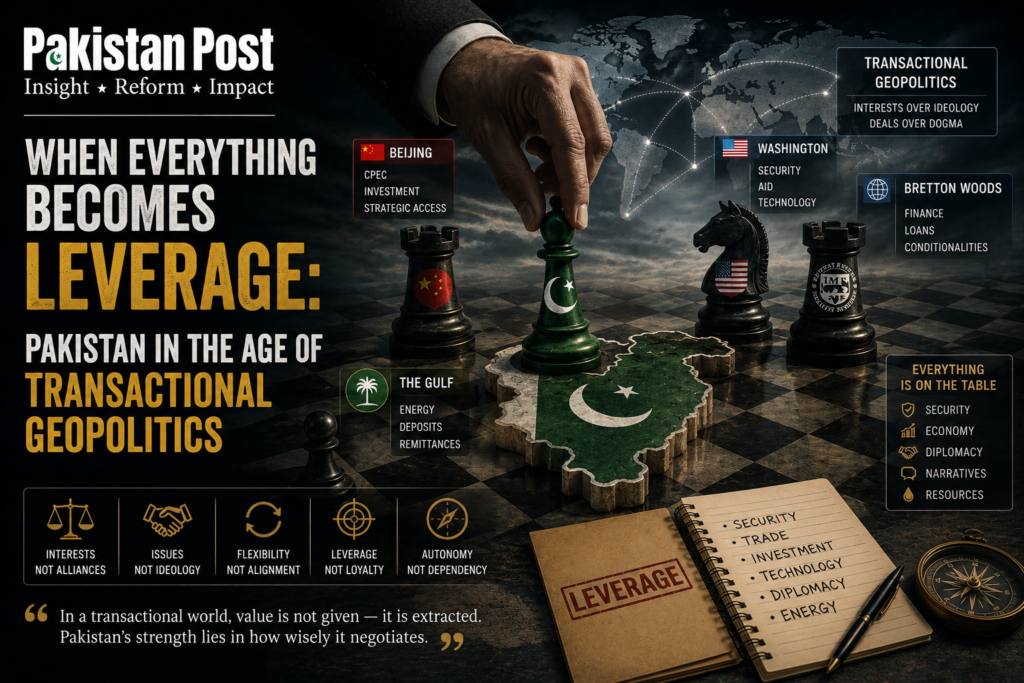
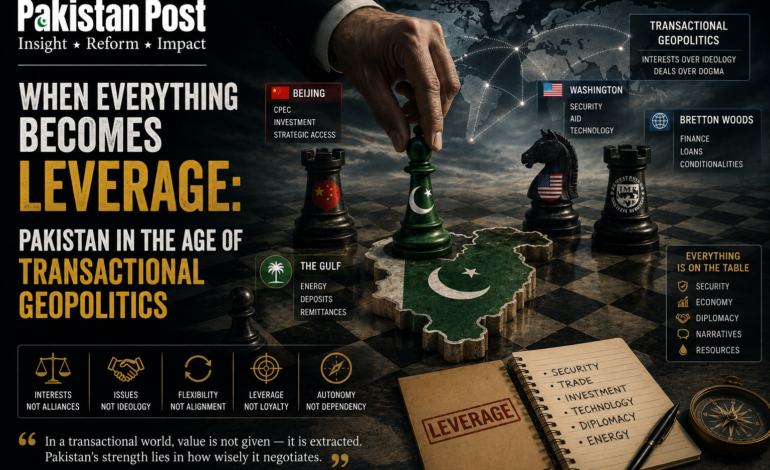
Pakistan now confronts an international order in which the old bureaucratic fiction that economics, diplomacy, security, and technology can be handled as separate theatres has largely collapsed. The world is moving into an era of open geopolitical bargaining where tariffs, sanctions, debt relief, ceasefire diplomacy, access to semiconductors, maritime routes, energy pricing, and military signalling increasingly belong to the same conversation. States no longer negotiate only over territory, trade, or security in isolation. They negotiate over packages of leverage. They bargain through markets, payment systems, export controls, digital infrastructure, access to finance, shipping insurance, intelligence cooperation, and reputational pressure all at once. For a country like Pakistan, this transformation is not an abstract feature of global disorder. It is a direct challenge to state capacity. Pakistan has long lived under the pressure of external financing needs, regional security volatility, and diplomatic asymmetry. What has changed is that these pressures are no longer arriving sequentially. They are converging into the same negotiating table. The practical question, therefore, is not whether Pakistan understands geopolitics in the traditional sense. It is whether the Pakistani state is institutionally equipped for a world in which its balance sheet, its sanctions exposure, its military posture, its technology access, and its diplomatic credibility can all be tested in the same week by the same crisis.
The first thing Pakistan must understand is that the return of transactional power politics does not mean the end of principles, institutions, or alliances. It means that all of them are now filtered through a harsher logic of leverage. The post Cold War habit of pretending that globalization had reduced strategic competition to a set of technical management questions has broken down. Great powers now use interdependence as an instrument rather than merely a condition. Supply chains are being weaponized, export controls are framed as national security tools, development finance is tied to strategic access, sanctions are used not simply to punish but to structure behaviour, and even ceasefire diplomacy is increasingly linked to energy routes, investor confidence, and technology concessions. In such an environment, the old foreign policy distinction between hard security and economic policy begins to look dangerously outdated. A port can be a logistics project, a naval asset, a debt question, a sanctions vulnerability, and a political symbol at the same time. A digital infrastructure agreement can be a development story, a data sovereignty issue, a cyber exposure, and a geopolitical alignment signal in one stroke. A currency crisis can weaken military options, distort diplomatic bargaining, and increase the price of neutrality. This is the ecosystem Pakistan must now learn to navigate.
The difficulty is that Pakistan’s institutional architecture still largely reflects an older mental map of the state. Security questions are often handled in one silo, fiscal negotiations in another, foreign policy messaging in a third, trade in a fourth, and digital regulation somewhere on the margins of national strategy rather than at its centre. That division was never entirely accurate, but it has become actively dangerous. In a world where technology denial can shape defence capability, where sanctions risk can affect energy imports, where IMF conditions can influence procurement space, and where military escalation can immediately alter sovereign financing costs, fragmentation is no longer just inefficient. It is strategically disabling. Pakistan’s problem is not merely that it faces multiple external pressures. Its deeper problem is that these pressures increasingly require integrated answers from a state that still often responds through compartmentalized reflexes.
Consider first the way economic instruments have become security tools. For much of the twentieth century, countries could at least pretend that trade policy was primarily about tariffs, market access, and industrial growth. That pretense has become difficult to sustain. Tariffs are now frequently imposed not just to protect domestic producers but to reshape geopolitical dependencies, retaliate for security behaviour, or force bargaining concessions in unrelated domains. Export controls are no longer niche regulatory instruments. They are strategic chokepoints designed to regulate access to the technologies that underpin military power, industrial competitiveness, and future intelligence capabilities. Financial surveillance, banking restrictions, insurance rules, and sanctions architecture now form part of the coercive toolkit through which major powers seek to discipline rivals and shape the choices of weaker states. Pakistan does not need to be the direct target of sanctions or tariffs to feel their effects. It only needs to be entangled in the supply chains, financing systems, energy routes, and diplomatic alignments affected by them.
That is why Pakistan should read the current era not as one in which it must simply avoid punishment, but as one in which it must understand how leverage travels. A sanctions package imposed on Iran can affect Pakistan’s energy calculations, border economy, and regional diplomacy. A new round of export controls on advanced semiconductors can shape Pakistan’s AI ecosystem, digital procurement choices, cloud architecture, and strategic dependence on either Chinese or Western technology stacks. A war scare in the Gulf can raise shipping costs, alter inflation assumptions, and complicate IMF targets. A U.S. China trade confrontation can change the terms on which Pakistan accesses machinery, components, telecom infrastructure, and even development financing. The key analytical mistake would be to view these as separate external events. They are not separate. They are linked through the material circuits of trade, credit, technology, and security that now define national resilience.
Pakistan’s strategic class therefore needs to abandon a lingering assumption that the country’s main foreign policy challenge is simply balancing relations among big powers. Balance still matters, but the deeper challenge is something more granular and more administrative: learning to operate in an age where every external relationship contains embedded economic, regulatory, and technological conditions. The future of Pakistani statecraft will not be decided only by summits, speeches, or military deterrence. It will also be decided by whether the state can read the legal fine print of export control regimes, anticipate the impact of sanctions spillovers on domestic markets, negotiate digital infrastructure agreements without surrendering data sovereignty, and align macroeconomic stabilization with strategic procurement decisions. This is less glamorous than grand strategy, but it is now inseparable from grand strategy.
The IMF provides perhaps the clearest example of how the age of transactional bargaining collapses old boundaries. In the Pakistani imagination, IMF programs have often been treated as painful but essentially economic arrangements. That view is no longer sufficient. An IMF program today affects Pakistan’s foreign policy room for manoeuvre because it shapes investor confidence, sovereign credit narratives, defence budgeting assumptions, subsidy politics, and the state’s capacity to absorb external shocks. If oil prices rise because of a regional war, if remittance flows wobble because of Gulf instability, or if exports are hit by trade disruptions, the fiscal targets and reserve assumptions underpinning an IMF program can come under strain. That strain is not just an accounting matter. It becomes a strategic constraint. A government that must preserve external financing credibility may have less room to escalate militarily, subsidize domestic prices for political stability, or undertake expensive geopolitical signalling. Conversely, a government that chooses symbolic defiance over economic prudence may discover that its diplomatic posture is being quietly disciplined by market reaction and creditor anxiety. In other words, the IMF file is now inseparable from the national security file, not because the Fund is a security institution, but because in fragile economies macroeconomic credibility determines how much strategic freedom the state can actually afford.
The same is true of technology. For too long, technology policy in Pakistan was treated as a developmental or commercial issue rather than a core question of sovereignty and strategic positioning. That luxury is disappearing. Access to advanced chips, cloud services, cyber tools, telecom infrastructure, AI systems, and digital payment rails is increasingly shaped by geopolitical competition. The U.S. China technology contest has made this obvious. Export controls on advanced semiconductors, restrictions on high end computing hardware, pressure around telecom vendors, and debates over data localization are no longer distant great power quarrels. They are the operating environment within which countries like Pakistan must build their digital futures. If Pakistan’s AI ambitions depend on imported compute, if its public sector digitization rests on foreign cloud architecture, if its telecom backbone is tied to one strategic bloc while its financial compliance obligations are tied to another, then technology access becomes a site of geopolitical vulnerability.
This matters because Pakistan is still in the early stages of deciding what kind of digital state it wants to become. It wants modernization, AI adoption, e governance, fintech expansion, and digital public infrastructure. Yet it has not fully resolved the strategic trade offs embedded in these choices. Should its digital backbone be built primarily through Chinese hardware and platforms, given the affordability, availability, and strategic intimacy that often accompany such arrangements? Should it seek Western or hybrid solutions for cloud, cyber, and AI ecosystems in order to avoid overdependence and reputational risk? Can it realistically pursue sovereign digital infrastructure when it remains dependent on imported hardware, external financing, and foreign technical ecosystems? These are not merely questions of procurement. They are questions about whether Pakistan will become a user of other people’s digital empires or a state capable of constructing at least partial technological agency of its own.
Technology also changes the meaning of neutrality. In an older diplomatic setting, a country could sometimes remain politically non aligned while continuing to trade broadly with rival blocs. In a world of technology controls, that becomes harder. The choice of vendors, standards, cloud hosts, chip suppliers, and cybersecurity partners can itself signal alignment, or at least create embedded dependencies that constrain future options. A country may declare strategic balance while its digital infrastructure tells a more revealing story. Pakistan must therefore understand that the digital domain is not peripheral to foreign policy. It is one of the arenas through which future foreign policy autonomy will be won or lost.
Then there is the question of ceasefires and crisis diplomacy. Traditionally, South Asian security analysis treated ceasefire management as a military and diplomatic matter. That is no longer sufficient. In an age of transactional bargaining, ceasefires can become part of broader packages involving financial reassurance, trade stability, investment signalling, and third party mediation. If a regional confrontation raises fears about market instability, insurance costs, shipping routes, or sovereign risk, then pressure for de escalation will not come only from diplomats worried about war. It will also come from creditors, investors, multilateral institutions, energy suppliers, and external partners whose own interests are tied to stability. Pakistan should not read this as evidence that economic logic will override military risk. Rather, it should understand that crises now trigger a multidimensional negotiation in which battlefield signalling, capital flight, commodity prices, and diplomatic intervention can all move together.
This is especially important because Pakistan has historically been more comfortable with the security grammar of crisis than with the financial grammar of crisis. The state knows how to think about escalation ladders, deterrence postures, and military signalling. It is less practiced at integrating those calculations with real time assessments of bond spreads, remittance risk, import financing, and sanctions exposure. Yet that is precisely what the contemporary environment demands. A ceasefire is no longer just a pause in hostilities. It can be a device through which external powers seek to stabilize markets, protect trade routes, prevent energy shocks, and preserve broader geopolitical bargains. If Pakistan’s decision makers do not understand that wider context, they may misread both pressure and opportunity in moments of conflict.
The Gulf theatre offers another illustration of why transactional geopolitics must be read as a fused domain rather than a set of separate files. Pakistan’s ties to the Gulf are not limited to diplomacy or sentiment. They involve remittances, oil imports, labour markets, investment promises, military ties, and religious symbolism. When the Gulf is stable, these links support Pakistan’s economy and strategic posture. When the Gulf is unstable, they become channels of vulnerability. A regional war can raise oil prices, threaten shipping routes, complicate domestic inflation management, and test Pakistan’s ability to remain diplomatically agile between rival regional actors. If the crisis also intersects with sanctions regimes, maritime security operations, or great power rivalry, then Pakistan can quickly find itself facing simultaneous pressure from creditors, energy suppliers, labour destination states, and strategic partners. This is not a hypothetical future. It is the operating reality of a country whose economic bloodstream is connected to one of the most volatile geopolitical theatres in the world.
What all this reveals is that Pakistan’s real challenge is one of state capacity rather than rhetorical positioning. The country does not primarily suffer from a lack of awareness that the world is changing. Its elite discourse is full of references to multipolarity, geoeconomics, strategic competition, and technological disruption. The deeper problem is that Pakistan’s institutions are still not organized for integrated bargaining. Ministries continue to defend turf rather than share risk assessments. Trade negotiators may not fully internalize security implications. Security planners may not always incorporate financial and technological dependencies into scenario planning. Digital regulators often operate at a distance from strategic decision making even though digital architecture now shapes everything from cyber resilience to investment attractiveness. Finance officials manage stabilization programs under intense pressure but may not always have a formal mechanism to align macroeconomic commitments with longer term strategic objectives. The result is a state that often understands the complexity of its environment conceptually but struggles to convert that understanding into coordinated policy.
If Pakistan wants to function in this age of fused bargaining, it will need an institutional revolution in how it thinks about national power. The old distinction between foreign policy and domestic policy must be softened. The distinction between economic planning and national security must be radically revised. The distinction between technology regulation and strategic doctrine must effectively disappear. What Pakistan needs is not another slogan about geoeconomics, but a governing architecture that treats sanctions risk, export controls, debt exposure, critical imports, digital infrastructure, and military signalling as parts of one strategic map.
This begins with intelligence and forecasting. Pakistan requires a permanent state capacity to map how external shocks travel through its economy and security environment. That means dedicated analytical machinery that can model what a new sanctions regime on Iran would do to fuel prices, what an escalation in the Red Sea would do to import costs, what U.S. China technology restrictions would do to Pakistan’s digital ambitions, what a tightening of global financial conditions would do to defence procurement space, and what a Gulf labour slowdown would do to remittances and domestic political stability. At present, such assessments may exist in fragments across ministries and agencies, but fragmentation is precisely the problem. In the age of transactional geopolitics, partial knowledge is not enough. The state needs a common operating picture.
The second requirement is integrated bargaining machinery. Pakistan cannot continue to send diplomats, finance officials, trade negotiators, military interlocutors, and technology policymakers into overlapping strategic conversations without a unified doctrine and a coordinated mandate. The country needs a high level institutional mechanism that can combine economic, security, diplomatic, and digital expertise into one negotiating framework. This is not a call for militarizing economic policy or technocratizing foreign policy. It is a call for recognizing that no major external negotiation is now purely one thing. A discussion with Gulf investors may implicate labour mobility, energy transition, port access, and political signalling. A conversation with Washington may involve IMF atmospherics, export controls, security deconfliction, and technology cooperation. Engagement with China may encompass debt terms, industrial parks, digital standards, defence procurement, and the security of personnel. The state needs a way to see these connections before events force them together under crisis conditions.
The third requirement is a new doctrine of economic security. Pakistan has spent decades talking about national security in military terms while treating economic fragility as a recurring inconvenience to be managed by emergency financing. That model is no longer viable. In a world where trade restrictions, payment systems, insurance markets, sanctions, and export controls can all be weaponized, economic resilience is not an adjunct to national security. It is one of its central pillars. Pakistan therefore needs to identify the sectors where vulnerability is most dangerous and where policy intervention can meaningfully reduce dependence. Energy remains the most obvious. Import compression is not a strategy. Pakistan needs a durable plan for energy diversification, storage resilience, and pricing reform that reduces the likelihood that every regional shock becomes a domestic fiscal crisis. The same logic applies to food imports, pharmaceutical supply chains, telecom equipment, and strategic digital infrastructure. The objective is not autarky. It is the reduction of catastrophic exposure.
The fourth requirement is technological realism. Pakistan cannot afford fantasies of instant digital sovereignty, but neither can it afford passive dependence. It needs a layered technology strategy. At the base level, it should diversify vendors and avoid locking critical public systems into single point dependencies where possible. At the middle level, it should invest in local capability for cloud governance, cybersecurity, data protection, and AI adaptation, even if frontier hardware remains imported. At the strategic level, it should decide which technological relationships are worth the geopolitical trade offs they carry. Some Chinese systems may be necessary and useful. Some Western systems may be necessary and useful. The point is not ideological purity. The point is to know what each dependency costs, what each dependency enables, and what each dependency forecloses. Pakistan’s digital future should be negotiated with eyes open, not inherited by default from the strategic competition of others.
The fifth requirement is narrative discipline. In a transactional world, states are judged not only by their intentions but by their reliability and coherence. Pakistan has too often oscillated between overstatement and defensiveness, between claiming centrality to global politics and protesting mistreatment by the same system. Neither posture is sufficient for the environment now taking shape. Pakistan needs a language of statecraft that is sober, legible, and credible across rival power centres. It should present itself not as a permanently aggrieved state seeking exemptions, nor as a theatre of great power romance, but as a serious middle power trying to build resilience under difficult conditions. That means fewer performative claims about sovereignty detached from fiscal reality and more visible commitment to institutional reform, regulatory predictability, and strategic consistency. The more transactional the world becomes, the more valuable credibility becomes as a national asset.
Yet even if Pakistan builds better institutions and sharper doctrine, it must still confront a deeper structural truth. Transactional geopolitics tends to punish countries that arrive at the negotiating table in a condition of recurring emergency. A state that is perpetually short of reserves, dependent on bailout cycles, vulnerable to energy shocks, and uncertain about its technology architecture will always bargain from weakness no matter how sophisticated its rhetoric becomes. This is why the ultimate answer to the new world of fused bargaining lies not only in foreign policy but in domestic reconstruction. The ability to negotiate with confidence abroad depends on the ability to govern with discipline at home. Tax capacity, export competitiveness, power sector reform, labour productivity, legal predictability, and digital competence are no longer merely development indicators. They are the infrastructure of sovereignty.
Pakistan’s challenge, then, is not to lament the transactional turn in world politics as though it were an aberration from a more innocent age. The world was never innocent. Power has always mixed coercion and commerce. What has changed is the visibility and speed of that fusion. Trade, sanctions, ceasefires, technology access, and security guarantees are now openly negotiated in the same breath. The countries that will fare best in this environment are not necessarily the largest or richest. They are the ones whose states can think across silos, anticipate linkages, and bargain with a clear hierarchy of interests. Pakistan still has time to become such a state, but only if it stops treating strategic complexity as something to be narrated and starts treating it as something to be administratively mastered.
The choice is stark. Pakistan can continue to operate with a twentieth century institutional map inside a twenty first century coercive economy, responding to each new shock as a separate emergency and calling the result resilience. Or it can accept that the meaning of statecraft has changed. In the emerging order, a tariff can be a warning shot, a chip license a strategic concession, a debt review a security variable, a ceasefire a market stabilizer, and a cloud contract a geopolitical alignment. Countries that fail to understand this will discover that their sovereignty has not disappeared dramatically through invasion or occupation. It has thinned gradually through unmanaged dependence, bureaucratic fragmentation, and bargaining unpreparedness. Pakistan’s task is to ensure that this does not become its fate. It must build a state capable of reading the full table of leverage, not just the military pieces upon it. Only then will it be able to negotiate the age of transactional power politics as a strategic actor rather than merely endure it as a vulnerable object.
A Public Service Message