Institutional Fragmentation and the Shifting Civil–Military Equilibrium in Pakistan

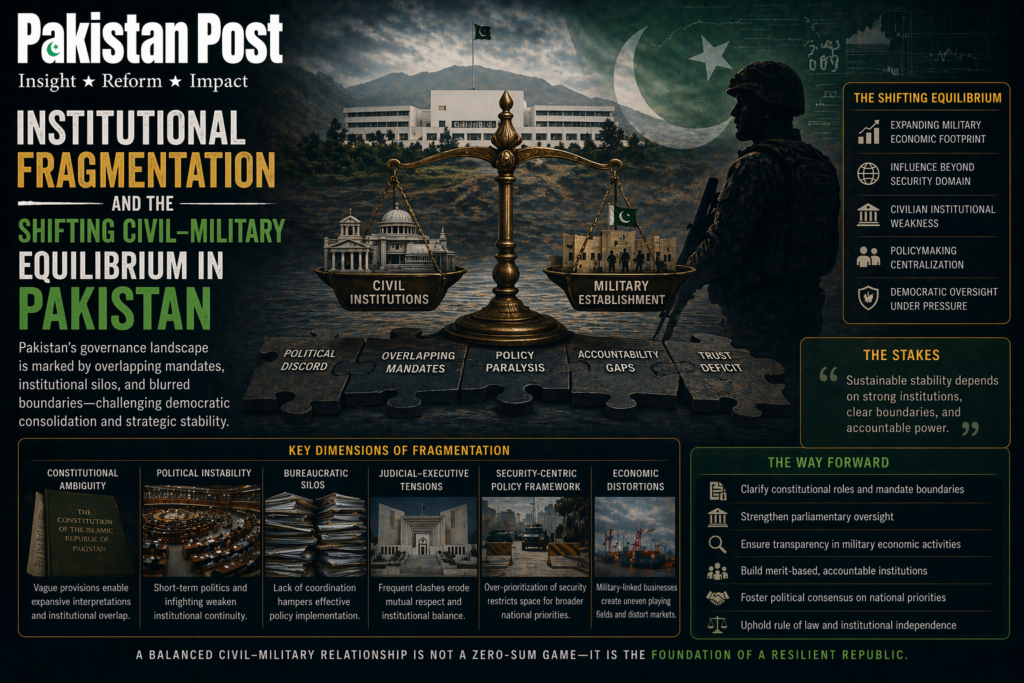
Pakistan’s governance system has long been described as a layered state, where formal constitutional arrangements coexist with informal centres of authority that shape policy direction, crisis response, and strategic decision-making. Over time, this coexistence has not matured into stable power-sharing but has instead generated a persistent condition of institutional fragmentation. The result is not a simple binary of civilian versus military dominance, but a more complex and evolving configuration in which jurisdictional boundaries blur, responsibilities overlap, and authority is continuously renegotiated under the pressure of political instability, economic fragility, and regional security concerns.
At the heart of this fragmentation lies a structural paradox. Pakistan possesses a constitutionally defined parliamentary democracy, a professional bureaucracy, an independent judiciary, and a set of elected institutions designed to mediate power. Yet the actual distribution of authority often diverges from this formal architecture. This divergence is not episodic; it is systemic. It reflects decades of institutional adaptation to recurring political crises, military interventions, coalition fragility, and governance gaps that have encouraged non-elected institutions to assume expanded roles in maintaining continuity of the state.
The civil–military relationship, in this context, cannot be understood as a static balance that shifts periodically between civilian supremacy and military dominance. Instead, it functions as a dynamic equilibrium shaped by shifting incentives, institutional capacities, and external pressures. In recent years, particularly amid heightened political polarization, economic distress, and security challenges, this equilibrium has appeared to evolve toward a hybrid configuration. In this configuration, cooperation, overlap, and competition coexist simultaneously, often within the same policy domains.
One of the central structural drivers of fragmentation is the uneven development of institutional capacity across the state apparatus. Civilian institutions, particularly those responsible for economic governance, regulatory enforcement, and long-term planning, have frequently struggled with continuity, expertise retention, and policy coherence. High turnover in political leadership, short electoral cycles, and coalition instability have compounded these weaknesses. In contrast, the military institution has maintained comparatively high organizational continuity, discipline, and strategic planning capacity, enabling it to play a more consistent role in areas extending beyond conventional defense.
This asymmetry has gradually expanded the scope of military involvement in domains traditionally considered civilian, including infrastructure development, disaster response, internal security coordination, and even aspects of economic stabilization during periods of fiscal stress. While often justified as pragmatic responses to governance gaps, these interventions have had cumulative institutional effects. They have reinforced a pattern in which civilian institutions increasingly rely on military coordination in moments of crisis, thereby normalizing overlap and reducing incentives for structural reform within civilian governance systems.
Another critical factor is the recurrent cycle of political instability that has characterized Pakistan’s democratic experience. Frequent changes in government, confrontational politics between ruling parties and opposition blocs, and contested legitimacy of electoral outcomes have all contributed to weakened civilian authority. In such an environment, the military has often been perceived, both domestically and externally, as a stabilizing force capable of ensuring continuity during political transitions. This perception, whether accurate or contested, has reinforced its institutional relevance beyond its formal constitutional remit.
However, it would be misleading to interpret this dynamic as a simple expansion of military dominance. Instead, what has emerged is a more intricate pattern of shared governance in which responsibilities are distributed unevenly across institutions depending on issue area and crisis intensity. In security and foreign policy, the military’s influence remains structurally significant, shaped by historical precedent, strategic necessity, and institutional expertise. In economic governance, the picture is more fluid, with civilian institutions formally in charge but often dependent on military-backed stabilization efforts during periods of macroeconomic volatility or external financing negotiations.
This overlapping jurisdiction has created a governance model that is neither fully civilian-led nor overtly military-controlled, but rather hybrid in nature. Such hybridity can generate short-term efficiency in crisis management, but it also produces long-term institutional ambiguity. When roles are not clearly delineated, accountability becomes diffuse. Policy ownership becomes contested. And institutional learning is weakened, as responsibility for outcomes is shared across multiple centres of authority.
The implications of this fragmentation extend beyond administrative inefficiency. It directly affects the quality of democratic consolidation. Democratic systems rely not only on elections but on predictable institutional hierarchies, transparent accountability mechanisms, and clear separation of functional domains. When these conditions are weakened, democratic legitimacy becomes vulnerable to episodic disruptions and informal interventions.
Yet the civil–military relationship in Pakistan is not static, and recent developments suggest subtle shifts rather than fixed patterns. One observable trend is the increasing institutional interdependence between civilian governments and the military establishment in managing economic crises. As Pakistan’s fiscal pressures have intensified, particularly under repeated engagements with international financial institutions and rising external debt obligations, the coordination between civilian economic managers and security institutions has become more pronounced. This reflects not only the scale of economic vulnerability but also the perceived necessity of unified state messaging and enforcement capacity during periods of financial uncertainty.
At the same time, there are indications of a gradual recalibration in the military’s public-facing role in governance. While its institutional influence remains significant, there is growing recognition of the limits of direct administrative engagement in complex civilian policy domains. This has led to a more selective approach, where involvement is often framed in terms of facilitation, coordination, or support rather than direct control. Whether this represents a structural transition or a tactical adjustment remains contested.
Civilian institutions, for their part, continue to face the challenge of asserting policy autonomy while operating within constraints imposed by political fragmentation and economic dependence. The lack of sustained policy continuity across successive governments has undermined their ability to build long-term institutional strength. Moreover, internal divisions within political parties and governing coalitions have further weakened their negotiating position within the broader state structure.
The judiciary also occupies an important, if complex, position within this fragmented system. At various points, it has played a decisive role in shaping political outcomes, adjudicating constitutional disputes, and interpreting the boundaries of institutional authority. However, its interventions have sometimes contributed to uncertainty regarding the separation of powers, adding another layer to the already complex institutional landscape.
International factors further complicate the domestic equilibrium. Pakistan’s geopolitical location, security partnerships, and dependence on external financial assistance create additional layers of institutional engagement. External actors often interact simultaneously with multiple centres of authority within the state, reinforcing patterns of overlap rather than clarity. This external engagement can inadvertently strengthen hybrid governance structures by incentivizing coordination among fragmented institutions rather than consolidation under a single civilian authority.
The broader question is whether this system is evolving toward greater cooperation, entrenched overlap, or structural competition. Evidence suggests elements of all three dynamics are present simultaneously. Cooperation is evident in crisis management, particularly in security and economic stabilization efforts. Overlap is institutionalized in policy domains where civilian and military roles intersect without clear demarcation. Competition, however, persists beneath the surface, particularly in matters of strategic direction, resource allocation, and political legitimacy.
This triadic configuration produces a state that is adaptive but structurally ambiguous. It can respond to crises with a degree of coordinated action, but it struggles to sustain coherent long-term policy trajectories. It can mobilize resources rapidly in emergencies, but it often lacks the institutional clarity required for consistent governance reform.
The long-term trajectory of this system will depend on several interrelated factors. The first is the capacity of civilian institutions to strengthen internal governance, reduce fragmentation within political parties, and build durable policy expertise. The second is the willingness of all institutional actors to clarify functional boundaries in a way that reduces overlap without undermining coordination. The third is the evolution of Pakistan’s economic structure, as sustained fiscal stability would likely reduce the frequency of crisis-driven institutional intervention.
Equally important is the role of political consensus. Without a minimum level of agreement among major political forces on constitutional continuity and institutional reform, the cycle of fragmentation is likely to persist. Political polarization not only weakens civilian governance but also increases reliance on non-political institutions for arbitration and stabilization.
In assessing whether Pakistan’s civil–military balance is moving toward cooperation, overlap, or competition, the most accurate conclusion is that it is moving toward a managed but unstable coexistence. This coexistence is not necessarily unsustainable, but it is inherently fragile. It depends on continuous negotiation rather than settled institutional norms, and on crisis-driven adaptation rather than structural clarity.
The challenge for Pakistan is not simply to redefine the civil–military balance in abstract terms, but to address the deeper structural fragmentation that makes such balance perpetually contingent. Until institutional authority becomes more clearly delineated and politically reinforced, the system will likely continue to oscillate between cooperation and competition, with overlap as its default condition.
In that sense, Pakistan’s governance model is not in transition toward a clearly defined endpoint. It is, instead, stabilizing within a form of institutional ambiguity that reflects both its historical trajectory and its contemporary constraints. Whether this ambiguity evolves into a more coherent system or deepens into chronic fragmentation will depend less on episodic political change and more on sustained institutional reform across the entire architecture of the state.
A Public Service Message