
Iran’s Retaliatory Capabilities and Pakistan’s Strategic Contingency Posture

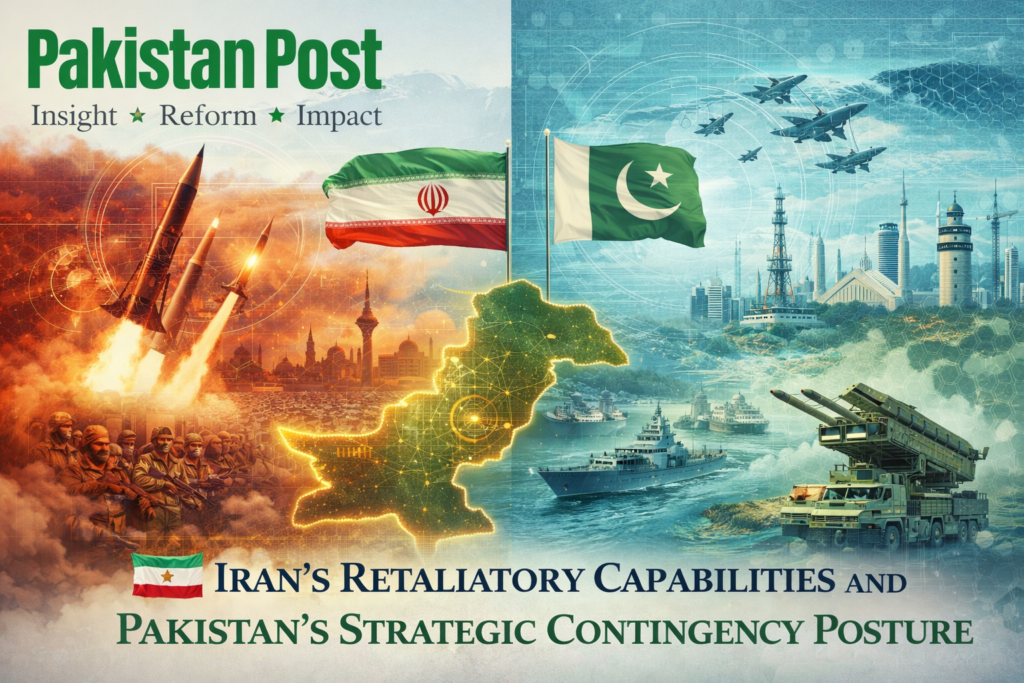
The evolving military confrontation between Iran, the United States, and Israel has introduced a new level of complexity to the strategic landscape of the Middle East. The coordinated strikes launched by US and Israeli forces against Iranian installations on February twenty eighth of twenty twenty six marked a significant escalation in the region, prompting an immediate and decisive response from Tehran through the deployment of drones and missile systems targeting American assets and allied interests across the Gulf. These developments have not only tested the operational readiness of regional actors but have also placed Pakistan in a position requiring meticulous strategic calibration. Islamabad’s geographic proximity, historical ties, and economic linkages with Iran necessitate a comprehensive understanding of Iran’s retaliatory capabilities and the corresponding implications for Pakistan’s national security and contingency posture.
Iran’s military strategy in this confrontation demonstrates a pronounced emphasis on precision and asymmetric warfare. The employment of advanced drones and ballistic missile systems illustrates a capacity for rapid response with significant operational reach. These capabilities are complemented by Iran’s integrated command and control networks, which enable coordinated strikes with strategic intent. For Pakistan, this operational profile demands an elevated level of situational awareness and continuous monitoring of potential threat vectors. The implications extend to border security, airspace management, and the protection of critical infrastructure along the western and southern peripheries of the country. In the context of modern conflict, where escalation can be swift and consequences diffuse, the ability to anticipate and mitigate risks is essential for maintaining national sovereignty and regional stability.
The strategic calculus for Pakistan extends beyond immediate military considerations. Iran’s retaliatory operations carry the potential to trigger secondary effects across the Gulf and South Asia, including disruptions to energy corridors, maritime trade routes, and regional supply chains. Pakistan’s reliance on imported energy and its integration into regional commerce underscore the importance of ensuring continuity in these vital domains. Consequently, Islamabad must maintain a robust contingency framework that encompasses intelligence fusion, interagency coordination, rapid response capabilities, and logistical resilience. This framework should not only address conventional threats but also account for emerging vectors, including cyber intrusion, electronic warfare, and the potential for asymmetric incursions that may seek to exploit vulnerabilities along Pakistan’s borders or critical infrastructure.
Operational readiness for Pakistan also entails the calibration of force posture in relation to both deterrence and diplomacy. Maintaining a visible but measured defensive stance communicates a commitment to sovereignty and preparedness without unnecessarily provoking adversaries or constraining diplomatic maneuverability. This posture requires a nuanced understanding of the operational envelope of Iran’s missile and drone capabilities, including range, targeting precision, and potential for escalation. By integrating intelligence assessments and scenario planning into strategic decision-making, Pakistan can enhance its deterrence credibility while preserving the flexibility to engage in dialogue and mediation where appropriate. The balance between signaling strength and facilitating negotiation is a hallmark of sophisticated statecraft in contemporary conflict environments.
Multilateral engagement constitutes a critical dimension of Pakistan’s strategic contingency posture. Active participation in international forums, including the United Nations Security Council and regional diplomatic initiatives, enables Islamabad to influence the discourse surrounding the conflict and advocate for measured responses. By supporting frameworks that emphasize de-escalation, restraint, and adherence to international norms, Pakistan reinforces its image as a responsible regional actor capable of contributing to conflict mitigation. This engagement also serves to reassure allies and partners that Pakistan’s operational preparedness is coupled with a commitment to diplomacy, reducing the risk of misperception and unintended escalation.
Economic and socio-political considerations further inform Pakistan’s strategy. Iran and Pakistan share significant energy cooperation agreements, trade arrangements, and cross-border connectivity initiatives. The potential disruption of these channels due to regional conflict presents a tangible risk to Pakistan’s economic stability. Consequently, contingency planning must integrate mechanisms for maintaining energy security, safeguarding trade corridors, and ensuring the continuity of cross-border economic activities. Cultural and societal linkages, including shared religious and ethnic communities along the border, also necessitate strategies for maintaining stability and cohesion within affected populations. Pakistan’s ability to leverage these dimensions enhances its influence as a stabilizing actor and provides channels for proactive engagement that extend beyond purely military or diplomatic measures.
Strategic communication constitutes another essential component of Pakistan’s contingency posture. Messaging that conveys operational readiness while emphasizing commitment to peaceful resolution serves multiple objectives. It reassures domestic constituencies regarding national security, signals to Iran and other regional actors that Pakistan is fully cognizant of evolving threats, and provides a platform for engagement with the United States, Gulf states, and other international stakeholders. By carefully calibrating statements and public diplomacy, Islamabad can navigate the complex terrain of regional alliances and power dynamics, maintaining credibility and influence without compromising operational security or strategic flexibility.
The evolving nature of contemporary conflict underscores the importance of integrating technological and intelligence capabilities into Pakistan’s strategic calculus. Iran’s demonstrated proficiency with drones, missile systems, and electronic warfare highlights the need for advanced surveillance, threat detection, and response mechanisms. Pakistan must invest in real-time intelligence gathering, cross-border monitoring, and rapid analysis to anticipate potential escalation scenarios. Integration of air defense systems, early warning networks, and civil-military coordination enhances resilience and ensures that contingencies can be executed effectively in a dynamic operational environment. This comprehensive approach mitigates risk while reinforcing Pakistan’s capacity to act as a stabilizing force in a volatile region.
Pakistan’s contingency planning also involves anticipating secondary effects on regional security and alliance structures. The current crisis has the potential to reshape the strategic calculus of Gulf Cooperation Council states, influence US and Israeli operational planning, and prompt responses from other regional actors such as Russia and China. By understanding these dynamics, Pakistan can position itself to mediate, advise, and influence decision-making processes in ways that minimize conflict spillover while preserving its sovereignty and strategic autonomy. The ability to operate effectively at the intersection of operational awareness, diplomatic engagement, and alliance management constitutes a significant strategic asset.
Furthermore, Pakistan’s approach exemplifies the integration of national security, economic resilience, and diplomatic influence into a cohesive strategic posture. By maintaining operational readiness while actively engaging in dialogue, supporting de-escalatory measures, and leveraging economic and cultural linkages, Islamabad presents a model for comprehensive statecraft in an era of complex, multi-dimensional threats. This holistic strategy enables Pakistan to navigate the challenges posed by Iran’s retaliatory capabilities while positioning itself as a credible mediator and stabilizing actor in the broader regional context.
The role of Pakistan as a geo-strategic actor in this environment extends beyond immediate security concerns to encompass long-term regional stability. Effective management of contingencies, coupled with proactive engagement in multilateral forums and alliance dynamics, enhances Pakistan’s influence and ensures that it can contribute meaningfully to conflict mitigation. The integration of operational preparedness, diplomatic acumen, and strategic communication ensures that Pakistan is not merely a passive observer but an active participant capable of shaping outcomes in ways that preserve regional equilibrium.
In conclusion, the escalation of hostilities between Iran, the United States, and Israel presents Pakistan with both significant challenges and unique opportunities. By comprehensively assessing Iran’s retaliatory capabilities, maintaining a robust contingency framework, and integrating operational, diplomatic, and economic considerations into its strategic posture, Pakistan reinforces its sovereignty, mitigates risk, and enhances its credibility as a regional stabilizer. The careful balance between preparedness, deterrence, and mediation underscores Pakistan’s capacity to navigate complex geopolitical environments with foresight and sophistication. In an era defined by rapid escalation, asymmetric threats, and contested regional influence, Islamabad’s strategic approach offers a template for middle powers seeking to reconcile national security imperatives with constructive engagement and conflict mitigation. Pakistan’s leadership, judgment, and operational discipline will determine not only its immediate security outcomes but also its long-term stature as a credible and indispensable actor in the evolving Middle East security architecture.
A Public Service Message