Who Controls Pakistan’s Political Narrative Across Competing Platforms?

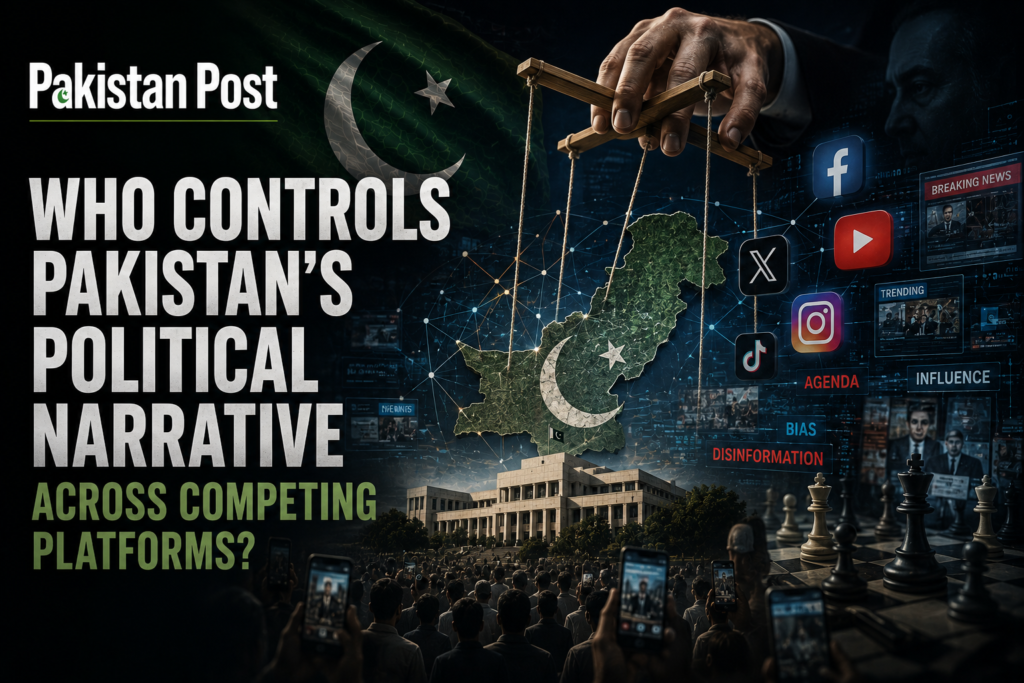
Pakistan’s political information economy is no longer organised around a small number of television channels, newspaper editors and party spokespersons. Political reality is now assembled across television studios, YouTube channels, TikTok feeds, Facebook pages, X accounts, WhatsApp groups and increasingly sophisticated networks of influencers, political commentators and anonymous digital operators. The consequence is not simply that Pakistan has more political content. It is that the mechanisms determining which version of events becomes visible, credible and emotionally compelling have fundamentally changed.
Television remains influential, particularly among older and urban audiences, but its agenda setting capacity is increasingly challenged by platforms that operate according to different incentives. A television newsroom can spend hours verifying a political claim before broadcasting it. A TikTok creator can convert the same claim into a twenty second video, attach emotionally charged imagery, add music and circulate it to millions before the newsroom has completed its verification. YouTube rewards duration and engagement. TikTok rewards retention and repetition. X rewards immediacy and conflict. Facebook can sustain political communities through highly personalised networks. Messaging applications create closed information environments in which the distinction between trusted communication and coordinated manipulation becomes difficult to establish.
This is creating a political information market in which speed has acquired greater value than verification, emotional intensity frequently outperforms factual complexity, and repetition can create the appearance of evidence. The central policy question is therefore no longer simply who owns the media. It is who controls distribution, interpretation and amplification.
For Pakistan’s state institutions, this distinction is strategically important. Conventional media regulation was designed around identifiable publishers and broadcasters. Digital political communication is distributed across thousands of accounts, pages, channels and informal networks operating across domestic and foreign platforms. A narrative can originate outside Pakistan, be adapted by a local influencer, clipped by a political activist, translated into Urdu, Punjabi or Pashto, and then circulated through messaging groups without a clear point at which responsibility can be assigned.
The old gatekeeping model assumed scarcity. There were limited television channels, limited broadcasting hours and relatively expensive mechanisms for mass communication. The digital model is based on abundance. Anyone with a smartphone can become a political distributor. A political party no longer needs to depend exclusively on television coverage to establish an agenda. It can produce its own clips, mobilise supporters, coordinate hashtags, publish long form interviews, deploy influencers and circulate short videos directly to voters.
That democratises political communication, but it also creates a new asymmetry. Institutions can possess superior information while still losing the public narrative because they communicate slowly, technically or inconsistently. A government department may have a documented position on an economic decision, a security incident or a diplomatic development, yet an emotionally edited video can reach a vastly larger audience before the official explanation appears.
This is particularly consequential during crises. In a security emergency, information has operational value. False claims about casualties, troop movements, border incidents, diplomatic statements or alleged government decisions can produce public pressure before authorities have established the facts. During an election, fabricated endorsements, manipulated speeches, synthetic audio and selectively edited footage can influence perceptions within hours. During an economic shock, misleading claims about currency, taxation, banking restrictions or commodity shortages can generate behaviour that amplifies the underlying problem.
Pakistan therefore needs to treat political information integrity as an element of national resilience rather than merely a media regulation issue.
The most consequential change is the decline of conventional gatekeepers. Television anchors, editors and newspaper institutions still possess professional authority, but their monopoly over political interpretation has weakened. An audience can watch a television bulletin and immediately compare it with dozens of alternative accounts on YouTube and X. The viewer is no longer merely consuming news. The viewer is selecting competing realities.
This has produced an environment in which partisan clipping has become a major political technology. A long speech can be reduced to ten seconds. A parliamentary exchange can be separated from its preceding question. A diplomatic statement can be presented without its qualifying language. A television interview can be clipped to emphasise an apparently controversial sentence while the surrounding explanation disappears. None of this necessarily involves fabricated material. The more difficult problem is selective truth.
For policymakers, selective truth is harder to counter than an obvious falsehood. A completely fabricated video can potentially be debunked through forensic analysis. A genuine video presented without context remains factually authentic while producing a misleading interpretation. The state therefore needs a verification architecture capable of addressing provenance, context, sequencing and intent.
Algorithmic amplification complicates the problem further. Platforms are not neutral distribution pipes. Their systems determine which material receives visibility according to engagement signals and other ranking mechanisms. Content that generates anger, fear, ridicule or partisan enthusiasm can therefore acquire greater reach than material that is accurate but emotionally restrained. The result is an information environment in which political entrepreneurs learn to design content for algorithmic performance.
Influencer culture has become central to this process. Influencers are not necessarily journalists, political actors or experts, yet many have audiences larger than conventional news programmes. Their authority often derives from familiarity rather than institutional credibility. Followers may regard an influencer as more authentic precisely because the person does not appear to operate within a formal newsroom.
This creates a strategic dilemma for political institutions. Attempts to dismiss influencers collectively as unreliable can strengthen their appeal. Attempts to control them through coercive mechanisms can deepen perceptions of information suppression. The more sustainable response is to build an alternative information architecture in which credible information is faster, more accessible and easier to understand.
Pakistan’s public institutions have often communicated as if information were a document rather than a competitive public service. Press releases are produced after decisions have already generated controversy. Technical notifications are published without explanatory material. Data may be available but not visualised. Statements can be released in English when the political conversation is occurring in Urdu or regional languages. By the time an official clarification reaches the public, an alternative narrative may have acquired substantial social momentum.
The remedy is not to abandon institutional caution. It is to professionalise institutional communication.
A national public interest media strategy should establish rapid verification and communication cells within key ministries and agencies, particularly those responsible for finance, foreign affairs, defence, interior, elections, health, energy and disaster management. These cells should not become political propaganda units. Their mandate should be narrowly defined: establish verified facts, identify significant misinformation, prepare evidence based explanations and communicate them rapidly through multiple platforms.
Such units would require direct access to subject matter experts, data repositories, legal advisers and digital forensic capabilities. Their operating model should resemble an emergency information service rather than a conventional public relations office. A significant claim should trigger a defined verification protocol, with provenance checks, source assessment, geolocation where appropriate, metadata examination, reverse image analysis and comparison against official records.
Speed matters because the first credible explanation frequently shapes subsequent interpretation. Yet speed without institutional discipline would simply reproduce the problem it seeks to solve. Verification must therefore be auditable. When an institution declares material false or misleading, it should explain why. The public should be able to inspect the underlying evidence whenever national security or legitimate privacy constraints do not prevent disclosure.
This principle should extend to election communication. Pakistan’s electoral information environment will increasingly be shaped by short videos, influencer endorsements, micro-targeted content, synthetic media and coordinated online campaigns. Election authorities therefore need permanent rather than temporary information integrity mechanisms. They should establish standard protocols with broadcasters, digital platforms and political parties for identifying manipulated election material, fabricated polling information, false voting instructions and impersonation campaigns.
Political parties also have a responsibility. A system in which every party treats digital manipulation as legitimate political competition will eventually damage all parties. Cross-party standards could establish minimum commitments against fabricated audio, deceptive editing, impersonation, coordinated false reporting and the deliberate circulation of demonstrably false election information. Enforcement should focus on clearly defined conduct rather than political opinion.
The establishment has an additional concern because information operations increasingly overlap with strategic competition. Foreign actors do not necessarily need to manufacture every political narrative themselves. They can exploit existing domestic divisions, amplify authentic grievances, recycle politically useful material and encourage competing groups to distribute it voluntarily. Strategic information operations are most effective when the target society performs much of the amplification internally.
This requires a distinction between foreign interference and domestic political disagreement. A robust national security framework must not classify criticism of government, military institutions or political parties as hostile information activity merely because it is uncomfortable. Democratic systems require disagreement. The strategic threat emerges when deception, covert coordination, foreign manipulation or fabricated material is used to distort public decision making at scale.
That distinction should be embedded in policy and law. Vague definitions create both enforcement problems and institutional mistrust. Pakistan needs precise thresholds for identifying coordinated influence operations, foreign information manipulation, synthetic impersonation and deliberate high impact disinformation. Independent oversight should accompany intrusive investigative powers.
The regulatory objective should be transparency rather than blanket control. Platforms operating in Pakistan should be encouraged, and where legally appropriate required, to provide mechanisms for reporting coordinated manipulation, impersonation and synthetic political content. Political advertising should have clear attribution. High reach political campaigns should disclose their sponsors where legally required. Researchers and authorised regulators should have carefully governed access to relevant aggregate data so that coordinated influence patterns can be studied.
Newsrooms must adapt as well. Traditional media organisations cannot remain dependent on television bulletins while their audiences increasingly discover political information through social platforms. Editorial departments require dedicated verification desks, platform editors and multilingual digital producers. Journalists should be trained to recognise manipulated audio, recycled footage, misleading captions, synthetic imagery and context stripping.
The objective should not be to make journalists technologically sophisticated at the expense of reporting judgement. It should be to combine traditional editorial standards with digital forensic awareness. A newsroom that can verify a photograph but cannot understand how its circulation was coordinated remains strategically vulnerable.
Pakistan also needs a large scale programme of digital media literacy. Media literacy cannot be reduced to telling citizens not to believe everything they see online. Citizens need practical tools for evaluating sources, distinguishing commentary from reporting, identifying manipulated clips, checking publication dates, recognising recycled material and understanding why emotionally provocative content is repeatedly placed in their feeds.
Such education should be multilingual and integrated into schools, universities, civil service training and community programmes. It should also reach public officials themselves. A senior bureaucrat who forwards an unverified political video into an official communication group can inadvertently legitimise misinformation. Institutional credibility begins with institutional information discipline.
The economic dimension is equally important. Political information now has commercial value. Attention generates advertising revenue, subscriptions, sponsorships and influence. Political entrepreneurs therefore have incentives to produce content that maximises engagement. This means misinformation cannot be understood exclusively as a political problem. It is also a market problem shaped by platform incentives.
Pakistan’s policymakers should consequently engage platforms through a regulatory framework that recognises both commercial realities and public interest obligations. The aim should not be to dictate political viewpoints. It should be to create transparency around political advertising, coordinated manipulation, impersonation, automated amplification and high risk synthetic media.
The country should also develop a national provenance infrastructure for official information. Government documents, speeches, statistics, emergency announcements and public advisories should carry verifiable digital signatures or equivalent authenticity mechanisms. Citizens should have a simple method for determining whether an official video, notification or statement has genuinely originated from the relevant institution.
This would help address a growing problem in which fabricated government notifications and manipulated official statements circulate before authorities can respond. Authentication should become part of the design of government communication rather than a reactive exercise after misinformation has spread.
The larger strategic objective should be to rebuild credibility without attempting to restore the old monopoly over information. That monopoly is gone. Trying to recreate it through censorship, platform blocking or administrative pressure is unlikely to succeed and may further accelerate migration towards alternative information channels.
A more resilient model would accept pluralism while strengthening verification. Television, YouTube, TikTok, Facebook, X and messaging platforms will continue to coexist. No single institution will control the national narrative. Nor should it. The legitimate objective is to ensure that citizens can navigate competing narratives with better evidence and greater transparency.
For Pakistan, the political information economy is becoming part of the governance environment itself. Public policy is no longer implemented in an information vacuum. Every tax measure, security decision, diplomatic statement, judicial development and administrative reform enters a competitive attention market almost immediately.
Institutions that understand this will not attempt to win every argument. They will build systems capable of establishing facts quickly, explaining decisions clearly and correcting errors credibly. They will invest in multilingual communication, digital verification, professional newsroom capacity and public media literacy. They will distinguish criticism from manipulation and political contestation from hostile influence operations.
The strategic advantage will ultimately belong not to the institution that speaks the loudest, but to the institution whose information can be verified, understood and trusted under pressure. Pakistan’s political information economy has already moved beyond the television era. The policy challenge is to ensure that public credibility moves with it.
A Public Service Message