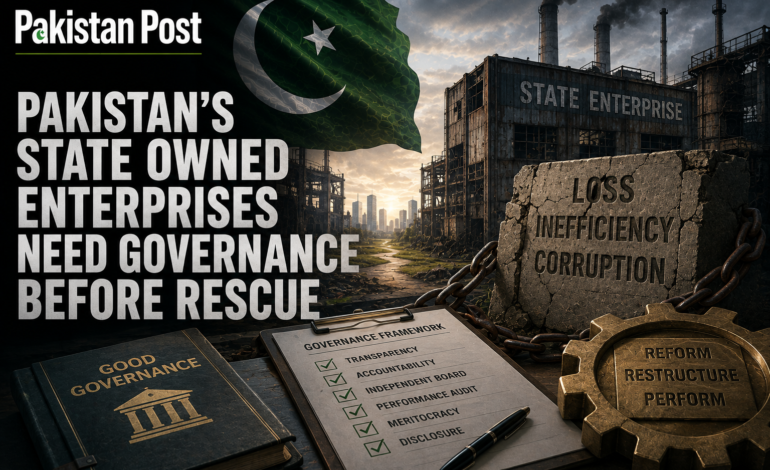
Pakistan’s State Owned Enterprises Need Governance Before Rescue

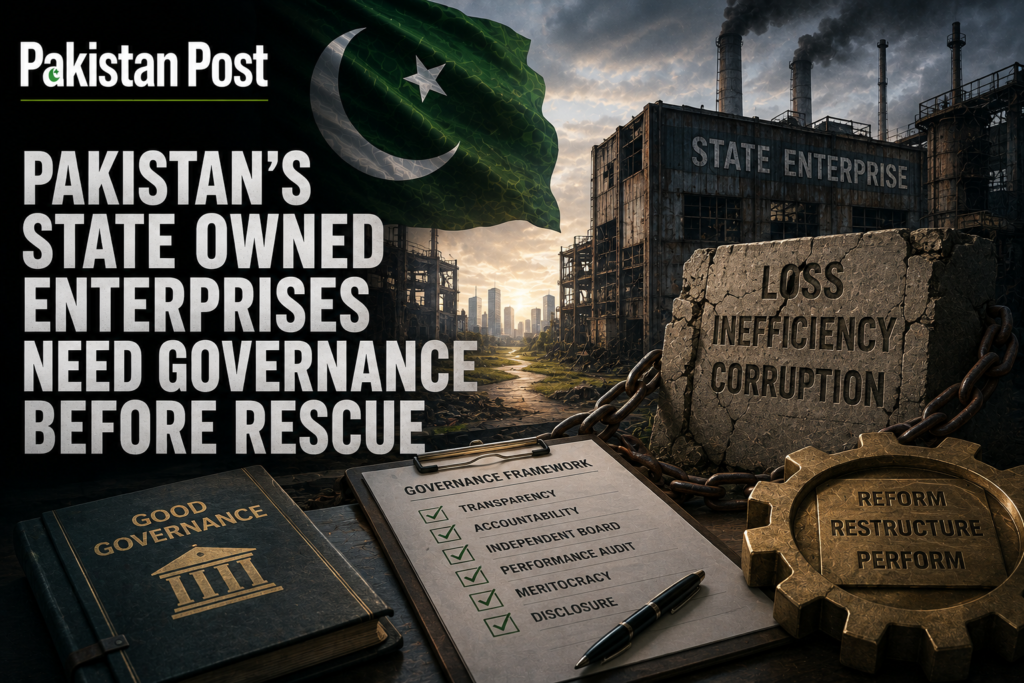
Pakistan’s state owned enterprise problem is no longer adequately described as a question of loss making companies requiring privatisation, refinancing or administrative restructuring. It is a problem of state capacity, ownership discipline and institutional incentives. The latest federal aggregate data show why. During FY2025, profit making state owned enterprises generated aggregate profits of about Rs709.9 billion, down 13 percent from the previous year, while loss making enterprises recorded aggregate losses of Rs832.8 billion. The overall portfolio therefore produced a net adjusted loss of Rs122.9 billion, compared with Rs30.6 billion in FY2024. The losses are concentrated in a relatively small number of enterprises, particularly in transport and power distribution, rather than being evenly distributed across the public sector.
That distinction matters for policy. A state that treats every enterprise as equally reformable will either privatise strategically important assets prematurely or continue subsidising commercially indefensible operations. Neither approach constitutes an ownership policy. Pakistan needs a framework that determines why the state owns an enterprise, what public objective ownership serves, what commercial return is expected, who is responsible for delivering it and under what circumstances ownership should end.
The central weakness is that restructuring has often been treated as an intervention into an enterprise rather than as a redesign of the relationship between the state and the enterprise. Debt is rescheduled, subsidies are rationalised, organisational charts are altered and new management teams are appointed, yet the underlying incentives remain intact. The enterprise continues to expect sovereign support, the ministry continues to exercise informal influence, the board remains insufficiently independent and management can often attribute poor commercial performance to policy obligations that have never been explicitly costed.
This produces a particularly damaging form of administrative ambiguity. An SOE can be simultaneously instructed to behave as a commercial company, a public service provider, an instrument of regional development, an employment mechanism and a vehicle for strategic policy. When these objectives conflict, financial losses become difficult to attribute. Management can argue that losses reflect public obligations, while the sponsoring ministry can argue that operational failure reflects managerial weakness. The taxpayer ultimately absorbs both.
Pakistan’s own institutional architecture has begun moving towards a more sophisticated approach. The Ministry of Finance maintains central monitoring arrangements covering financial performance, corporate governance, business plans, fiscal flows, board evaluation, internal controls and senior executive appointments. The SOE framework also recognises the importance of clear commercial mandates, capable boards, centralised ownership monitoring and transparency. The problem is therefore less the absence of concepts than the weak conversion of those concepts into binding ownership behaviour.
The first requirement should be an explicit ownership test. Every federal SOE should have a publicly defensible answer to one question: why must the state own this enterprise? Strategic necessity may justify continued ownership where an enterprise supports national security, critical infrastructure, energy security, financial stability or another clearly defined sovereign interest. A natural monopoly may require public ownership where competition cannot efficiently reproduce the service. A commercially viable company may remain state owned if it generates a demonstrable return and the state has a credible ownership rationale. An enterprise that satisfies none of these tests should enter an orderly exit process.
This would replace the present political vocabulary of “strategic” and “non strategic” with a measurable ownership doctrine. Strategic status should not become a permanent exemption from commercial discipline. An entity performing a strategic function should have that function defined, costed and periodically reviewed. If the state requires an enterprise to maintain loss making routes, provide subsidised services or retain excess capacity for national resilience, the resulting public service obligation should be transparently quantified and compensated through the budget rather than concealed inside the company’s accounts.
That separation is particularly important in power, transport and infrastructure. The latest SOE reporting indicates that major losses remain concentrated in sectors where commercial viability is constrained by structural obligations, financing costs, depreciation and public service responsibilities. Treating these losses as ordinary managerial underperformance would be misleading. Treating them as an unlimited claim on the exchequer would be equally indefensible. The appropriate solution is contractual clarity.
The state should therefore move from open ended support to performance based ownership contracts. Each enterprise should have a three to five year corporate plan containing measurable targets for revenue, operating cost, return on capital, debt reduction, service quality, procurement efficiency, workforce productivity and cash generation. Where public service obligations exist, those should appear separately. The board should be assessed against the agreed contract, while the responsible ministry should be assessed on whether it allowed the board to operate within the agreed mandate.
This would change the accountability chain. At present, failure can disappear into institutional complexity. A ministry can blame the board, the board can blame management, management can blame inherited liabilities and management can invoke government policy. A performance contract would establish a traceable line from ownership objectives to board responsibilities, executive incentives and measurable outcomes.
Board reform is consequently more important than repeated management reshuffles. A commercially oriented SOE cannot operate with a board selected primarily through administrative convenience or political representation. Board members should possess demonstrable expertise in finance, industry, law, risk, technology, human resources or the relevant commercial sector. Appointment should follow transparent competency criteria, with declarations of conflicts of interest and published board evaluation results. The state should remain the owner, but ownership should not mean day to day operational control.
This is where Pakistan’s reform architecture needs a sharper institutional firewall. The ministry that sets policy should not routinely function as the operational manager of the company it regulates or owns. The ownership function should be consolidated through a professionalised central ownership mechanism capable of monitoring portfolio performance, approving ownership strategies and challenging weak boards. The existing Central Monitoring Unit provides a foundation for such oversight, including corporate governance, fiscal flows and business plan assessment. What is required is greater authority, clearer escalation procedures and consequences when performance deteriorates.
Procurement deserves particular attention because governance failures frequently become financially visible only after contracts have been awarded. SOEs should operate through procurement systems that are digitally traceable from planning to payment. Tender specifications, evaluation criteria, contract awards, beneficial ownership information where legally appropriate, variations, extensions and completion certificates should be subject to structured disclosure and automated risk analysis. Exceptions for national security or genuine commercial confidentiality should be narrowly defined and independently reviewed rather than becoming a general justification for opacity.
The same principle should apply to staffing. Chronic overemployment is not simply a human resources problem. It is a governance problem when political authorities can influence recruitment while boards remain accountable for financial performance. Workforce restructuring should therefore be linked to operating models, productivity indicators and credible transition arrangements. Voluntary separation, redeployment and retraining may be preferable to indiscriminate retrenchment, but the objective must remain economic viability. An enterprise cannot be preserved indefinitely because its payroll has become politically difficult to reform.
Debt presents another recurring weakness. Refinancing can stabilise an SOE temporarily while leaving the underlying business model untouched. Repeated sovereign guarantees may reduce immediate financial pressure but transfer enterprise risk to the public balance sheet. The state should establish explicit thresholds for additional borrowing, guarantees and capital injections. Any request for extraordinary fiscal support should include a restructuring plan, a quantified fiscal return and an assessment of whether continued ownership remains justified.
This is particularly important because the SOE balance sheet is large enough to affect macroeconomic management. Federal SOEs recorded total liabilities exceeding Rs31 trillion in the first half of FY2025, while their asset base exceeded Rs37.7 trillion. These figures mean that SOE reform is not a peripheral privatisation issue. It is part of sovereign risk management. Weak enterprises can transmit pressure into government guarantees, banking exposure, arrears, energy pricing and development expenditure.
Pakistan should consequently establish a formal portfolio classification with four policy outcomes: strategic retention, commercial restructuring, partial or full divestment and orderly exit. The classification should be based on strategic necessity, financial viability, restructuring potential and market conditions. It should be reviewed periodically by an independent technical body rather than becoming a permanent political designation.
The green, amber and red categorisation already being used in government discussions could provide a practical starting point. But classification should trigger action. A green enterprise should operate under normal commercial discipline and potentially return dividends to the state. An amber enterprise should receive a time bound restructuring mandate with defined milestones. A red enterprise should face a decision on sale, merger, liquidation or another orderly resolution mechanism. No enterprise should remain red indefinitely while continuing to accumulate public liabilities.
Privatisation should therefore be treated as one instrument within a broader ownership strategy, not as the strategy itself. Recent decisions by the Privatisation Commission illustrate that the portfolio is being reconsidered, with Saindak Metals Limited, Pakistan Minerals Development Corporation and National Insurance Company Limited recommended for inclusion in the active privatisation programme. Such transactions can improve the portfolio, but sale alone does not solve the governance question. If the regulatory framework remains weak, the state can simply replace inefficient public ownership with poorly supervised private concentration.
For strategically sensitive enterprises, the state may instead need a regulated corporate model. Critical infrastructure, energy networks, defence related production and other national assets can remain under public ownership while adopting private sector governance standards. Independent boards, professional chief executives, audited financial statements, transparent procurement, capital discipline and performance contracts are not incompatible with sovereign ownership. On the contrary, they are essential to making ownership credible.
There is also an institutional concern that should be addressed directly. Reform must distinguish between legitimate strategic oversight and operational interference. Security sensitive enterprises require government supervision, but strategic supervision should concern national objectives, resilience, continuity and risk rather than individual appointments, contracts or routine commercial decisions. Excessive intervention can undermine precisely the managerial autonomy required to protect strategic assets.
The objective should be a state that owns fewer enterprises, but governs the ones it retains far better. That does not necessarily mean rapid privatisation. Some enterprises may have strategic value that cannot be captured through short term financial analysis. Others may be viable businesses capable of generating dividends and supporting national industrial objectives. Some may be capable of recovery if governance, capital structure and operating models are corrected. Others may have reached the point where continued public ownership represents a transfer of resources from productive sectors to institutional inertia.
The decisive reform, therefore, is not another rescue package. It is a closed ownership cycle. The state should define the purpose of ownership, appoint an independent board, approve a measurable performance contract, monitor financial and operational indicators, disclose public service costs, enforce procurement and conflict of interest rules, review capital injections and determine at predetermined intervals whether the ownership rationale still holds. Persistent failure should automatically trigger escalation rather than another refinancing exercise.
For Pakistan’s fiscal managers and strategic institutions, this is ultimately a question of state credibility. A government that cannot distinguish between a strategically necessary enterprise and a politically protected enterprise cannot allocate capital efficiently. A government that cannot impose consequences for repeated commercial failure cannot establish credible managerial accountability. And a government that continues carrying avoidable corporate liabilities on its balance sheet reduces the fiscal space available for infrastructure, defence resilience, human capital and economic stabilisation.
The reform agenda should therefore move beyond the language of saving SOEs. The relevant question is whether each enterprise serves a clearly defined national purpose at an acceptable fiscal and economic cost. Where the answer is yes, ownership should be professionalised and performance should be enforced. Where the answer is uncertain, restructuring should be time bound and independently evaluated. Where the answer is no, the state should exit without allowing political convenience to convert a commercial decision into indefinite public liability.
Pakistan does not need a larger catalogue of SOE reform plans. It needs an ownership regime capable of reaching a decision and enforcing it. Restructuring should no longer be the stage at which accountability stops. It should be the point at which accountability becomes measurable, contractual and consequential.
A Public Service Message